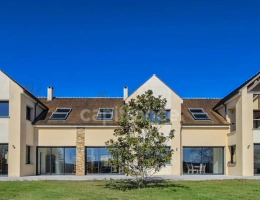
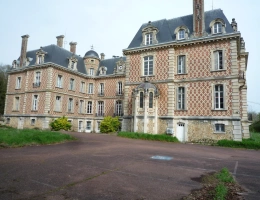
A luxury property for sale in Île-de-France is most often a classical chateau in dressed stone along the Seine or Marne valley, a Brie manor house surrounded by wheat fields, or a fine nineteenth-century country residence in the forests of Fontainebleau or Rambouillet. Despite its closeness to Paris, the region keeps a rural heritage of large residences concentrated mostly in its outer ring. Browse every luxury property for sale listed by private owners, specialist agencies and notaries across Île-de-France.
This page gathers real price benchmarks for the region's large residences, a tour of the areas where they cluster, the particularities of local buildings and the checks worth making before buying a chateau or an estate near Paris. To prepare your project, read our guide to buying luxury property in France.
Our observatory tracks, in the DVF land registry data published by the French tax administration, sales of houses over 300 m² of living space on 0.05 to 10 ha of land, above €1,000/m²: chateaux, manor houses, master houses, villas and large rural residences. The benchmarks below are based on these actual sales, after removal of outliers; an estate of more than 10 ha or a listed monument sold with its farmland is excluded.
In Île-de-France, 90 sales of luxury properties were recorded in 2025. The median price stands at €1,445,000*, with an average of €1,916,500; the floor/ceiling range (P10–P90) runs from €700,000 to €3,496,500 and the median price per square metre of living space reaches €4,247/m² (average 366 m² of living space on 7,207 m² of land). The region sits 76% above the 2025 national median (€822,000 across 981 sales). Over five years (2021-2025), the regional median comes to €1,263,100 across 592 sales.
| Department | Sales | Median price | Floor – ceiling (P10–P90) | €/m² living space |
|---|---|---|---|---|
| Essonne (91) | 53 | €887,000* | €494,000 – €1,610,700 | 2,584 |
| Hauts-de-Seine (92) | — | no rural municipalities | — | — |
| Seine-Saint-Denis (93) | — | no rural municipalities | — | — |
| Seine-et-Marne (77) | 168 | €785,000 | €437,500 – €1,668,700 | 2,094 |
| Val-d'Oise (95) | 57 | €1,075,000* | €685,200 – €1,640,500 | 2,674 |
| Val-de-Marne (94) | — | no rural municipalities | — | — |
| Yvelines (78) | 211 | €1,524,000 | €865,000 – €2,750,000 | 4,141 |
| Year | Sales | Median price | €/m² living space |
|---|---|---|---|
| 2021 | 203 | €1,190,000 | 2,830 |
| 2022 | 142 | €1,105,800 | 3,228 |
| 2023 | 86 | €1,392,500* | 3,993 |
| 2024 | 71 | €1,325,000* | 3,613 |
| 2025 | 90 | €1,445,000* | 4,247 |
These benchmarks place an asking price within its market; they do not replace a valuation of the property itself, whose worth depends on condition, architecture, outbuildings and setting. The breakdown by stratum (coastal, rural tourist, ordinary rural) and the full methodology are in our observatory of luxury property prices in France (in French). Then work out purchase costs and borrowing capacity with our financial tools and calculators, and prepare your project with our guide to buying luxury property in France.
Source: DVF (DGFiP), transactions from 1 January 2021 to 31 December 2025, processed by ma-propriete.fr; prices rounded to the nearest €100. * Fewer than 100 sales: read as an indication only.
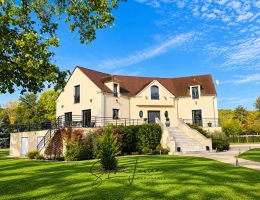
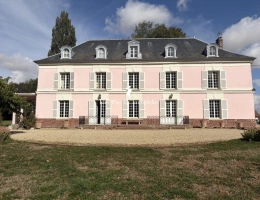
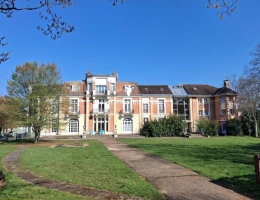
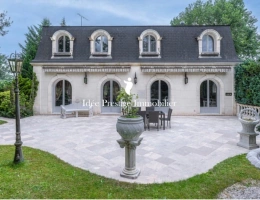
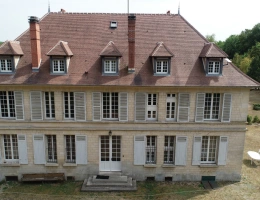
The classical chateau, in dressed stone with a slate roof and an ordered façade, dominates prestige buildings in Île-de-France, a legacy of the hunting and country residences built around the fringes of the royal court from the seventeenth century onward. In Seine-et-Marne and the Yvelines, these fine homes sit within a formal French garden or landscaped park, sometimes with service wings, an orangery or a chapel. In the Essonne and the Val-d'Oise, the plainer Brie or Vexin manor house remains surrounded by farmland, built lower and with fewer decorative flourishes than its grander neighbours.
Outbuildings occupy a significant part of these properties: service wings, stables, orangeries and sometimes dovecotes reflecting an earlier farming use. Many of these residences, built or reworked between the seventeenth and nineteenth centuries, need ongoing technical upkeep, particularly for slate roofs and old window frames, and a number carry a full or partial historic-monument listing that shapes what can be altered.
Seine-et-Marne, between the Fontainebleau forest, the Loing valley and the Brie, concentrates the region's most sought-after chateaux and estates. The Yvelines, around Rambouillet and the Chevreuse valley, offer a comparable wooded setting close to Versailles. The Essonne, between the Hurepoix and the Gâtinais français, offers more discreet residences. The Val-d'Oise, around the Vexin français, still keeps a well-preserved rural heritage. The Hauts-de-Seine, Seine-Saint-Denis and Val-de-Marne, in the inner ring, hold very few rural properties of this kind, as urban development there is continuous; buyers naturally turn instead to Seine-et-Marne, the Yvelines, the Essonne or the Val-d'Oise to find an estate with land and outbuildings.
Seine-et-Marne has a TGV station at Marne-la-Vallée–Chessy, the Essonne at Massy, and the Val-d'Oise at Charles-de-Gaulle airport; the Yvelines has no TGV station of its own, apart from a few services at Versailles-Chantiers. The Hauts-de-Seine, Seine-Saint-Denis and Val-de-Marne are served by the urban rail network and the RER rather than by TGV, and a car remains the most practical way to reach an estate set back from a town centre. The Chevreuse valley and the area around Fontainebleau rank among the most sought-after areas, while the Gâtinais français and the Vexin remain more accessible.
Near the state forests of Fontainebleau or Rambouillet, the local plan and the rules protecting wooded areas strictly govern any extension or new building. On a listed or registered chateau, sign-off from the Architecte des Bâtiments de France is required for any visible change to the façades or the park, and rights of way should be checked with the notary.
Development pressure and the risk of building on neighbouring plots, particularly in Seine-et-Marne and the Val-d'Oise, deserve a close look at the local plan of surrounding communes before buying. On older buildings, slate roofs and eighteenth- or nineteenth-century timber framing call for a thorough survey by a heritage architect; upkeep of a formal French garden is also a separate budget from the buildings themselves.
Luxury property listings in Île-de-France are placed by private owners, specialist agencies and notaries; filter them by area, property type, outbuildings and park size, then set an e-mail alert to follow new listings as they come to market, whether you are set on the outer ring or open to the whole region. Also explore the chateaux for sale in Île-de-France to target that specific type.