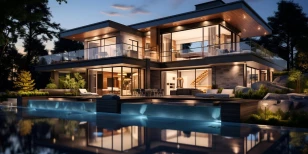

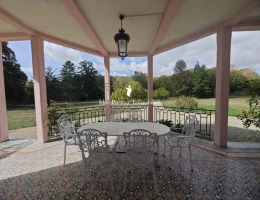
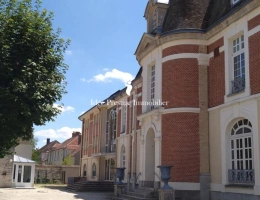
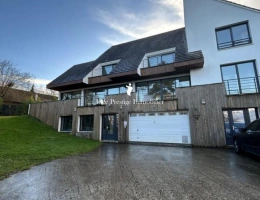
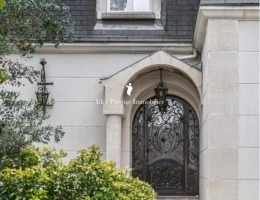
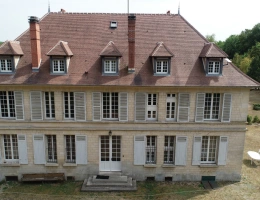
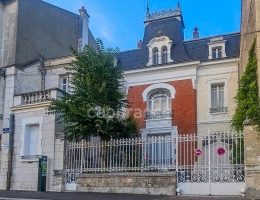
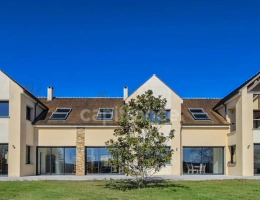
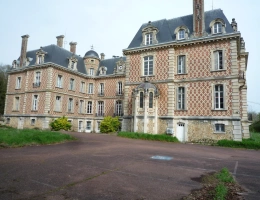
A manor house for sale in Hauts-de-Seine remains a rare configuration: the department, almost entirely built up since the nineteenth century, has kept very few rural residences with attached land, apart from a few traces around Marnes-la-Coquette, Vaucresson and the edge of the Meudon forest. Most of the older residential heritage here takes the form of bourgeois villas, private mansions or urban parks inherited from large estates now built over and subdivided long ago. You will still find the manor houses for sale listed by private owners, agencies and notaries across the department and its neighbouring areas.
This page explains honestly what the Hauts-de-Seine market genuinely offers in character residences, the few areas where an old house with parkland survives, and why a manor search usually moves outward to the greater ring of departments. To approach this kind of purchase as a whole, read our guide to buying prestige property in France.
DVF land registry data does not identify manor houses as such: the benchmarks below cover sales of houses over 300 m² of living space on 0.05 to 10 ha, above €1,000/m², tracked by our observatory. They frame the market for large residences without describing it entirely: an estate with 30 ha of parkland or a listed monument sold with its farmland falls outside this scope.
This inner-suburb department has no rural municipalities: the benchmarks below are those of the Île-de-France region. Across the Île-de-France region, the 2025 median stands at €1,445,000* (90 sales), against €822,000 in France in 2025 (981 sales).
| Scope | Sales | Median price | Floor – ceiling (P10–P90) | €/m² living space (median) |
|---|---|---|---|---|
| Île-de-France (2025) | 90 | €1,445,000* | €700,000 – €3,496,500 | 4,247 |
| France (2025) | 981 | €822,000 | €428,000 – €3,100,000 | 2,308 |
The breakdown by stratum (coastal, rural tourist, ordinary rural) and the five-year trend are in our observatory of prestige property prices in France (in French). Before making an offer, work out purchase costs and borrowing capacity with our financial tools and calculators.
Source: DVF (DGFiP), transactions from 1 January 2021 to 31 December 2025, processed by ma-propriete.fr; prices rounded to the nearest €100. * Fewer than 100 sales: read as an indication only.
The heavy densification of Hauts-de-Seine over a century and a half has erased most rural residences in favour of housing developments, apartment blocks and large public landscaped grounds, such as the Saint-Cloud park or the Sceaux estate on the department's edge. The few older houses still standing sit mainly in Marnes-la-Coquette, Vaucresson or on the edge of the Meudon forest, where wooded plots classed as unbuildable have protected early twentieth-century character housing rather than a manor house in the strict medieval or classical sense. Most of the large seigneurial farms that still existed in the nineteenth century were absorbed by the capital's continuous growth.
When such a property comes onto the market, it is usually presented as a character property with an enclosed park rather than a farming manor with outbuildings, for lack of available attached land. Properties to renovate are rare and contested, since development pressure around Paris makes it hard to keep a large undeveloped plot intact over time, even for owners who would like to pass the property on unchanged.
The western communes, Marnes-la-Coquette, Vaucresson and the edge of Ville-d'Avray toward the Fausses-Reposes forest, hold most of the wooded properties still visible from the road; the rest of the territory, from Nanterre to Clamart by way of Boulogne-Billancourt, offers almost no property of this kind. Buyers looking for a genuine manor with land most often turn to Yvelines, Essonne or Val-d'Oise, thirty minutes to an hour away by road, where rural land remains available and prices are markedly more accessible for comparable size.
The department has no TGV station; links run on RER and Transilien services to Paris-Saint-Lazare and Paris-Montparnasse, plus the Massy TGV stations in neighbouring Essonne. La Défense and the Paris ring road provide dense road and rail links, but ones with little bearing on a search for a rural manor; a buyer set on staying close to Paris should expect real trade-offs on the nature of the property.
Within Hauts-de-Seine itself, any remaining wooded plot usually falls under a restrictive local development plan, or even a protected woodland designation that bars any new building; check this status before considering a project, including on land attached to an existing residence. Near a historic monument, exterior works require the approval of the Architecte des Bâtiments de France.
If your search widens toward Yvelines, Essonne or Val-d'Oise, have the private drainage system checked, often required outside built-up areas, the condition of old roof timbers, and the municipal or private status of access tracks to isolated properties, two matters rarely encountered within the urban fabric of Hauts-de-Seine. Also check any easements attached to a listed park, which can limit future division of the land.
The few listings for manor houses and character properties in Hauts-de-Seine are placed by private owners, specialist agencies and notaries; filter them by price, living space and land, and set an e-mail alert to hear as soon as a matching property is published in the department or the surrounding area. To widen the search usefully, browse the manor houses for sale in Île-de-France.