
A chateau for sale in Côte-d'Or often stands between Dijon, the wine-growing Côte and the wooded plateaus of the Auxois and Châtillonnais districts, in a department whose long-standing agricultural wealth left many seigneurial residences behind. The supply combines remodelled medieval strongholds, classical eighteenth-century residences built by Dijon's parliamentary nobility, and rural gentlemen's residences surrounded by land and woodland. Browse every chateau for sale listed by the private owners, agencies and notaries of Côte-d'Or.
This page gathers real price benchmarks for large residences in the department, the areas where they are found, the particularities of Burgundy building stock and the checks to make before a visit. To plan a heritage purchase from start to finish, read our guide to buying prestige property in France. Properties close to Dijon appeal to buyers seeking urban proximity, while those in the Auxois attract buyers drawn to open space and hunting.
DVF land registry data does not identify chateaux as such: the benchmarks below cover sales of houses over 300 m² of living space on 0.05 to 10 ha, above €1,000/m², tracked by our observatory. They frame the market for large residences without describing it entirely: an estate with 30 ha of parkland or a listed monument sold with its farmland falls outside this scope.
In Côte-d'Or, 54 sales were recorded from 2021 to 2025, with a median price of €722,500*, a floor/ceiling range (P10–P90) of €440,500 to €1,160,200 and a median of €1,843/m² of living space, for an average of 378 m² of living space and 10,669 m² of land. Across the Bourgogne-Franche-Comté region, the 2025 median stands at €590,000* (43 sales), against €822,000 in France in 2025 (981 sales).
| Scope | Sales | Median price | Floor – ceiling (P10–P90) | €/m² living space (median) |
|---|---|---|---|---|
| Côte-d'Or (2021-2025) | 54 | €722,500* | €440,500 – €1,160,200 | 1,843 |
| Bourgogne-Franche-Comté (2025) | 43 | €590,000* | €385,000 – €1,004,000 | 1,714 |
| France (2025) | 981 | €822,000 | €428,000 – €3,100,000 | 2,308 |
The breakdown by stratum (coastal, rural tourist, ordinary rural) and the five-year trend are in our observatory of prestige property prices in France (in French). Before making an offer, work out purchase costs and borrowing capacity with our financial tools and calculators.
Source: DVF (DGFiP), transactions from 1 January 2021 to 31 December 2025, processed by ma-propriete.fr; prices rounded to the nearest €100. * Fewer than 100 sales: read as an indication only.
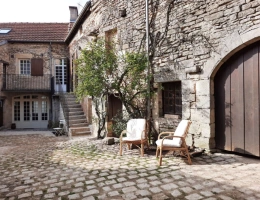
Ochre and beige Burgundy limestone dominates local building stock, paired with slate roofs or, more rarely, glazed flat tiles on some ceremonial buildings. Historic residences range from medieval strongholds with round towers and moats, still common in the Auxois and Châtillonnais districts, to classical eighteenth-century residences with a central block and symmetrical pavilions, built by Dijon's great parliamentary families.
Outbuildings often include service wings, a dovecote, a chapel and, on properties close to the wine-growing Côte, a former vat room or press house. Some more rural residences in the Auxois and Châtillonnais count as a chateau to renovate, with old roofs and timber frames in need of work; the condition of the structure weighs heavily on price there. Carved cornices and classical pediments, common on Dijon residences, contrast with the more defensive outline of Auxois strongholds.
Residences cluster first around Dijon and the wine-growing Côte, from Nuits-Saint-Georges to Beaune, an area where built estates sit alongside some of Burgundy's most renowned vineyards. The Auxois, around Semur-en-Auxois and Vitteaux, offers more rural chateaux amid a hedgerow landscape, while the Châtillonnais to the north, more wooded and more discreet, offers hunting and forest properties. To the east, the Hautes-Côtes and the Saône countryside remain more affordable. A number of estates also retain a working kitchen garden or orchard from their farming past.
Côte-d'Or benefits from the Dijon and Montbard TGV stations, which put Paris about an hour and a half away, as well as the A6 motorway running north to south through the department. The most sought-after, and therefore most expensive, areas are those of the wine-growing Côte and the outskirts of Dijon; the Auxois and Châtillonnais districts remain more affordable for a comparable size. Between these two areas, the Saône valley to the east and the Salins district further north form farming zones where less sought-after but often well-preserved residences remain.
Many Côte-d'Or chateaux are listed or registered historic monuments, notably in the Auxois and around Dijon; exterior works then require the opinion of the Architecte des Bâtiments de France and the regional heritage office. On properties adjoining the wine-growing Côte, carefully separate the residential buildings and grounds from any parcels farmed as a wine estate, whose operation falls under a distinct land and tax regime. Because several Côte-d'Or chateaux changed hands multiple times during the nineteenth and twentieth centuries, buyers should ask for a full chain of title and confirm that any earlier subdivisions of the parkland or the wine-growing plots were properly registered.
On the technical side, have the moats and drainage systems checked, as these are common on Auxois medieval residences, and confirm the drainage arrangements of isolated Châtillonnais properties. Roof timbers and coverings, sometimes old, deserve a survey by a heritage architect before any offer. Properties within the UNESCO-listed Burgundy climats perimeter must also comply with a management plan governing alterations visible from the Côte.
Chateau listings in Côte-d'Or are published by private owners, specialist agencies and notaries; you can filter them by price, living space, land area and outbuildings, then set up an e-mail alert to follow new properties as they come to market. To widen your search, browse the chateaux for sale in Bourgogne-Franche-Comté.