
Looking for a chateau for sale in Territoire de Belfort means exploring mainland France's smallest department, set against the first foothills of the Ballon d'Alsace and the southern Vosges, between the Belfort Gap and the borders with Haut-Rhin and Doubs. Supply here is limited but genuine: eighteenth and nineteenth-century manor houses and small chateaux tucked into wooded valleys around Giromagny, Rougemont-le-Château or Delle, often built from pink Vosges sandstone and attached to a farm or a pond. Browse every chateau for sale listed by the private owners, agencies and notaries active in this area.
This page brings together real price benchmarks for this discreet market, the areas where residences still come up for sale, the character of the local building stock and the checks worth making before committing to an often old property. To plan a heritage purchase from start to finish, read our guide to buying prestige property in France. Buyers here are looking as often for a second home near the Ballon d'Alsace as for a rural gîte project on the edge of the forest, in a market where supply stays limited.
DVF land registry data does not identify chateaux as such: the benchmarks below cover sales of houses over 300 m² of living space on 0.05 to 10 ha, above €1,000/m², tracked by our observatory. They frame the market for large residences without describing it entirely: an estate with 30 ha of parkland or a listed monument sold with its farmland falls outside this scope.
The local market is too thin to publish a reliable department-level benchmark (2 sales in five years): we give the figures for the Bourgogne-Franche-Comté region. Across the Bourgogne-Franche-Comté region, the 2025 median stands at €590,000* (43 sales), against €822,000 in France in 2025 (981 sales).
| Scope | Sales | Median price | Floor – ceiling (P10–P90) | €/m² living space (median) |
|---|---|---|---|---|
| Bourgogne-Franche-Comté (2025) | 43 | €590,000* | €385,000 – €1,004,000 | 1,714 |
| France (2025) | 981 | €822,000 | €428,000 – €3,100,000 | 2,308 |
The breakdown by stratum (coastal, rural tourist, ordinary rural) and the five-year trend are in our observatory of prestige property prices in France (in French). Before making an offer, work out purchase costs and borrowing capacity with our financial tools and calculators.
Source: DVF (DGFiP), transactions from 1 January 2021 to 31 December 2025, processed by ma-propriete.fr; prices rounded to the nearest €100. * Fewer than 100 sales: read as an indication only.
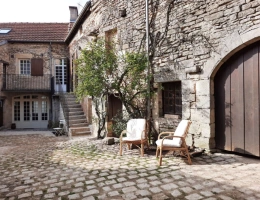
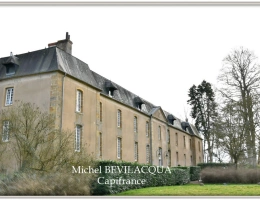
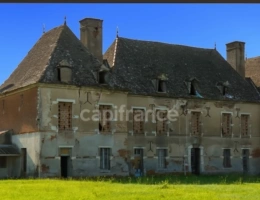
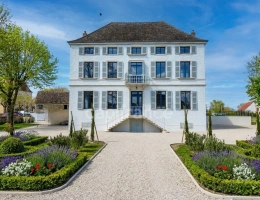
Territoire de Belfort has few grand pleasure chateaux: the market instead consists mostly of manor houses, gentlemen's residences and small eighteenth and nineteenth-century chateaux, built from pink Vosges sandstone or rendered rubble stone, with steeply pitched tile or slate roofs suited to the massif's harsh winters. Their plain façades sometimes borrow the wide porches and attached barn volumes typical of neighbouring Franche-Comté farmhouses. Some façades still keep hand-cut stone window surrounds and pedimented dormers, evidence of a local building craft that remains visible today on the older houses of the area.
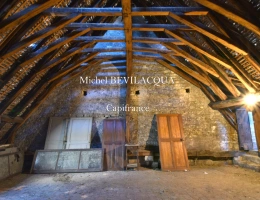
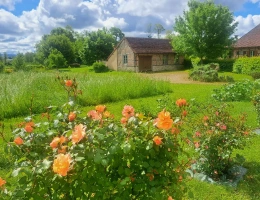
Properties for sale usually come with agricultural outbuildings: a barn, stable, former press house or bakehouse, and occasionally a headwater pond carried over from the local fish-farming tradition. The condition of the roof timbers and covering, exposed to a damp semi-continental climate, deserves close attention before any offer. Occasionally a disused mill or a sunken ice house survives on the grounds, a reminder of a rural economy that has since shifted toward residential use.
Properties cluster mainly in the valleys radiating out from Belfort toward the Ballon d'Alsace: the Giromagny and Rougemont-le-Château area to the north, more forested and discreet; the Delle and Swiss-border area to the east, more rural and farming-oriented; and the suburban ring around Belfort and Danjoutin to the west, where large residences are scarcer. The Belfort-Montbéliard TGV station links the department to Paris and Strasbourg in a little over two hours, and the A36 motorway runs across the territory from west to east.
The most sought-after properties sit close to Belfort itself and along the routes toward Montbéliard, while isolated hamlets in the southern Territoire or the Vosges foothills remain more affordable for comparable quality. Isolated hamlets in the southern Territoire, near the Doubs border, keep a scattered settlement pattern where quiet prevails, away from the busiest roads.
Some older residences in the department are listed as historic monuments or stand close to a protected site tied to Belfort's military heritage; this status, and its impact on planned works, should be verified with the regional heritage authority. Proximity to woodland also means checking rights of way and the legal clearance obligations that apply when a property borders a forest. It is also worth asking about the site's industrial past, since the Belfort basin's mining and manufacturing history has occasionally left traces on certain plots of land.
On the technical side, check the drainage system, often non-mains in these rural valleys, and the condition of any hydraulic structures where the property includes a pond or stream: regulations covering water bodies and their upkeep can be demanding. The heating cost of older buildings, given harsh winters, is also worth budgeting for. Buyers should also budget time for a heating-system review, since older stone buildings in this climate often justify an upgrade.
Chateau and manor-house listings in Territoire de Belfort are published by private owners, local agencies and notaries; filter them by price, living space and outbuildings, then set up an e-mail alert to follow new properties as they come to market. To widen your search across the wider region, browse the chateaux for sale in Bourgogne-Franche-Comté.