

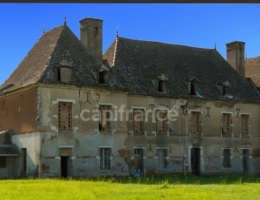
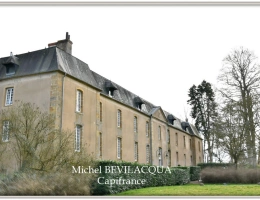
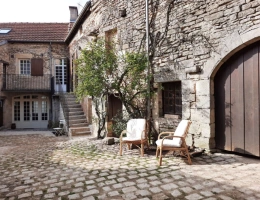
A chateau for sale in Jura is often found between the Arbois vineyards, the first plateaus of the Jura massif and the lakes of the region known as the lake district, in a department where mountain terrain and vine-growing alternate over short distances. The supply combines remodelled fortified manors in the Dole plain, classical residences in the vineyard area and mid-mountain gentlemen's residences surrounded by forest and pasture. Browse every chateau for sale listed by the private owners, agencies and notaries of Jura.
This page gathers real price benchmarks for large residences in the department, the areas where they are found, the character of Jura building stock and the checks to make before committing. To plan a heritage purchase from start to finish, read our guide to buying prestige property in France. Vineyard-area properties mainly appeal to buyers drawn to the wine-growing landscape, while lake-district properties attract buyers interested in nature and fishing.
DVF land registry data does not identify chateaux as such: the benchmarks below cover sales of houses over 300 m² of living space on 0.05 to 10 ha, above €1,000/m², tracked by our observatory. They frame the market for large residences without describing it entirely: an estate with 30 ha of parkland or a listed monument sold with its farmland falls outside this scope.
The local market is too thin to publish a reliable department-level benchmark (17 sales in five years): we give the figures for the Bourgogne-Franche-Comté region. Across the Bourgogne-Franche-Comté region, the 2025 median stands at €590,000* (43 sales), against €822,000 in France in 2025 (981 sales).
| Scope | Sales | Median price | Floor – ceiling (P10–P90) | €/m² living space (median) |
|---|---|---|---|---|
| Bourgogne-Franche-Comté (2025) | 43 | €590,000* | €385,000 – €1,004,000 | 1,714 |
| France (2025) | 981 | €822,000 | €428,000 – €3,100,000 | 2,308 |
The breakdown by stratum (coastal, rural tourist, ordinary rural) and the five-year trend are in our observatory of prestige property prices in France (in French). Before making an offer, work out purchase costs and borrowing capacity with our financial tools and calculators.
Source: DVF (DGFiP), transactions from 1 January 2021 to 31 December 2025, processed by ma-propriete.fr; prices rounded to the nearest €100. * Fewer than 100 sales: read as an indication only.
Building style varies with altitude: the plain around Dole keeps classical historic residences in pale limestone, while the first Jura plateaus show heavier construction, with steeply pitched roofs and thick walls suited to harsh winters. Remodelled medieval fortified manors stand alongside eighteenth-century residences, and the market often calls the more modest rural residences of the Revermont district gentilhommières.
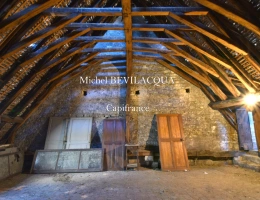
Typical outbuildings include service wings, a chapel and, in the vineyard area, a former storeroom or vaulted cellar. Part of the stock, especially in mountain areas, counts as a chateau to renovate, with roofs and timber frames affected by winter snow; insulation and heating are frequent items of work. Rendered façades and steeply pitched roofs, common throughout the Jura massif, are found on both Dole-plain residences and higher-altitude farmhouse-chateaux.
Residences cluster around Dole and its farming plain, in the Arbois and Château-Chalon vineyards, an area prized for its vine-covered hillsides, and around Lons-le-Saunier and the Revermont district. The lake district, around Clairvaux-les-Lacs and Saint-Laurent-en-Grandvaux, offers wooded mid-mountain properties close to bodies of water, while the higher Haut-Jura remains more discreet and more geared toward nature tourism. A number of estates also retain a working kitchen garden from their earlier farming use.
Jura benefits from the Dole TGV station, which puts Paris a little under two hours away, as well as the A39 motorway serving the western part of the department. The most sought-after areas remain the Arbois vineyards and the outskirts of Dole, while the Haut-Jura and the lake district offer more affordable properties for a comparable size. Between these areas, the Grandvallier district around Saint-Claude forms a more secluded mid-mountain zone where a few isolated residences remain.
Some Jura chateaux and fortified manors are listed or registered historic monuments, notably around Dole and in the vineyard area; exterior works then require the opinion of the Architecte des Bâtiments de France. On properties adjoining the Arbois or Château-Chalon vineyards, separate the residential buildings and grounds from any parcels actually farmed as vines, whose land status differs considerably from ordinary parkland. Buyers should also be aware that some Jura properties near the vineyards were historically divided between a residential lot and separate vine parcels sold to different owners, so a careful review of the cadastral plan is worthwhile before assuming that visible vines form part of the sale, and mountain properties may carry additional easements tied to shared forest access tracks.
On the technical side, have the insulation and heating system checked, a sensitive point at altitude, along with the condition of the steeply pitched roofs and their timber frames, often strained by snow. Properties near the Jura lakes deserve a check of easements tied to the water features and of the drainage system. Properties near the Swiss border must also comply with specific local tax rules, which should be checked with a notary.
Chateau listings in Jura are published by private owners, specialist agencies and notaries; you can filter them by price, living space, land area and outbuildings, then set up an e-mail alert to follow new properties as they come to market. To widen your search, browse the chateaux for sale in Bourgogne-Franche-Comté.


