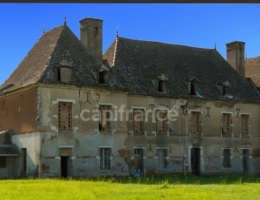
A chateau for sale in Saône-et-Loire usually stands between the Charolais hedgerow country, the Mâconnais vineyards and the plains of the Bresse bourguignonne, in a department shaped by the former Cluny abbey and a long cattle-farming tradition. The supply combines classical Charolais residences built in pale stone, Clunisois fortified manors and Mâconnais gentlemen's residences surrounded by vines or pasture. Browse every chateau for sale listed by the private owners, agencies and notaries of Saône-et-Loire.
This page gathers real price benchmarks for large residences in the department, the areas where they are found, the character of the local building stock and the checks to make before committing. To plan a heritage purchase from start to finish, read our guide to buying prestige property in France. Mâconnais properties mainly appeal to buyers drawn to the wine-growing landscape, while Charolais properties attract buyers interested in cattle farming and open space.
DVF land registry data does not identify chateaux as such: the benchmarks below cover sales of houses over 300 m² of living space on 0.05 to 10 ha, above €1,000/m², tracked by our observatory. They frame the market for large residences without describing it entirely: an estate with 30 ha of parkland or a listed monument sold with its farmland falls outside this scope.
In Saône-et-Loire, 61 sales were recorded from 2021 to 2025, with a median price of €512,000*, a floor/ceiling range (P10–P90) of €348,600 to €825,000 and a median of €1,437/m² of living space, for an average of 371 m² of living space and 13,807 m² of land. Across the Bourgogne-Franche-Comté region, the 2025 median stands at €590,000* (43 sales), against €822,000 in France in 2025 (981 sales).
| Scope | Sales | Median price | Floor – ceiling (P10–P90) | €/m² living space (median) |
|---|---|---|---|---|
| Saône-et-Loire (2021-2025) | 61 | €512,000* | €348,600 – €825,000 | 1,437 |
| Bourgogne-Franche-Comté (2025) | 43 | €590,000* | €385,000 – €1,004,000 | 1,714 |
| France (2025) | 981 | €822,000 | €428,000 – €3,100,000 | 2,308 |
The breakdown by stratum (coastal, rural tourist, ordinary rural) and the five-year trend are in our observatory of prestige property prices in France (in French). Before making an offer, work out purchase costs and borrowing capacity with our financial tools and calculators.
Source: DVF (DGFiP), transactions from 1 January 2021 to 31 December 2025, processed by ma-propriete.fr; prices rounded to the nearest €100. * Fewer than 100 sales: read as an indication only.
The Charolais and Brionnais districts are marked by a distinctive pale limestone, used for historic residences as much as for the Romanesque buildings shaped by the former abbey of Cluny. Roofs are mostly Burgundy flat tile or slate depending on altitude, and some residences keep corner turrets and a main building remodelled over the centuries. The Mâconnais and the Bresse bourguignonne, further east, show more gentilhommières in golden stone or timber framing, often called small chateaux by the market.
Typical outbuildings include farm service wings, a dovecote, a chapel and, in the Mâconnais, a former vat room where the property adjoins the vineyards. Some residences in the Clunisois and Charolais districts count as a chateau to renovate, with old roofs and timber frames; the condition of the adjoining farm buildings also affects the overall value of these estates. Shallow-pitched roofs and genoise eaves, common in the Mâconnais under southern influence, contrast with the steeper roofs found in the Charolais and Clunisois districts.
Residences cluster around Cluny and its abbey, in the Charolais district around Charolles and Paray-le-Monial, and in the Mâconnais vineyards between Mâcon and Tournus, an area prized for its vine-covered landscapes. The Bresse bourguignonne, around Louhans, offers timber-framed properties surrounded by farmland, while the more rural Brionnais to the south offers more secluded estates amid well-preserved hedgerow country. To the north, Chalon-sur-Saône and the Saône valley round out the supply. A handful of estates also keep a working orchard or dovecote from their farming past.
The department benefits from the Le Creusot and Mâcon-Loché TGV stations, which put Paris about an hour and forty minutes away, as well as the A6 motorway running north to south through the territory. The most sought-after areas remain the wine-growing Mâconnais and the outskirts of Cluny, while the Brionnais and the northern Charolais offer more affordable properties for a comparable size. Between these areas, the Tournus district, along the Saône, forms a transition zone where older, less sought-after but often well-located residences remain.
Some Saône-et-Loire chateaux are listed or registered historic monuments, notably around Cluny and in the Charolais district; exterior works then require the opinion of the Architecte des Bâtiments de France and the regional heritage office. On Mâconnais properties, clearly separate the residential buildings and grounds from any parcels actually farmed as vines, whose land status differs from ordinary parkland. On properties near Cluny, buyers should also confirm whether any archaeological survey obligations apply, since parts of the town sit above monastic remains.
On the technical side, have the timber framing checked in the Bresse bourguignonne, which is sensitive to damp and ground movement, and confirm the drainage arrangements of isolated rural properties. Roof timbers and coverings, sometimes old on Clunisois residences, deserve a survey by a heritage professional before making an offer. Properties within the perimeter of Cluny abbey must also comply with planning rules intended to preserve views over the listed site.
Chateau listings in Saône-et-Loire are published by private owners, specialist agencies and notaries; you can filter them by price, living space, land area and outbuildings, then set up an e-mail alert to follow new properties as they come to market. To widen your search, browse the chateaux for sale in Bourgogne-Franche-Comté.