
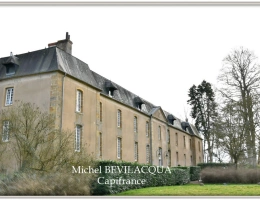
A chateau for sale in Nièvre typically stands between the Loire valley and the first slopes of the Morvan, in a department where open farmland alternates with wooded uplands. The supply combines classical Loire-valley residences, Morvan strongholds remodelled over time and Nièvre gentlemen's residences surrounded by farm outbuildings, sometimes with ponds or hunting woods attached. Browse every chateau for sale listed by the private owners, agencies and notaries of Nièvre.
This page gathers real price benchmarks for large residences in the department, the areas where they are found, the particularities of local building stock and the checks to carry out before a visit. To plan a heritage purchase from start to finish, read our guide to buying prestige property in France. Properties on the edge of the Morvan particularly appeal to buyers drawn to nature and hunting, while those in the Loire valley attract buyers seeking quick access to Paris.
DVF land registry data does not identify chateaux as such: the benchmarks below cover sales of houses over 300 m² of living space on 0.05 to 10 ha, above €1,000/m², tracked by our observatory. They frame the market for large residences without describing it entirely: an estate with 30 ha of parkland or a listed monument sold with its farmland falls outside this scope.
The local market is too thin to publish a reliable department-level benchmark (23 sales in five years): we give the figures for the Bourgogne-Franche-Comté region. Across the Bourgogne-Franche-Comté region, the 2025 median stands at €590,000* (43 sales), against €822,000 in France in 2025 (981 sales).
| Scope | Sales | Median price | Floor – ceiling (P10–P90) | €/m² living space (median) |
|---|---|---|---|---|
| Bourgogne-Franche-Comté (2025) | 43 | €590,000* | €385,000 – €1,004,000 | 1,714 |
| France (2025) | 981 | €822,000 | €428,000 – €3,100,000 | 2,308 |
The breakdown by stratum (coastal, rural tourist, ordinary rural) and the five-year trend are in our observatory of prestige property prices in France (in French). Before making an offer, work out purchase costs and borrowing capacity with our financial tools and calculators.
Source: DVF (DGFiP), transactions from 1 January 2021 to 31 December 2025, processed by ma-propriete.fr; prices rounded to the nearest €100. * Fewer than 100 sales: read as an indication only.
Building styles vary noticeably between the Loire valley, where pale ashlar stone and slate roofs dominate, and the Morvan, where local granite and either stone slabs or flat tiles give historic residences a heavier, more rustic character. Strongholds remodelled during the Renaissance stand alongside eighteenth-century residences with regular façades and more modest gentilhommières, often called small chateaux by the local market.
Outbuildings frequently include farm service wings, a chapel, a dovecote and, on some estates, a working farm. A notable share of the local stock counts as a chateau to renovate, with roofs and timber frames weakened by the damp Morvan climate; the condition of the roof covering weighs heavily on the purchase price. Steeply pitched roofs and pedimented dormers, more common in the Morvan, contrast with the gentler roofs and regular façades found in the Loire valley.
Residences cluster first around Nevers and along the Loire valley, as far as La Charité-sur-Loire and Decize, a farming and river area sought after for its closeness to Berry. The Nièvre section of the Morvan, around Château-Chinon and Lormes, offers more secluded, wooded properties well suited to hunting, while the Nivernais canal, between Clamecy and Corbigny, traces a corridor of old residences tied to the former log-floating trade. To the south, the Bazois district and the southern Morvan remain more discreet. A handful of estates also keep a working orchard or kitchen garden dating from their farming past.
Nièvre has no TGV station; connections to Paris run on Intercités trains from Nevers, while the A77 motorway provides the department's north-south link. The most sought-after areas remain those of the Loire valley near Nevers, while the Morvan and the Bazois offer more affordable properties for a comparable size. Between these two areas, the Bazois district, around Château-Chinon and Moulins-Engilbert, forms a hedgerow transition zone where properties remain harder to find on the open market.
Some Nièvre chateaux are listed or registered historic monuments, particularly in the Loire valley and around Nevers; exterior works then require the opinion of the Architecte des Bâtiments de France. On Morvan properties, check for any regional nature park designation, which can constrain outdoor works, fencing and planting. Buyers should also note that some Nièvre chateaux sit within the boundaries of a former seigneurial estate whose surrounding farmland was sold off separately over time, so it is worth checking historical land records to understand what remains attached to the residence today.
On the technical side, have the roof timbers and coverings inspected, as they are often strained by a damp climate, and check the drainage system of isolated estates, which is still frequently self-contained. Flood zoning along the Loire is also worth checking, as are easements tied to ponds and the former locks of the Nivernais canal. Properties within the Morvan regional nature park must also comply with a landscape charter governing façade colours and joinery.
Chateau listings in Nièvre are published by private owners, specialist agencies and notaries; you can filter them by price, living space, land area and outbuildings, then set up an e-mail alert to follow new properties as they come to market. To widen your search, browse the chateaux for sale in Bourgogne-Franche-Comté.