

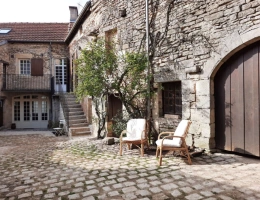
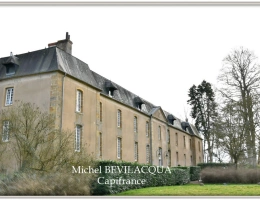
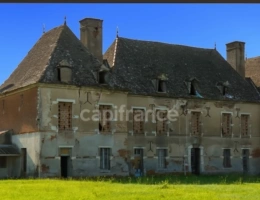
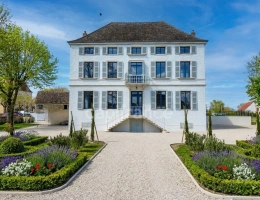
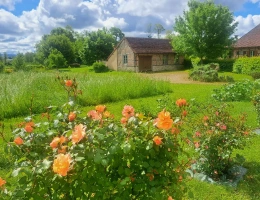
A chateau for sale in Doubs often stands between the Besançon citadel and the first plateaus of the Jura massif, in a department where Vauban's military architecture has long stood alongside seigneurial residences. The supply combines remodelled fortified manors in the Doubs and Loue valleys, eighteenth-century Franche-Comté residences and rural gentlemen's residences set against the first foothills of the Jura. Browse every chateau for sale listed by the private owners, agencies and notaries of Doubs.
This page gathers real price benchmarks for large residences in the department, the areas where they are found, the particularities of Franche-Comté building stock and the checks to make before a visit. To plan a heritage purchase from start to finish, read our guide to buying prestige property in France. Properties close to Besançon appeal to buyers seeking urban proximity, while properties in the Haut-Doubs attract buyers drawn to nature and winter sports.
DVF land registry data does not identify chateaux as such: the benchmarks below cover sales of houses over 300 m² of living space on 0.05 to 10 ha, above €1,000/m², tracked by our observatory. They frame the market for large residences without describing it entirely: an estate with 30 ha of parkland or a listed monument sold with its farmland falls outside this scope.
The local market is too thin to publish a reliable department-level benchmark (19 sales in five years): we give the figures for the Bourgogne-Franche-Comté region. Across the Bourgogne-Franche-Comté region, the 2025 median stands at €590,000* (43 sales), against €822,000 in France in 2025 (981 sales).
| Scope | Sales | Median price | Floor – ceiling (P10–P90) | €/m² living space (median) |
|---|---|---|---|---|
| Bourgogne-Franche-Comté (2025) | 43 | €590,000* | €385,000 – €1,004,000 | 1,714 |
| France (2025) | 981 | €822,000 | €428,000 – €3,100,000 | 2,308 |
The breakdown by stratum (coastal, rural tourist, ordinary rural) and the five-year trend are in our observatory of prestige property prices in France (in French). Before making an offer, work out purchase costs and borrowing capacity with our financial tools and calculators.
Source: DVF (DGFiP), transactions from 1 January 2021 to 31 December 2025, processed by ma-propriete.fr; prices rounded to the nearest €100. * Fewer than 100 sales: read as an indication only.
Doubs is known for a sturdy Franche-Comté architecture suited to a harsh climate: thick limestone walls, very steeply pitched roofs once covered in wood shingles or flat tiles, and, in some rural areas, combined farmhouse-chateaux where residence and farm buildings share a single roofline. The oldest historic residences keep towers and defensive features inherited from medieval fortified manors, while the eighteenth century brought more classical façades to the valleys.
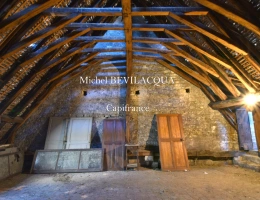
Outbuildings frequently include service wings, a chapel and former farm buildings, sometimes converted into living space. Part of the stock, particularly in the Haut-Doubs, counts as a chateau to renovate, with roofs and timber frames strained by altitude and harsh winters; insulation and the heating system are frequent items of work. Rendered façades and curved shutters, typical of Franche-Comté architecture, are found on both Doubs valley residences and Haut-Doubs farmhouse-chateaux.
Residences cluster first around Besançon and the Doubs valley, an area marked by the Vauban citadel and dense heritage, and along the Loue valley, between Ornans and Quingey, prized for its river landscapes and limestone cliffs. To the north, the Montbéliard area keeps residences tied to the former principality, while the Haut-Doubs, around Pontarlier and Morteau, offers more rural mid-mountain properties close to the Swiss border. A handful of estates also keep a small working orchard dating from their farming years.
Doubs benefits from the Besançon Franche-Comté TGV and Besançon-Viotte stations, which put Paris a little under two and a half hours away, plus a station at Montbéliard; the A36 motorway serves the whole department. The most sought-after areas remain the Doubs valley and the outskirts of Besançon, while the Haut-Doubs and the Montbéliard area offer more affordable properties for a comparable size. Between these two areas, the wooded and sparsely populated Levier plateau forms a transition zone where a few isolated properties remain within reach of more moderate budgets.
Some Doubs chateaux and fortified manors are listed or registered historic monuments, notably around Besançon; exterior works then require the opinion of the Architecte des Bâtiments de France and the regional heritage office. Near the citadel, some properties sit within a protected perimeter tied to the UNESCO-listed Vauban fortifications, adding constraints on exterior alterations. Because the Doubs valley experienced industrial activity in the nineteenth century, buyers of riverside properties should also check for any former mill rights or water-use easements attached to the land, which can affect how a moat or a millpond may be maintained.
On the technical side, have the insulation and heating system checked, a sensitive point given the harsh climate of the Haut-Doubs, along with the condition of the steeply pitched roofs and their timber frames. Properties near the Doubs or the Loue deserve a check of flood zoning and the drainage system. Properties near the Swiss border must also comply with specific local tax and declaration rules, which should be checked with a notary.
Chateau listings in Doubs are published by private owners, specialist agencies and notaries; you can filter them by price, living space, land area and outbuildings, then set up an e-mail alert to follow new properties as they come to market. To widen your search, browse the chateaux for sale in Bourgogne-Franche-Comté.