

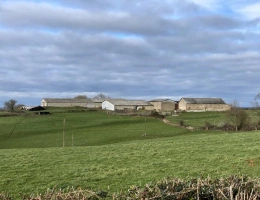
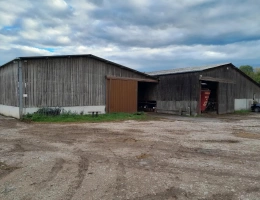

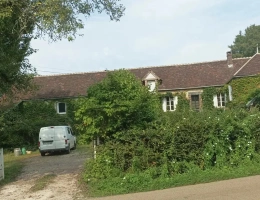
Looking for farms for sale in the Territoire de Belfort means accepting one rule: supply is scarce, and the deal is won by watching rather than by choosing. The smallest department in mainland Burgundy-Franche-Comté holds few holdings, squeezed between the conurbation, industry and the Vosges foothills; when one is released, neighbours move fast. This page records what comes up, whether a complete farmstead, a block of pasture or a single livestock building. Instructions come from stockmen at the end of their careers, from landowners and from local rural property professionals. They join our national selection of farms for sale in France.
In a market this size, knowing the context replaces having a choice: understanding which communes keep a firm farming vocation, which fields are earmarked for building and which system can still be financed here is worth more than a long list of adverts. The sections below supply those bearings. For building the project itself, turn to our white paper « Créer une exploitation agricole », written in French, which sets out each administrative and financial step.
Land forms the base of a farm's value. DVF, the property sales database published by the French tax administration (vineyards excluded), records a 2025 median of €3,820 per hectare in Territoire de Belfort (90), an average of €4,011 and 16 sales; four transactions in five fall between €3,400 and €4,975, against a national median of €5,307. * Fewer than 30 recorded sales: indicative value.
The SAFER land value benchmark sets €3,570 per hectare for vacant land and pasture offered for sale in the same year, -1.4% over one year and -11.0% over ten, against €6,460 nationally. Land sold with a tenancy in place is valued at €3,670, effectively the same level as vacant land, where the national discount runs close to 17%. That near-parity most likely reflects the fact that a sale of let land escapes SAFER's pre-emption right, and that the stated price of vacant land is held down by side arrangements, key money or the separate sale of payment entitlements. The gap is too small to read as anything other than parity.
Against the Bourgogne-Franche-Comté region, whose median is €2,773 per hectare, this department sits 38% higher. For commune-level detail and comparisons with neighbouring areas, see our land price observatory, then cost your purchase with our financial calculators.
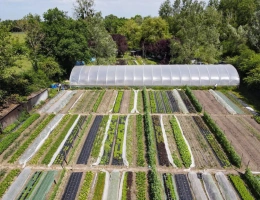
The leading orientation is milk: medium-sized dairy holdings running Montbéliarde cows, grazed on permanent pasture and supplying regional processing. Next come mixed farming systems, combining forage cereals, maize and a herd, plus a few suckler beef units on the foothill grazings. The immediate proximity of a dense population also sustains market-garden holdings and direct-selling enterprises, whose viability rests on short supply chains far more than on the area held.
A working farm of that last kind deserves attention, because it is often the realistic way into the department. On a few well-placed hectares, a vegetable enterprise or a farm shop yields an income the same ground under forage never would. Value then shifts towards the buildings, field irrigation, packing equipment and an established customer base — all items to be valued separately from the soil when taking over.
To the north, the Vosges foothills, towards Giromagny, Rougemont-le-Château and Étueffont, gather the most distinctly farmed districts: grass, slopes, dairy holdings and buildings grouped in the villages. The centre, around the Savoureuse valley and the conurbation, retains only residual farming, hemmed in by development and infrastructure. To the south, the Sundgau country towards Delle, Beaucourt and Grandvillars keeps a landscape of ponds, woodland and meadows, on fragmented parcels inherited from local history.
Neighbouring districts, towards the Haute-Saône westward and the Haut-Rhin to the north-east, usefully widen the search: the farming market ignores administrative boundaries, and a farmstead just beyond one can perfectly well serve fields inside the department. Given how narrow the department is, it pays to think in terms of a living area rather than a boundary line when setting the search perimeter.
The first check is the planning document: in so urbanised a department, how a parcel is zoned decides its farming future, and some ground cultivated today already sits within areas opened to development. Consult the zoning, the reserved sites and the infrastructure schemes before settling on a value. Collective agricultural compensation may also apply to projects that consume cultivated land, which can change the balance of a deal.
The usual rural rules then bite unusually hard, since expansion by neighbours is the main competition. SAFER, notified by the notary, may pre-empt and steer a property towards a new entrant, provided the file is lodged early and properly documented. Permission to farm follows the thresholds of the regional structure plan. A sitting tenant, lastly, keeps his priority claim, which affects when the land actually becomes available: let farmland answers to particular conditions.
Patience decides matters here: a handful of sales a year, and properties that often find a buyer before everyone has seen them. An e-mail watch, set deliberately wide, remains the most effective tool. Widen the perimeter to the whole living area from the outset, then tighten on the production wanted rather than on acreage, which sorts little in a department this compact. Sellers and professionals in the area lodge an instruction online in minutes. A wider choice sits under farms for sale in Bourgogne-Franche-Comté.