
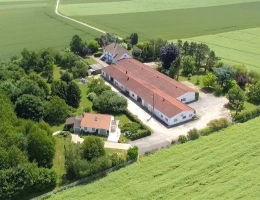
The market for a poultry farm for sale in Seine-et-Marne owes much to the department's unusual position: wide arable plains with France's largest consumer market on their doorstep. Poultry here often takes the form of an enterprise grafted onto a cereal holding, with free-range poultry, laying hens kept outdoors, farmhouse chickens and sometimes turkeys and ducks for the festive season. Offers come from farmers preparing a handover, from agencies specialising in rural land and from notaries in the Brie, with the buildings, the range and the outlets described. They join the poultry farms for sale across France.
Gathered here are the bearings a listing never carries: farmland prices in the department, the districts where such units are found, the technical checks worth making on a livestock building, and the constraints of farming on the edge of a capital region. If you are preparing to set up, our white paper « Créer une exploitation agricole » (in French) sets out the steps.
Land remains the largest item when buying a poultry farm. According to sales recorded by the French tax administration (DVF, vineyards excluded), the median price of agricultural land in Seine-et-Marne (77) stood at €7,015/ha in 2025, with an average of €7,828/ha across 126 sales; 80% of transactions fall between €5,009 and €11,030/ha, against a national median of €5,307/ha.
The SAFER benchmark of land values (2025 figures) puts vacant land and pasture at €7,600/ha (-1.4% year on year, -10.2% over ten years), against a national average of €6,460/ha; land already let sells around 17% lower.
Where arable land already trades high, a poultry enterprise earns its value elsewhere: the size and condition of the building, insulation, ventilation, heating, silos, entry room, catching area and lorry access. Then come the flock, the equipment, the fenced range and, very often, the goodwill: nearby customers, supply agreements with retailers, delivery rounds and a place in a farm-sales network. Our land price observatory and financial calculators let you test those assumptions.
Two families of property stand out. On one side, a purpose-built broiler house run under contract with a production organisation or producer group, where powered ventilation, heating, the feed line and a compliant entry room drive value, and where the remaining term of that contract matters as much as the roof. On the other, diversification units set up inside an old Brie farm building, often spacious and soundly framed but needing work on insulation, water supply and effluent handling. In both cases the year of construction, the usable area and the capacity per batch govern the asking price.
Downstream equipment often makes the difference: an egg packing room, a grader, a cold store, an approved slaughter room for farmhouse birds. These represent substantial investment and extend the value of the building itself, and they are what allows a holding to keep the margin that a purely contract unit hands to its integrator. Where a farmhouse and land come with the sale, ask for an item-by-item breakdown, since the residential appeal of the Brie tends to inflate the dwelling's share of a single overall figure.
Units are found mainly in the east and south of the department, away from the advancing suburbs: the central Brie around Rozay-en-Brie and Nangis, the Brie des Morins towards Coulommiers and Rebais, the Provins country, the Bassée valley along the Seine, and the Gâtinais around Nemours and Château-Landon. These districts still hold complete farmsteads, with buildings, yard and adjoining land, an arrangement that has become rare close to the conurbation. The western side, from Melun to Marne-la-Vallée and out towards Sénart, is under heavy pressure that makes complete farm units scarce and pulls values upwards.
That geography has a practical consequence: the further from the conurbation, the more affordable the buildings, but the longer the delivery rounds become. Districts within reasonable reach of the main roads and of the Paris-region markets usually strike the best compromise between purchase cost and ease of selling, provided the lanes leading to the yard can take a collection lorry in every season of the year.
Land comes first. In a department of large arable holdings, taking over ground goes through the structures control, the French authorisation regime for farming a given area, and through SAFER's pre-emption right; rented parcels pass on with the rural lease, subject to the landlord's agreement. Infrastructure schemes and planning documents also deserve a look, since they can freeze parcels or complicate an extension. Asking the commune for a planning certificate before making an offer is the cheapest precaution available, and it often changes what a buyer is willing to pay.
Then comes the livestock frame: classification as a classified installation according to flock size, notification of the change of operator, the manure spreading plan, distances from dwellings and an up-to-date biosecurity plan. Avian influenza episodes periodically require birds to be housed, which calls for covered space suited to a flock normally kept outdoors. Residential neighbours, sensitive to odour and to traffic, make it worth examining both the access routes and the hours at which batches are collected.
This selection brings together properties entrusted by private vendors, by rural estate agencies and by notaries working in the department. Refine by area, budget or production to pick out the chicken farm, the broiler farm or the egg farm that fits your plan, and create an alert so that no new sale passes you by. You can then browse every poultry farm for sale in Île-de-France.