
Buying a poultry farm for sale in Yvelines means accepting a particular logic: few properties available, strong competition for land, but customers within immediate reach. The department combines wide cereal plains with quieter livestock country, where farmhouse poultry houses, outdoor flocks of laying hens and units selling birds at the gate or in vegetable boxes still survive. Offers come from farmers organising their retirement, from rural estate agencies and from notaries, and they set out the buildings, the range, the equipment and the sales method. They add to the poultry farms for sale across France.
This page rounds out the listings with what helps you decide: farmland values in the department, the districts where supply renews itself, the signs of wear to spot on a building, and the rules that apply to livestock kept close to a dense residential fabric. For a set-up project, our white paper « Créer une exploitation agricole » (in French) details the stages.
Land remains the largest item when buying a poultry farm. According to sales recorded by the French tax administration (DVF, vineyards excluded), the median price of agricultural land in Yvelines (78) stood at €7,398/ha in 2025, with an average of €7,365/ha across 36 sales; 80% of transactions fall between €5,518 and €9,274/ha, against a national median of €5,307/ha.
The SAFER benchmark of land values (2025 figures) puts vacant land and pasture at €8,410/ha (+17.6% year on year, +5.3% over ten years), against a national average of €6,460/ha; land already let sells around 17% lower.
Here value rests less on acreage than on two things: the tool and the goodwill. The tool means the buildings, their insulation, ventilation and heating, the silos, the packing room, the cold store and the layout of the ranges. The goodwill means the buying habits built around the farm, the standing orders, the regular rounds and the arrangements made with shops and restaurants. To gauge how much that is worth, lean on our land price observatory and our financial calculators.
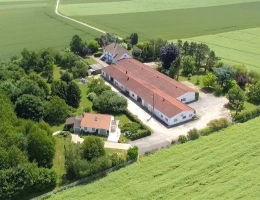
Most properties belong to mixed farms. Expect medium-sized buildings, mobile houses set on grass, old farmyard structures converted for floor-kept hens and, more rarely, a purpose-built house run under contract. Buyers examine the frame and roof, insulation, ventilation, the heating used at the start of a batch, silos, the feed line, the biosecurity entry room and whether a full sanitary break can be organised. The state of the fencing, the grass cover on the range and protection against predators also count in the assessment, as does whether the yard can be kept clean in winter.
The second and decisive element sits downstream: egg packing room, grader, cold store, approved slaughter room, farm shop or vending machine. This equipment is costly to rebuild from scratch, and it is what secures the margin on every bird or egg leaving the yard. Where the sale includes a house and land, the residential share is often high in this department: have the dwelling, the livestock building, the equipment and the land valued separately rather than accepting a single figure.
The west of the department, around Houdan, Septeuil and the Mantois, keeps a long poultry tradition and remains where this kind of property appears most often. To the south of it, the Rambouillet plateau and its forest, the upper Chevreuse valley and the communes of the Jouars plain hold mixed crop and livestock farms able to carry a poultry enterprise. The north, around Limay and the Moisson loop, completes the picture, with river-valley land that has kept a farming vocation. The Versailles plain and the eastern side, heavily built up, rarely release a complete farm unit.
Access to customers is the heart of the matter: markets, producer shops and rounds into the conurbation guarantee a constant outlet, while land prices discourage any project resting on acreage alone, however good the ground may be. The districts furthest from the capital offer the most affordable terms of purchase, and they are also where a buyer stands the best chance of finding buildings and grazing held together in one block.
Planning dominates. Farmland in this department is widely covered by protective documents and by perimeters safeguarding natural and agricultural areas. That secures the land's vocation, and it also tightly frames any construction, including a simple extension to an existing house: a plan for a new building should always be checked with the commune well before an offer is made. Neighbours form the other limit here, with the distances from third-party dwellings governing any extension, and perceived nuisance, odour, noise and traffic, calling for a continuing dialogue with residents and with the local council.
On the sector side, the unit falls under declaration, registration or authorisation as a classified installation according to flock size, a change of operator is notified to the prefecture, and the biosecurity plan must be current, with enough shelter to house birds during avian influenza risk periods. Direct selling means verifying the health approval or exemption the unit operates under. Finally, rented land follows the rural lease, and the transaction goes through the structures control, the French authorisation regime for taking over farmland, and SAFER.
The properties gathered here are offered by private owners, by rural estate agencies and by notarial offices. Filter on covered area, budget and production, whether a chicken farm geared to direct sales with free-range poultry, an egg farm built around laying hens or a broiler farm to bring back into service, then create an alert to follow each new sale. It is often worth widening afterwards to every poultry farm for sale in Île-de-France.