
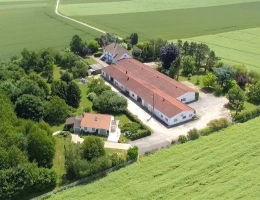
Hunting for a poultry farm for sale in Essonne means working a department shaped by arable farming, where birds are a second enterprise rather than the main one. On the cereal plateaux of the south, across the Hurepoix and in the Gâtinais français, growers have added a farmhouse poultry house, a laying unit or an open range to sell chickens and table eggs to the large population next door. The properties shown reach us from farmers stepping back, from firms specialising in rural property and from notaries, with detail on the buildings and the way output is sold. They join the national offer of poultry farms for sale.
Judging a broiler farm or an egg farm from a listing alone is hard: this page adds the value of land in Essonne, the districts where farmsteads still come free, how to examine a livestock building and the checks specific to poultry keeping. If you are building a first entry into farming, our white paper « Créer une exploitation agricole » (in French) sets out the path, from the recognised qualification to the funding package.
Land remains the largest item when buying a poultry farm. According to sales recorded by the French tax administration (DVF, vineyards excluded), the median price of agricultural land in Essonne (91) stood at €8,000/ha in 2025, with an average of €8,011/ha across 32 sales; 80% of transactions fall between €5,903 and €10,380/ha, against a national median of €5,307/ha.
The SAFER benchmark of land values (2025 figures) puts vacant land and pasture at €8,260/ha (-9.1% year on year, -22.4% over ten years), against a national average of €6,460/ha; land already let sells around 17% lower.
Beyond the area farmed, what is paid for here lies in the buildings and the goodwill. Look at the usable length of the house, insulation, air renewal, heating for young batches, silos and feed line, the concreted apron, then the fencing and shade on the range. An egg grading room, a farm shop, a market round or organic certification already gained all pass on as assets distinct from the walls. Our land price observatory places the asking price, our financial calculators test the figures.
Nothing here is industrial in scale: converted farm sheds, medium-sized houses, mobile huts moved over grass or stubble, aviaries for laying hens fitted into a former storage building. Faced with a poultry building on the market, check the frame and roof, insulation, ventilation, chick heating, the floor and how easily it can be cleaned between batches, then the kit: silos, augers, drinking lines, controller, standby generator. The entry room, the range fencing and the drainage around the building separate a unit ready to stock from a site needing work before the first birds arrive.
Then comes the outlet, which decides a great deal in this department. Few units are tied to a producer group by an integration contract; most live on direct sales, weekly markets, producer shops or boxes delivered into town. That customer base, any health approval and the packing room make up value the land registry never shows. Where the farm is sold with a dwelling house and land, ask for an item-by-item breakdown: a business loan and a home loan are not assessed together.
The south and west, around Étampes, Dourdan and Méréville, open onto wide arable plateaux where farmsteads are large and land is sought after; poultry appears there as diversification on an established holding. The Gâtinais français, towards Milly-la-Forêt and La Ferté-Alais, is more broken up, mixing woodland, crops and small farms geared to retail. The Hurepoix, between Limours and Arpajon, keeps medium-sized holdings within immediate reach of the conurbation. To the north, continuous building leaves little room for livestock of any kind, and what farmland remains is watched closely by developers.
The district to target therefore follows the plan. Retail selling works best close to main roads and to the towns that buy, accepting neighbours alert to noise and smell. A more conventional unit, taking in feed and chicks by lorry, is easier to run on the southern plateaux, where access suits heavy vehicles and buildings stay affordable. Either way, supply is thin and moves quickly.
Depending on flock size, the unit falls under declaration, registration or authorisation as a classified installation, the French environmental permitting regime; the buyer notifies the prefecture on arrival and reads the order in force before committing. The biosecurity plan, the entry room and the housing measures imposed when avian influenza risk rises apply to the small free-range units that are common here too. In a department where many villages have turned residential, the distance to third parties and control of nuisance shape daily life on the holding as much as any future enlargement.
The review continues on planning and tenure. The local planning document decides what may be built or extended, and development schemes are frequent in the department's inhabited valleys. Check manure storage capacity and the spreading plan, Essonne being classified a nitrate vulnerable zone. Part of the land is usually rented: the rural lease continues with the buyer if the landlord agrees, and the sale goes through the structures control, the French authorisation regime for taking over farmland, and through SAFER's pre-emption right.
These properties are entrusted to us by farmers selling on their own account, by rural estate agencies and by notaries in the department. Narrow by building area, by budget or by production to pick out the laying hens enterprise or the chicken farm you want, then create an alert to follow new publications. The regional view, gathering every poultry farm for sale in Île-de-France, widens the selection.