Thinking of buying a poultry farm for sale in Île-de-France? The region around Paris is no intensive production basin, yet it holds broiler and laying units run as a sideline on large arable holdings, alongside farms built around direct selling. The listings gathered here are placed by farmers handing over their business, by specialist rural agencies and by notaries, and they set out the building area, the system in use, the state of the range where there is one and where the output is currently sold. They belong to the national picture of poultry farms for sale.
Beyond the listings, this page gathers the benchmarks worth having before you commit: farmland prices around Paris, the departments where holdings still change hands, the condition of the buildings and the checks specific to the sector. If you are preparing to set up, our white paper « Créer une exploitation agricole » (in French) sets out the route from the agricultural qualification to the funding package.
Land remains the largest item when buying a poultry farm. According to sales recorded by the French tax administration (DVF, vineyards excluded), the median price of agricultural land in Île-de-France stood at €7,465/ha in 2025, with an average of €7,932/ha across 214 sales; 80% of transactions fall between €5,253 and €10,940/ha, against a national median of €5,307/ha.
The SAFER benchmark of land values (2025 figures) puts vacant land and pasture at €8,190/ha (+5.7% year on year, +7.5% over ten years), against a national average of €6,460/ha; land already let sells around 17% lower.
Here, hectares explain only part of what a poultry holding is worth: the buildings and the goodwill weigh more heavily. What counts is the state of the house and its equipment, feed storage, an egg room or packing area, and above all the customer base built up over the years, markets or short-circuit deliveries, which passes on with the business. Our land price observatory and our financial calculators will help you judge whether an asking price sits where it should.
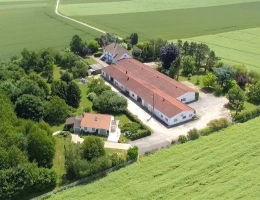
Poultry houses in this region rarely look like the long units of western France: expect medium-sized buildings, mobile huts on open range and premises converted from former farm sheds. Buyers look closely at the frame and insulation, the ventilation, the heating used for day-old chicks, the silos, the floor surface and the scope for a proper clean-out between batches. A free-range poultry system, whether label rouge or organic, also needs a fenced, planted and well-drained range, whose area governs the stocking density allowed. A building recently brought up to standard sells above premises needing heavy refurbishment.
Chickens, turkeys, guinea fowl and ducks raised for meat sit alongside egg units: a laying hens enterprise is judged on its capacity, its system, aviary, floor or free range, and on the way table eggs are graded and sold on. A few work under an integration contract with a producer group; others live on local custom alone. Where a holding is offered with a dwelling house and land, ask for an item-by-item breakdown rather than one overall figure: the production tool and the house are not valued against the same references.
Seine-et-Marne holds most of the supply: the Brie, the Provinois and the Gâtinais combine arable farming with diversification units, and this is where complete farmsteads most often come on the market. Yvelines, around the plaine de Versailles and the Chevreuse valley, offers smaller poultry enterprises strongly geared to selling at the farm gate. Essonne, from the Hurepoix to the Gâtinais français, mixes cereals with small farmhouse units, several selling eggs and table birds at the gate. Val-d'Oise, and the Vexin français in particular, keeps an active farming fabric in which a poultry building occasionally comes up for sale, usually within a wider arable holding.
The three inner-ring departments present a very different picture. Val-de-Marne still has a handful of holdings on its Brie edge, often geared to visitors and direct sales. Hauts-de-Seine and Seine-Saint-Denis, almost entirely built up, see practically no transactions of this kind: projects there take the form of an urban farming venture rather than a conventional handover. Pressure on land is strong everywhere and supply is thin, so a search confined to one department rarely succeeds. It pays to watch the whole of the outer ring, and the neighbouring departments beyond the regional boundary, at the same time.
Depending on flock size, a unit falls under declaration, registration or authorisation as a classified installation, the French environmental permitting regime, and any change of operator must be notified to the prefecture: read the order in force and its requirements before making an offer. The biosecurity plan, the entry room and the housing measures linked to avian influenza apply to small units too, including those selling direct. In a peri-urban setting, the distance to dwellings and the management of odour and noise shape daily life on the farm as much as its scope for expansion.
The second review covers land and planning: read the local planning document, since the zoning of each parcel determines what may be built or extended, and development schemes are numerous in this region. Part of the land is usually rented, the rural lease continues with the buyer subject to the landlord's agreement, and the transaction goes through the structures control, the French authorisation regime for taking over farmland, and through SAFER's pre-emption right. Have the buildings, equipment and land valued separately before signature.
Behind these listings you will find private sellers, rural estate agencies and notarial firms. Filter by department, by building area or by budget, set up an e-mail alert so that you hear about each new property as soon as it is listed, and, if your plans remain open as to the type of production, widen your search to all farms for sale in Île-de-France.