
The market for a poultry farm for sale in Val-de-Marne amounts to a handful of chances a year, nearly all of them in the east of the department, where the Brie plateau still holds cultivated land and working farmsteads. What comes up are small farmhouse enterprises: chickens and guinea fowl reared in short batches, laying hens on range, birds and table eggs sold at the gate or on the markets of the conurbation. The few properties that are released are flagged to us by the farmers themselves, by rural estate agencies and by notaries. They appear among all the poultry farms for sale in France.
Because supply is so thin, it pays to arrive prepared: below you will find the value of land locally, the communes where farming survives, how to appraise a livestock building in a peri-urban setting and the permits to verify. Our white paper « Créer une exploitation agricole » (in French) supports anyone shaping a project, from the training required to the business plan.
Land remains the largest item when buying a poultry farm. This department has no rural communes in the statistical sense, so the figures below are those of the Île-de-France region. According to sales recorded by the French tax administration (DVF, vineyards excluded), the median price of agricultural land in the region stood at €7,465/ha in 2025, with an average of €7,932/ha across 214 sales; 80% of transactions fall between €5,253 and €10,940/ha, against a national median of €5,307/ha.
The SAFER benchmark publishes no average for this territory; the national reference is €6,460/ha for vacant land and pasture and €5,350/ha for tenanted land.
In this peri-urban setting, value shifts from the ground to the tool and the customers. Buyers weigh the state of the house and its equipment, feed storage, the egg grading room, the packing area, the shop and its fit-out, and also how steadily people come and what position the farm holds on nearby markets. Visitor activities, school groups or seasonal selling, are appraised separately. Frame your budget with our land price observatory and our financial calculators.
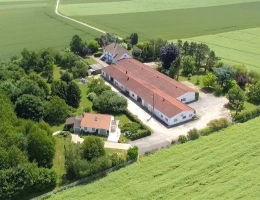
Forget the long units of western France: what this department offers are low-capacity houses, mobile shelters set on grass, sometimes a wing of a farmstead refitted or a former horticultural building converted. The inspection starts with the soundness of the structure and roof, insulation and air flow, the heating available for young birds, the floor surface and the fencing of a range in a busy area. Then come the fittings: silos or hoppers, feed distribution, drinking lines, lighting, and protection against predators and intrusion, a more pressing concern here than elsewhere.
How the output is sold shapes the rest of the value. Almost no unit on the market here is tied to a producer group; direct selling dominates, with a shop, markets and sometimes deliveries to restaurants. That goodwill, the local reputation and any health approval are negotiated apart from the buildings. Where the property includes a house, the residential share may exceed that of the working tool: ask for a written breakdown before you put a loan application together.
Farming holds on in the east and south-east, on the Brie plateau around Santeny, Marolles-en-Brie, Villecresnes, Mandres-les-Roses and Périgny-sur-Yerres, where arable fields, horticulture and a few farmhouse livestock enterprises sit side by side. The plaine des Bordes, towards Chennevières-sur-Marne, adds to these open spaces. The Yerres valley marks the boundary with Seine-et-Marne and opens onto a denser rural fabric, often more affordable. These communes form the last farming belt in the department, the one where a poultry building comes up for sale now and again, usually within a complete farmstead. The north and west, from Vitry to Nogent, are entirely built up: no conventional handover is conceivable there.
Searching here therefore means thinking at the scale of the eastern edge, then crossing the departmental boundary as soon as the project calls for area. Having several million consumers on the doorstep remains the main advantage: modest volumes can be sold on terms unavailable elsewhere, A laying hens enterprise sells its output without difficulty here, provided you accept a compact holding under constant public view.
The first move is to read the commune's planning document: the zoning of parcels, reserved sites and development schemes decide the future of a holding far more than its present condition. Next comes the classified installations regime, the French environmental permitting system, which applies according to flock size, with declaration, registration or authorisation and notification of the change of operator to the prefecture. In so dense an environment, the distance to dwellings and the handling of odour, noise and manure govern relations with neighbours and often rule out any extension.
Animal health deserves equal care: a biosecurity plan, an entry room, controlled access and housing measures whenever avian influenza surveillance requires them, including for small free-range flocks visited by the public. On tenure, check the status of each parcel, since a rural lease continues with the buyer subject to the landlord's agreement, and the sale remains subject to the structures control, the French authorisation regime for taking over farmland, and to SAFER, even on small areas.
This selection gathers properties offered by farmers, by agencies specialising in rural property and by notaries' offices. Use the area, price and production filters to spot the egg farm or the poultry house you are after, then save an alert, which matters all the more on so thin a market. Browse the poultry farms for sale in Île-de-France as well.