

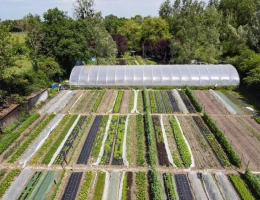
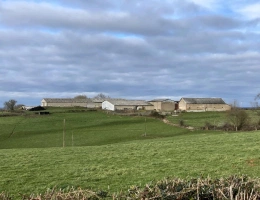
An arable farm for sale in Saône-et-Loire sits in a department better known for Charolais cattle and vineyards, yet the Saône valley and the Bresse around Louhans carry genuine cropping rotations of wheat, maize, barley and oilseed rape. The holdings shown here are placed by farmers preparing to step back, by firms that deal only in rural property and by notaries in Chalon-sur-Saône, Louhans or Tournus; they set out what is owned and what is rented, how the fields are grouped, what can be stored and what machinery goes with the sale. You will find them again among the arable farms for sale listed across France.
Beyond the particulars, this page gathers what usually decides a purchase: land values recorded locally, the districts where holdings come up most often, how to judge a Bresse farmstead and its grain bins, and the checks to run before signing. For anyone starting out, our white paper « Créer une exploitation agricole » (in French) walks through each stage of setting up.
Pricing the land comes first in any plan to buy an arable farm. On the basis of 2025 DVF sales (vineyards excluded), the median in Saône-et-Loire (71) works out at €2,349/ha and the average at €2,437/ha, across 391 transactions. The central range covering 80% of sales runs from €1,629 to €3,300/ha; nationally the median is €5,307/ha.
The SAFER benchmark, the market's second yardstick, gives €2,550/ha in 2025 for vacant land and pasture (-0.8% over twelve months, +6.2% over ten years), beside a national €6,460/ha; tenanted land is worth about 17% less.
At equal size, the gap between two asking prices comes from elsewhere: the water-holding capacity of the soils and how steady the harvests are, the distance between blocks and the yard, drainage on the cold Bresse clays, access to water for maize, storage volume and the quality of the ventilation, the age of the combine and the main tractor, the basic payment entitlements attached to the business, and the contract binding it to a cooperative or a grain merchant. Our land price observatory and our financial calculators help you place your own project.
The Bresse rests on heavy, damp clays where drainage governs everything: without a maintained network, working windows narrow and maize takes precedence over winter cereals. The Saône valley, from Chalon to Tournus, offers the opposite, deep and warm alluvium where wheat, barley and oilseed rape perform consistently and where the lighter ground is sometimes irrigated. On the slopes and around Cluny, thin soils sit directly on limestone and restrict what can be grown. Ask for soil analyses, field-by-field yields and the drainage plan: potential changes quickly from one side of a valley to the other.
Timber-framed Bresse farmsteads with long roofs sit next to newer portal-frame sheds. Look at bin capacity, ventilation, whether a drier is present, the state of the concrete and the width of the access for articulated lorries. A cereal farm able to store its own harvest keeps control of when it sells, and that shows in the asking price. Where a manor house or a restored Bresse farmhouse is part of the lot, have a residential valuer price it: its value answers to a market quite separate from the farming business.
The Saône valley forms the cropping backbone, from Verdun-sur-le-Doubs through Chalon-sur-Saône to Tournus, with sought-after arable land and steady competition for it. The Bresse louhannaise, around Louhans, Cuiseaux and Montpont-en-Bresse, combines maize, cereals and poultry units; fields there are smaller and hedged. Towards Autun and the Charolais, at Charolles, Paray-le-Monial or Digoin, grassland dominates and crops mainly feed livestock, so sales involve mixed systems. The Chalonnais, the Mâconnais and the Clunisois leave little room for broadacre cropping, since the vineyard absorbs much of the available ground.
For a buyer the consequence is plain: arable land in the Saône valley sells quickly and at high levels, while the Bresse and the west of the department offer gentler entry prices in exchange for scattered fields and more demanding soils. Measure the road distance between blocks before you decide, because over those distances fuel and tractor hours end up weighing as much as the price paid per hectare.
A takeover goes through the structures control, the prefectural authorisation that governs expansion and new entrants, and SAFER may exercise its right of pre-emption as soon as the notary notifies the preliminary contract. Work through each rural lease, noting when it expires, what rent is paid, which environmental undertakings attach to it and where the sitting tenant stands. Where the business is held in a company, the deal may take the form of a share transfer, with tax treatment and liabilities very different from a straight land purchase. Ask for the accounts, the graphical field register and the history of support payments.
On the technical side, confirm that abstraction permits are valid and the boreholes work, look into flood risk on fields bordering the Saône, the Doubs or the Seille, check that the Bresse drains have genuinely been maintained, and make sure the basic payment entitlements transfer and are declared within CAP deadlines. A look at the crop-protection store, the fuel tanks and the electrical boards avoids unplanned work in the first season.
Retiring owners, rural property agencies and notaries add new holdings to this section regularly. Narrow the search by area, budget or district, switch on an alert to see listings as they go live, then widen the view to the arable farms for sale in Bourgogne-Franche-Comté.


