

An arable farm for sale in Haute-Saône is best understood from a map: the Saône valley around Gray, together with the limestone plateaux that frame it, carries most of the department's cropland, while the north-east towards Lure and Luxeuil-les-Bains gives more room to grass and woodland. Wheat, barley, oilseed rape and maize shape the rotation. What appears online comes from farmers preparing their exit, firms specialising in rural property and notarial offices in Vesoul, Gray or Luxeuil; the particulars set out the split between owned and rented ground, the storage capacity and the machinery fleet. Read them alongside the arable farms for sale listed across France.
On this page: the land values recorded in the department, the districts where holdings change hands most often, how to inspect a Haute-Saône farmstead and its grain bins, and the obligations that come with taking over a crop farm. For the project itself, from feasibility study to funding plan, our white paper « Créer une exploitation agricole » (in French) works through each stage.
Pricing the land comes first in any plan to buy an arable farm. On the basis of 2025 DVF sales (vineyards excluded), the median in Haute-Saône (70) works out at €2,615/ha and the average at €2,727/ha, across 156 transactions. The central range covering 80% of sales runs from €1,999 to €3,577/ha; nationally the median is €5,307/ha.
The SAFER benchmark, the market's second yardstick, gives €2,660/ha in 2025 for vacant land and pasture (-1.5% over twelve months, +0.8% over ten years), beside a national €6,460/ha; tenanted land is worth about 17% less.
Beyond acreage, what pushes an asking price up or down is thoroughly concrete: soil depth and agronomic potential, how tightly the fields cluster around the yard, drains laid and maintained, a licensed borehole, storage volume and the quality of the ventilation, the age of the combine and of the cultivation kit, the basic payment entitlements, the contract tying the business to its cooperative or grain merchant. A cereal farm equipped to keep its own harvest stays in control of when it sells. Our land price observatory and our financial calculators are there to steady that judgement.
The silts and alluvium of the Saône valley hold the department's best arable land, with maize wherever water can be reached; on the plateaux around Vesoul, Gy or Combeaufontaine the clay-limestone soils are thinner and their water reserve caps yields as soon as a season turns dry. On the colder ground, working drainage dictates when you can travel the fields at all. Ask for soil analyses, the drainage plan and harvest results block by block rather than whole-farm averages: potential shifts sharply over a few kilometres. The standard sequence runs wheat, winter barley and oilseed rape, with maize, sunflower or protein crops added.
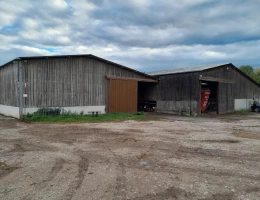
As for buildings, heavy Franche-Comté barns sit next to more recent steel-framed sheds. Look at the roof structure and covering, the load-bearing concrete apron, articulated-lorry access, the number and condition of the bins, the ventilation and, where one exists, the drier. A grain farm with storage of its own escapes the queue at harvest intake. If a dwelling forms part of the lot, have it valued separately: the residential appeal of the valley follows a logic quite unlike that of farmland.
The south-western tip of the department, around Gray, Dampierre-sur-Salon and Autrey-lès-Gray, continues the Burgundian cropping plain: compact field blocks, silos and buyers close at hand, keenly contested deals. The plateaux framing Vesoul, the Monts de Gy district and the country near Port-sur-Saône mix cropping with grassland on more modest holdings. Towards Lure, Luxeuil-les-Bains and the Vosges foothills, grass, forest and livestock take over, and arable land comes up more sporadically. In the north, around Jussey and Vauvillers, what is offered tends to be fragmented.
Value gaps owe more to soil potential and to neighbours looking to expand than to the state of the buildings. Near Gray, an outside buyer meets established competition; in the centre and north, there is room to negotiate and the entry cost stays more approachable. Cost out the travel between blocks before you commit: scattered ground weighs on every season, in fuel as in tractor hours.
Every takeover goes through the structures control, the prefectural authorisation governing new entrants and farm expansion, and SAFER, the rural land agency, may pre-empt as soon as the notary notifies it of the sale. Work through the rural leases field by field: expiry date, rent, environmental clauses, the sitting tenant's right of pre-emption. A long-standing verbal arrangement between neighbours, common enough here, can undermine the land base of your project. Where the farm is held in a company, the deal may transfer shares rather than assets, and the tax treatment and warranties change completely.
Then confirm that basic payment entitlements are genuinely transferred and declared within the CAP calendar, that abstraction permits are valid if any fields are irrigated, and that no easements arise from drinking-water catchments or from the valley's wetlands. The graphical field register lets you compare declared areas with those advertised. A survey of the fuel tanks, the crop-protection store and the electrical installations rounds off the visit.
Retiring owners, rural property agencies and notarial offices add instructions here week by week. Narrow by area, budget or district, save an alert so no new listing slips past, and widen the search to the arable farms for sale in Bourgogne-Franche-Comté.


