

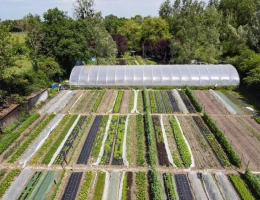
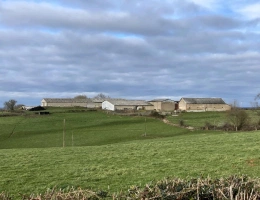
Finding an arable farm for sale in Territoire de Belfort takes patience: the smallest department in mainland France holds few specialised cropping businesses, and cash crops usually sit alongside a dairy or suckler herd. Wheat, barley, maize and oilseed rape occupy the Belfort gap and the Sud-Territoire, between the built-up area and the Swiss border. The holdings shown come from farmers handing over, rural property firms covering the Belfort-Montbéliard area and local notaries; they state the area farmed, the share under tenancy, the buildings and the machinery. Each also appears among the arable farms for sale listed nationwide.
What this page adds to the listings is what a buyer looks for next: the level of land values recorded locally, the districts where openings occasionally appear, the condition to expect from buildings and storage, and the steps a takeover depends on. Our white paper « Créer une exploitation agricole » (in French) sets out the stages of setting up, from plan to finance.
Pricing the land comes first in any plan to buy an arable farm. On the basis of 2025 DVF sales (vineyards excluded), the median in Territoire de Belfort (90) works out at €3,820/ha and the average at €4,011/ha, across 16 transactions. The central range covering 80% of sales runs from €3,400 to €4,975/ha; nationally the median is €5,307/ha. * Fewer than 30 recorded sales: indicative value.
The SAFER benchmark, the market's second yardstick, gives €3,570/ha in 2025 for vacant land and pasture (-1.4% over twelve months, -11.0% over ten years), beside a national €6,460/ha; tenanted land is worth about 17% less.
In a market this narrow, value rarely rests on acreage alone. It depends on the quality of the silts in the gap, drainage on the heavier ground, how tightly fields sit around the yard, the ability to store a harvest rather than deliver it at once, the condition of the shed and workshop, the machinery taken over, the basic payment entitlements and the chosen outlet with a cooperative or regional merchant. A dwelling counts too, since demand around Belfort stays firm. Our benchmarks are gathered in the land price observatory and the financial calculators.
The Belfort gap, the open corridor between the Vosges and the Jura, carries decent silts where wheat, barley and oilseed rape follow one another, often with maize grown for animal feed. Northwards, at the foot of the Vosges, soils lighten then turn stony and grassland takes over. In the Sud-Territoire the clay ground copes badly with excess water and needs its drainage kept up. Always ask for analyses, the drainage plan and the record of past results: on holdings of this size, a few poor fields weigh heavily on the balance of a season.
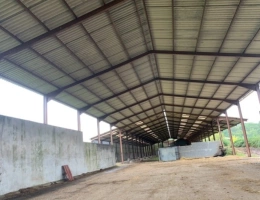
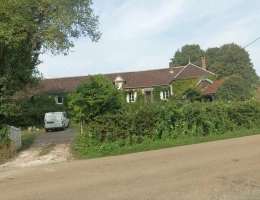
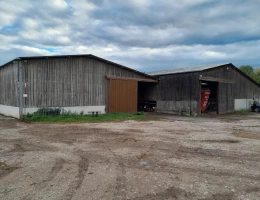
Buildings range from old village farmsteads, sometimes attached to their neighbours, to more recent sheds put up on the edge of the village. Check the roof structure, the covering, machine access through narrow streets and the real storage capacity, often no more than a covered flat store. A grain farm with ventilated bins or a drier is the exception here and is priced accordingly. Where the house is included, have it valued separately: Belfort and the Montbéliard basin keep the residential market busy.
Most of the cultivated ground lies in the central plain, around Bavilliers, Châtenois-les-Forges and Trévenans, then in the Sud-Territoire from Grandvillars to Delle and Beaucourt, where fields are most open. The sub-Vosges north, towards Giromagny and Rougemont-le-Château, is grassland and forest, with forage crops as a complement. To the west, the boundary with Haute-Saône continues comparable mixed farming systems. Building along the Belfort-Montbéliard axis and the infrastructure crossing it reduce the available farmland further.
The result is that sales are rare and often settled within a close circle before they are ever advertised. Extending the search to neighbouring communes in Haute-Saône and Doubs widens the field without moving the farmstead far. Steady watching and a well-tuned alert are worth more than an occasional look, in a market where a handful of transactions make up the year.
A takeover falls under the structures control, the prefectural authorisation required to farm beyond certain thresholds, and SAFER may pre-empt once the notary has notified the sale. Review the rural leases: expiry dates, rent, environmental clauses, the tenant's right of pre-emption. Check the planning status of fields close to built-up areas or infrastructure projects as well, because land zoned for future development is a different asset at a different price. Where the business is held in a company, an audit of the accounts comes before any offer.
Technically, check that drains have been maintained, that a manure plan exists where animals remain on the holding, that the crop-protection store and fuel tanks comply, and that basic payment entitlements transfer within CAP deadlines. Finally, look into rights of way and utility easements, which are common in a department crossed by so many routes.
Retiring owners, rural property agencies and notarial offices place their instructions here. Target the area and budget that suit your project, create an alert so that an inevitably infrequent listing does not pass you by, and carry on through the arable farms for sale in Bourgogne-Franche-Comté.


