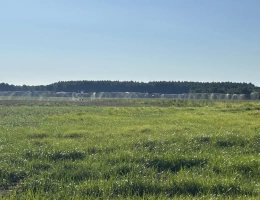
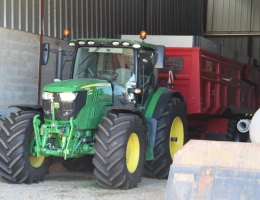
Spotting an arable farm for sale in Gironde means looking outside the vineyard: cropping is concentrated in the south of the department, on the sands of the Gironde Haute Lande and in the Bazadais, and on the palus and river terraces of the Garonne, the Dordogne and the Isle, where irrigated maize dominates. Farmers nearing retirement, rural property firms and notarial offices in Langon, Libourne or Blaye entrust these properties; the particulars state the rotation, the irrigated area, the boreholes, the storage and the machinery included. Compare them with the whole set of arable farms for sale tracked in France.
This page adds what a listing leaves out: land values observed in the department, the districts where deals keep recurring, how to read a Gironde steading and its harvest buildings, and the checks to run before taking over a cereal farm that sits next to the vineyard. Our white paper « Créer une exploitation agricole » (in French) sets out how to structure the purchase.
Pricing the land comes first in any plan to buy an arable farm. On the basis of 2025 DVF sales (vineyards excluded), the median in Gironde (33) works out at €5,000/ha and the average at €5,536/ha, across 85 transactions. The central range covering 80% of sales runs from €2,244 to €8,978/ha; nationally the median is €5,307/ha.
The SAFER benchmark, the market's second yardstick, gives €8,340/ha in 2025 for vacant land and pasture (-2.7% over twelve months, +56.5% over ten years), beside a national €6,460/ha; tenanted land is worth about 17% less.
Area weighs less in the bargaining than buyers expect. What tells is the soil, whether podzolic sand from the Landes or alluvium behind flood embankments, how compact the blocks are, the licensed borehole rate and the aquifer it draws on, the condition of pivots and reels, bin capacity, the presence of a drier, the age of the harvest machinery, the basic payment entitlements and the commitment to a cooperative or grain merchant. Place your offer with our land price observatory and our financial calculators.
Two agronomic worlds coexist. In the south, the Landes sands are poor, free-draining and acid: they only yield under irrigation and fertiliser, which makes the borehole and the water resource decisive. Along the rivers, the palus and alluvial terraces offer deep ground, sometimes heavy and waterlogged, protected by embankments and drained by ditch networks maintained by a landowners' association. Ask for analyses, organic matter levels, block-by-block yields over several seasons and, on the palus, a precise account of the drainage network and the outfall structures.
Buildings range from the stone Gironde farmhouse to the airial clearings of the Landes, with newer steel-framed sheds alongside. Check the bearing capacity of the yards, articulated-lorry access, the seal and ventilation of the bins, and the electrical supply available for the drier and the irrigation pumps. An arable land holding able to store its own harvest keeps control of its delivery schedule. The dwelling, in demand across a highly attractive department, must be valued apart from the land and the working equipment.
Around Bazas, Captieux and Grignols, then towards Hostens and Saint-Symphorien, the large fields won from the heath carry maize and contract crops: this is where the biggest and most workable units change hands. The Garonne terraces from La Réole to Langon, and the palus of the Cubzaguais, the Bourgeais and the Blayais, mix cropping, grassland and vines on smaller holdings, where part of the income comes from enterprises other than cereals. Ask early which of those the seller intends to keep. Wherever the vineyard advances, in the Entre-deux-Mers as in the Blayais, the price of ploughable ground follows at once.
Proximity to Bordeaux adds a pressure that neighbouring departments do not know: residential demand, development schemes and leisure projects lift land values as soon as you approach the main roads. So check the local planning zoning, any reserved sites, and the distances between blocks, steading and the nearest collection point before settling on a budget, since a block cut off by a fast road is worked at a cost of its own.
A takeover requires an operating authorisation under the structures control and notification of the sale to SAFER, the rural land agency, which may pre-empt. Then review the rural leases, their expiry, their rent and the sitting tenant's right of first refusal. Water deserves sustained attention: the deep Gironde aquifers are covered by a dedicated management plan and summer abstraction falls under collective management at basin level. Make sure the borehole is declared, that its authorisation is current and that it will genuinely pass to the buyer.
Study the match between the areas declared in the graphical field register and those in the contract, the transfer of basic payment entitlements, membership of an embankment or drainage association and the charges it brings, and the estuary flood zones. Where fields adjoin vines, spraying distances and neighbourhood charters restrict certain operations. Finally inspect the fuel tank, the crop-protection store and the electrical installation.
The offers gathered here are entrusted by retiring owners, by agencies specialising in rural land and by Gironde notaries. Adjust your area, budget and district criteria, create an alert to follow new cropping units coming to market in the department, then extend the search to the arable farms for sale in Nouvelle-Aquitaine.