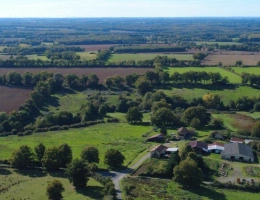
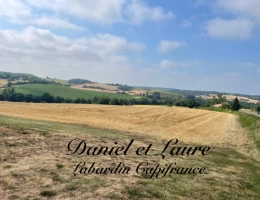
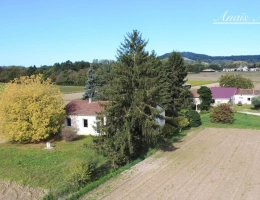
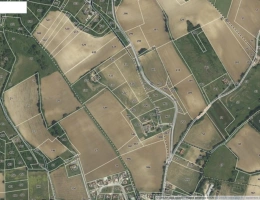
Looking for an arable farm for sale in Deux-Sèvres points you towards the southern half of the department and its northern tip: the plains around Niort, the Mellois country of Melle, Lezay and Chef-Boutonne, and the open fields of the Thouarsais. On these clay-limestone groies and deeper red soils, soft wheat, barley, oilseed rape, sunflower and maize shape the rotation, with pulses added here and there. Files reach us from growers arranging their retirement, from rural property firms based in Niort or Thouars, and from notarial offices; each states the area, the owned share, the irrigable ground, the storage and the machinery included. Weigh them against every arable farm for sale we track.
Beyond the particulars, this page gives the ploughland values actually recorded across the department, the districts where handovers follow one another, how to judge a Poitou farmstead and its grain bins, and the checks that apply to a cereal farm sitting between open plain and hedged country. To build your own entry plan, our white paper « Créer une exploitation agricole » (in French) works through each stage.
Pricing the land comes first in any plan to buy an arable farm. On the basis of 2025 DVF sales (vineyards excluded), the median in Deux-Sèvres (79) works out at €3,278/ha and the average at €3,376/ha, across 409 transactions. The central range covering 80% of sales runs from €2,334 to €4,502/ha; nationally the median is €5,307/ha.
The SAFER benchmark, the market's second yardstick, gives €3,470/ha in 2025 for vacant land and pasture (-2.0% over twelve months, +9.1% over ten years), beside a national €6,460/ha; tenanted land is worth about 17% less.
Acreage alone never settles the worth of a working unit. Weigh in the depth of the groie soils and their water-holding capacity, how compact the blocks are, a declared borehole with a transferable abstraction volume, bin capacity and the presence of a drier, the state of the harvest chain, the basic payment entitlements and the commitment given to a grain buyer. Cross-check your figure with our land price observatory and our financial calculators.
The groies of the Mellois and the Niortais, stony and calcareous, carry winter cereals well, yet their limited water reserve caps yields as soon as a spring ends without rain. The deeper red soils behave quite differently and call for a steady liming programme. Ask for the analyses, the workable depth measured by auger, the drainage plan and the yields block by block over several seasons: a whole-farm average erases gaps that weigh heavily in a financing plan.
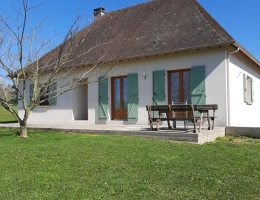
Buildings usually pair a limestone dwelling with older barns and newer steel-framed sheds. Check that the turning aprons bear weight, that articulated lorries can reach them, that the bins are sealed and ventilated, that the drier burner works and that the intake pit is sound. A grain farm able to hold its own harvest chooses when to deliver and when to sell rather than taking what the calendar imposes. The dwelling, sought after by buyers moving out from Niort, has to be valued apart from the land and the plant.
The plain running south-east of Niort towards Beauvoir-sur-Niort, Brioux-sur-Boutonne and Chef-Boutonne remains the cereal heart of the department, continued by the Mellois and by the plain of La Mothe-Saint-Héray and Lezay. Units are large, field blocks are compact, and neighbours in an expanding phase keep the market contested. To the north, around Thouars, Airvault, Saint-Varent and Oiron, the Thouarsais open fields form a second pocket of supply, with holdings sometimes bordering quarries or the local vineyard.
The Gâtine, from Parthenay to Secondigny, and the Bressuire hedgerow country belong to livestock instead: arable land there is scarce and mostly feeds the herd. Westwards, the Marais poitevin separates the wet marsh, kept in grass, from the drained marsh, which is cropped and managed by drainage boards whose water rules bind any incoming owner. Cost the distances between blocks, steading and collection point before you commit.
The Sèvre niortaise and Marais poitevin basin is classified as a water allocation zone: irrigation abstraction is capped, managed by a single collective body and regularly restricted by prefectural order in dry spells. Ask for the permit attached to the borehole, the volume notified, the history of restrictions and, where relevant, the agreement tying the farm to a substitution reservoir, whose transfer is never automatic. The deal then falls under the structures control, the French authorisation regime for taking on farmland, and SAFER, the rural land agency, may pre-empt once the notary notifies the sale.
Part of these plains is designated a special protection area for the little bustard: agri-environmental schemes there frame the rotation, the timing of field work and the retention of cover, under multi-year commitments that either pass on or must be settled. Read every rural lease, its term, its environmental clauses and the tenant's right of first refusal. Confirm that the graphical field register matches the advertised areas, settle what happens to the basic payment entitlements, then inspect the fuel tanks, the crop-protection store and the electrical installation.
What you see here is entrusted to us by growers organising their handover, by agencies specialising in rural land and by notarial offices across the department. Narrow by area, budget or district, keep your criteria running as an alert, then widen the watch to arable farms for sale in Nouvelle-Aquitaine.