
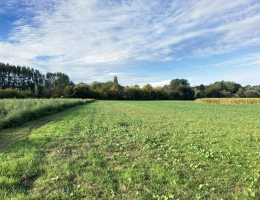
Buying an arable farm for sale in Dordogne usually points to the north-west of the department and to the terraces of the main valleys: the Ribérac plain grows wheat, barley, oilseed rape and sunflower on open ground, while the Isle, the Dordogne and the Vézère carry irrigated maize. The properties shown come from farmers organising their retirement, from rural property firms and from notarial offices in Périgueux, Bergerac or Ribérac; every set of particulars sets out the rotation, the share of land held freehold, the irrigable area, storage capacity and the machinery included. Read these Périgord files alongside the arable farms for sale listed across France.
Beyond the sales description, this page gathers the land values recorded in the department, the districts where handovers cluster, how to weigh up a Périgord farmstead and its sheds, and the checks that apply to a cereal farm split between valley and plateau. Our white paper « Créer une exploitation agricole » (in French) supports the planning stage.
Pricing the land comes first in any plan to buy an arable farm. On the basis of 2025 DVF sales (vineyards excluded), the median in Dordogne (24) works out at €4,716/ha and the average at €4,967/ha, across 126 transactions. The central range covering 80% of sales runs from €2,845 to €7,424/ha; nationally the median is €5,307/ha.
The SAFER benchmark, the market's second yardstick, gives €5,030/ha in 2025 for vacant land and pasture (-4.4% over twelve months, +7.2% over ten years), beside a national €6,460/ha; tenanted land is worth about 17% less.
Acreage alone does not set the value of such a unit. What also counts is the water-holding capacity of the boulbène or clay-limestone soils, how tightly the blocks sit together, whether a declared borehole and a transferable abstraction volume come with the farm, the condition of the irrigation reels, bin capacity and the presence of a drier, the age of the combine, the basic payment entitlements and the contract tying the business to its cooperative. To calibrate your offer, lean on our land price observatory and our financial calculators.
Périgord sets very different ground side by side: silty boulbène soils that cap and stay wet on the north-western plateaux, firmer clay-limestone land around Ribérac, deep alluvium in the Isle and Dordogne valleys, shallow causse soils towards Terrasson and Sarlat, acid sands in the Double and the Landais. Ask for soil analyses, genuine working depth, the liming history and field-by-field yields over several seasons. Look closely at drainage as well: on boulbène, an old and neglected network delays autumn sowing and undermines consistency far more than the headline acreage suggests.
The buildings usually pair a stone house under tile with older outbuildings that are hard to repurpose and one or two steel-framed sheds. Check the bearing capacity of the yards, access for grain lorries, the seal and ventilation of the bins, and the state of the drier where maize comes in wet. A grain farm with enough storage of its own chooses its delivery dates instead of enduring them. The house, sought after by residential buyers, is priced separately from the working unit.
Around Ribérac, Verteillac and Saint-Aulaye, the north-western plain offers the most regular field patterns and draws keen competition from neighbours looking to expand. The Isle terraces from Neuvic to Mussidan, and those of the Dordogne near Lalinde and Bergerac, gather irrigated maize and contract crops; ground there is more contested, all the more so as the Bergerac vineyard and walnut orchards take up part of the better land. Towards Nontron and the northern Périgord, grass and woodland take over again, on smaller and more fragmented holdings.
The south-east, between Sarlat, Le Bugue and Terrasson, is shaped more by tourism, walnut growing and forestry than by cropping: supply stays thin and building values are pulled up by residential demand. Before committing, measure the runs between blocks, steading and collection point, and ask how many separate access tracks the harvest depends on; broken relief and winding roads stretch field days well beyond what the distance on the map suggests.
A takeover falls under the structures control, the prefectural authorisation that governs new entrants and farm expansion, and the sale is notified to SAFER, the rural land agency, which holds a pre-emption right. Then go through every rural lease: expiry, rent, environmental clauses and the sitting tenant's right of first refusal. Water calls for particular care: in the Adour-Garonne basin the resource is managed collectively, summer abstraction is authorised season by season and cut back in drought. Check the borehole declaration, its upkeep and the exact terms on which the authorisation passes to the buyer.
Confirm that the graphical field register matches the advertised areas, that basic payment entitlements transfer, and look at rights of way, the flood zones along the Isle and the Dordogne and the protection perimeters around drinking-water catchments. Where a company holds the farm, the deal may concern shares, with their own tax treatment and liabilities. Finish with the crop-protection store, the fuel tanks and the electrical inspection of the buildings.
The properties gathered here are entrusted by retiring owners, by rural property professionals and by notarial offices in the department. Narrow by area, budget and district, keep an alert running so you hear as soon as a Périgord crop farm comes to market, then carry your search on to the arable farms for sale in Nouvelle-Aquitaine.



