
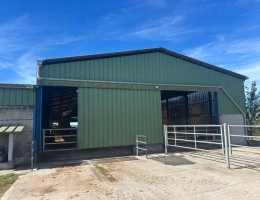
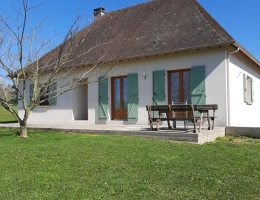
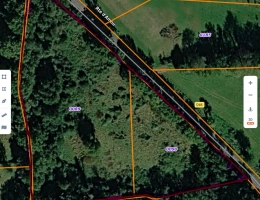
Spotting the right farms for sale in the Deux-Sèvres means knowing which third of the county you are standing in: the hedgerow country of the north, laced with banks and given over to livestock; the open, mechanised cereal plain of the centre and south; and the wet meadows of the marshland to the west. The mandates published here come from farmers organising their withdrawal, from land practices based in Bressuire, Parthenay or Niort, from notary offices and from handover advisers. Records state the workable area, the stocking rate carried, the condition of the hedge network, the buildings and the milking equipment. They feed our selection of farms for sale in France.
The page does not stop at what is available: it shows how values rank between drained plain, hedgerow country and flood meadow, where handovers appear, and what is at stake when a herd and a processing room come with the land. For a project just taking shape, our white paper « Créer une exploitation agricole » (in French) lays the legal and financial groundwork.
Land forms the base of a farm's value. DVF, the property sales database published by the French tax administration (vineyards excluded), records a 2025 median of €3,278 per hectare in Deux-Sèvres (79), an average of €3,376 and 409 sales; four transactions in five fall between €2,334 and €4,502, against a national median of €5,307.
The SAFER land value benchmark sets €3,470 per hectare for vacant land and pasture offered for sale in the same year, -2.0% over one year and +9.1% over ten, against €6,460 nationally. Land sold with a tenancy in place is valued at €3,250, a discount of about 6%.
Against the Nouvelle-Aquitaine region, whose median is €4,538 per hectare, this department sits 28% lower. For commune-level detail and comparisons with neighbouring areas, see our land price observatory, then cost your purchase with our financial calculators.
The county ranks first in France for goat's milk, and that shows in what comes to market: goat enterprises form a dense group, usually built around a recent goat house, a properly sized parlour and a collection contract, sometimes a cheese dairy under a protected designation. The hedgerow country also carries suckler cattle enterprises of local beef breeds and dairy herds, on low-input grassland systems whose strength comes from grazing rather than bought feed. These herds rely on forage ground close at hand, so the shape of the farmed block matters here as much as the number of hectares.
Southwards, arable holdings take over on the shallow limestone soils, with wheat, oilseed rape, sunflower and pulses; mixed farms bridge the two worlds. A few poultry units top up income. A working farm in the bocage is judged on its forage self-sufficiency, a plain holding on its field pattern and cropping: two quite different valuation logics.
The Gâtine and the Bressuire bocage, from Parthenay to Bressuire, Mauléon and Moncoutant, hold most of the livestock handovers: shallow soils over bedrock, fields cut up by hedges, plenty of buildings and contained entry prices. The Thouarsais, to the north-east, opens onto lighter land and mixed systems leaning towards the Saumur country. The Niort plain, through the Mellois to Melle, Chef-Boutonne and Brioux, carries the largest arable structures, and that is where competition between expanding neighbours bites hardest.
To the west, the Niort plain gives way to the Marais poitevin, where natural meadows, drainage ditches and flooding constraints limit use and create a market of its own, sought after by extensive grassland systems. An agricultural property on that fringe is judged first on how well the ground carries stock and on the grazing calendar it allows. Purchases there often aim at extra area rather than at a complete holding with its buildings.
Two local constraints can be read in the field before any document. The first is the hedge network: removing it is regulated, maintaining it conditions access to certain support payments, and a heavily fragmented field pattern weighs hard on labour time. The second concerns the wetlands and marsh meadows, designated and covered by contracted agri-environmental measures: no ploughing up, cutting dates fixed, stocking capped, and multi-year commitments that transfer or unwind under precise rules worth having spelled out before any offer.
The rest belongs to checks that apply everywhere but are better dealt with early. The sale passes before SAFER, which keeps a priority right to acquire. Bringing the land into use further requires administrative clearance, granted according to the enlargement rules in force across the region. A running tenancy gives the tenant first rank among possible purchasers. Finally, a goat house or a cattle shed calls for a look at its environmental permit status, its effluent storage and the statutory separation distances.
Goat and cattle keepers, plain arable farmers, specialist agencies and county notaries send their mandates here as holdings wind down. Sort by enterprise, area, soil type or budget band, set up the e-mail alert so you can follow new listings without checking daily, and publish your own property if you are handing over. To open up the search, browse farms for sale in Nouvelle-Aquitaine.


