Searching for farms for sale in Charente starts with understanding what the Cognac vineyard does to the land market: wherever vines may be planted, ground moves into another price bracket and open-field farming retreats. Most agricultural opportunities therefore lie outside the crus — north towards the Ruffécois, east and south-east towards the Confolentais and the Montmorélien, where arable and livestock share the ground. Owners winding down, Charente notaries, rural agencies and succession advisers entrust these properties to us as handovers come up. Each file details the cropping, the water resource available, the nature and condition of the buildings and what stays with the property. These holdings round out the national list of farms for sale in France, inside and outside the vineyard perimeter.
Listings on their own do not tell everything: this page sets out how land values stand depending on whether the ground may be planted, which sectors are genuinely present, which districts renew the supply, and which legal points to settle before committing. A buyer still at the study stage will find in our white paper « Créer une exploitation agricole » (in French) the legal, social and financial sequence of setting up.
Land forms the base of a farm's value. DVF, the property sales database published by the French tax administration (vineyards excluded), records a 2025 median of €4,500 per hectare in Charente (16), an average of €4,708 and 182 sales; four transactions in five fall between €2,987 and €6,977, against a national median of €5,307.
The SAFER land value benchmark sets €4,970 per hectare for vacant land and pasture offered for sale in the same year, -0.4% over one year and +12.4% over ten, against €6,460 nationally. Land sold with a tenancy in place is valued at €4,460, a discount of about 10%.
Against the Nouvelle-Aquitaine region, whose median is €4,538 per hectare, this department sits 1% lower. For commune-level detail and comparisons with neighbouring areas, see our land price observatory, then cost your purchase with our financial calculators.
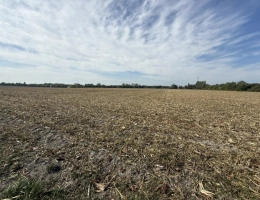
The plains of the north, around Ruffec, Villefagnan and Aigre, carry arable holdings on groie and champagne soils: durum wheat, oilseed rape, sunflower and maize wherever irrigation is secured. Eastwards and to the south-east the land closes in and beef takes over, usually on grass-based systems over acid soils. Goat units, an extension of the Poitou cheese basin, mark the north-eastern edge, and mixed farming bridges the two worlds.
To these add more scattered productions: walnut groves in the Charente valley, small blocks of orchards, contract poultry units. A working farm whose parcels fall inside the regional appellation area trades on an altogether different scale of value, even with no vines planted: have that classification confirmed before any comparison, since it explains most of the price gaps recorded in the department.
The centre and west, from Cognac to Segonzac and Jarnac, belong to the champagne and borderies crus: land is dearest there and non-vine farming marginal. The north, from the Ruffécois to the Charente valley, offers the most consistent cereal ground and a market driven by enlargement. The south, around Barbezieux, Montmoreau and Chalais, mixes outlying vineyard, crops and livestock on more varied soils, often with substantial sets of buildings. The Charentaise Double, west of Montmoreau, adds sandy, wooded ground suited to extensive systems and to projects that pair farmland with standing timber.
To the east, the Confolentais and the edges of the Montmorélien form the entry-level district: bocage, pasture, medium-sized livestock holdings and the lowest land values in the department. That is where complete units, buildings included, come free most regularly, and where blocks of bare farmland allow a structure to be consolidated.
Water governs any spring-crop project: the Charente basin sees recurrent low-flow tension, collective management of abstractable volumes and frequent summer restrictions. Check where the resource comes from, whether an abstraction licence exists, whether the holding is attached to a substitution reservoir, and what orders it has been subject to in recent seasons. An irrigated holding without a guaranteed volume is not worth the same as one whose water right is established, at comparable area and soil. Priority catchment zones in the north of the department call for the same scrutiny, since action programmes there govern how crops may be grown.
Rural law then applies its filters. SAFER Nouvelle-Aquitaine is notified of sales and may pre-empt, with particular attention to land inside the appellation area. The authorisation to farm is assessed against the regional structures plan, which ranks applicants against each other. Finally, an agricultural property already let stays occupied: the tenant holds a first-rank right to buy, and recovering let land is subject to restrictive conditions.
Charente farm property splits into two markets that barely meet; start by ruling the appellation area in or out, then refine by production, by area and by budget. The e-mail alert will flag listings matching that framing. Owners preparing to wind down can entrust their property to us directly. To widen the search, see farms for sale in Nouvelle-Aquitaine.