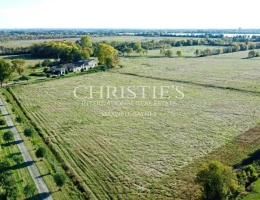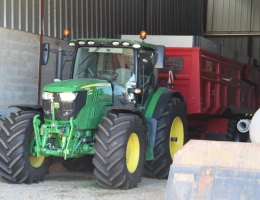
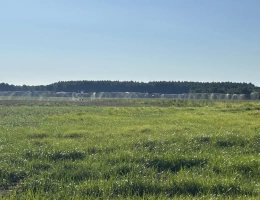
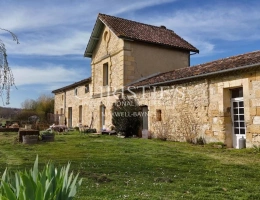
Looking at farms for sale in Gironde means, first of all, looking at what the vine does not occupy. The Bordeaux vineyard covers a very large share of the department and belongs to another category of the site; the farming dealt with here survives around it, on the alluvial flats of both riverbanks, the sandy soils of the south-west, the grassland of the northern Medoc and the small valleys of the Entre-deux-Mers. Owners winding down, notarial offices in Bordeaux, Libourne and Bazas, rural property agencies and succession advisers send us these holdings, stating area, soil type, access to water, buildings and how the parcels are occupied. This Gironde selection adds to the wider set of farms for sale in France.
Listings say what is for sale, not what it is worth: the rest of this page gives the real level of non-wine land values in the department, the districts where area comes free, the productions that still find room here and the checks that precede any offer. While the project is still taking shape, our white paper « Créer une exploitation agricole » (in French) helps set its scope and timetable.
Land forms the base of a farm's value. DVF, the property sales database published by the French tax administration (vineyards excluded), records a 2025 median of €5,000 per hectare in Gironde (33), an average of €5,536 and 85 sales; four transactions in five fall between €2,244 and €8,978, against a national median of €5,307.
The SAFER land value benchmark sets €8,340 per hectare for vacant land and pasture offered for sale in the same year, -2.7% over one year and +56.5% over ten, against €6,460 nationally. SAFER publishes no local figure for let land, too few sales being recorded; nationally, land sold with a farm tenancy in place trades at a discount of about 17%.
Against the Nouvelle-Aquitaine region, whose median is €4,538 per hectare, this department sits 10% higher. For commune-level detail and comparisons with neighbouring areas, see our land price observatory, then cost your purchase with our financial calculators.
On the sands of the Val de l'Eyre, the Pays de Buch and the edge of the Landes, irrigated arable holdings grow maize, seed maize and field vegetables on free-draining soils that make water indispensable. Around the city and in the Blaye country, market gardening holds a long-standing place: asparagus, sand-grown carrots, seasonal vegetables and short supply chains feeding Bordeaux. The flood-prone alluvial flats of the Garonne and the Dordogne carry hay and grazing meadows worked by cattle enterprises, with the Bazadaise breed still present in the south of the department.
Add tree nurseries and horticultural units in the urban belt, plus poultry and waterfowl enterprises in the Bazas country and the far south. These systems share one trait: value lies less in area than in equipment — pumping station, irrigation network, glasshouses, cold store, approved building. Establish the age of those installations and what bringing them up to standard would cost, which often exceeds the discount granted on the land price.
The northern Medoc, beyond the most sought-after appellation communes, keeps grassland, low-lying ground and livestock holdings in an area where vineyard pressure clearly eases. The Entre-deux-Mers is largely under vine, but its valleys — the Dropt, the Engranne, the Gamage — hold meadows and cropped parcels that recent vine grubbing has made more reachable. The Bazas and La Reole country, to the south-east, forms the most straightforwardly agricultural part of the department, with livestock, cropping and far less strained land values.
Westwards, the Val de l'Eyre and the approaches to the Arcachon basin face competition from both forestry and coastal building. Close to Bordeaux itself, farming gives way to housing and logistics: the few properties that appear trade at levels unrelated to their productive potential, and rarely pass to a farmer. An agricultural property there is almost always an asset play.
Access to water is the main technical point: the deep aquifers are under managed allocation and agricultural boreholes require authorisation, with volumes granted and later revisable. On the alluvial flats and in the valleys, add the question of flooding, of the ditch network and of the upkeep obligations attached to the water structures, which govern whether a meadow can be worked as much as soil quality does. The planning classification deserves checking too: proximity to building land distorts any price comparison.
On the legal side, three matters to settle. SAFER is notified of the sale and may substitute itself for the buyer. The authorisation to farm is assessed against the regional reference framework for farm structures used in Nouvelle-Aquitaine. Finally, a large share of Gironde land is let: rented farmland changes hands with the tenant attached, and that tenant may buy ahead of anyone else, so the area a newcomer can actually take over shrinks accordingly.
Non-wine farming supply is narrower here than elsewhere in the region, and the interesting properties move fast. Register an e-mail alert as soon as your requirements are settled, entering the sector and the district before the budget, otherwise the search returns mostly vineyard properties. Sellers post their listings freely. To widen the field, browse farms for sale in Nouvelle-Aquitaine.