

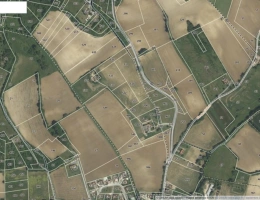
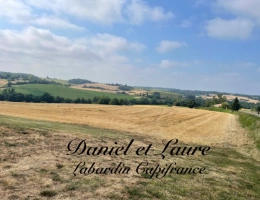
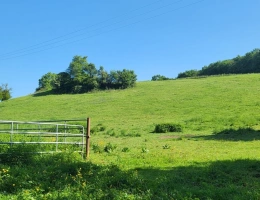
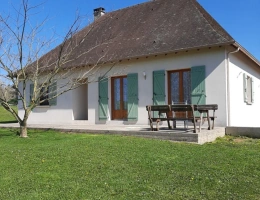
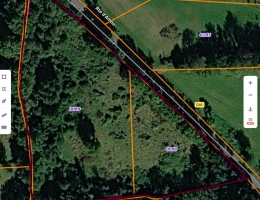
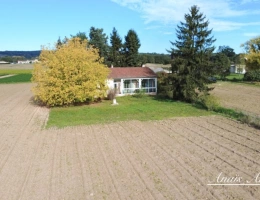
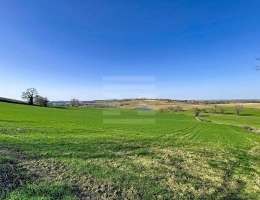
A goat farm for sale in Charente sits inside the foremost caprine basin in France: the department milks numerous herds, often of substantial size, whose milk feeds regional dairies and, less frequently, an on-farm cheese room. The properties gathered on this page are entrusted to us by breeders arranging their handover, by agencies specialising in working farms and by notaries in the Ruffécois, the Angoumois and the Charente limousine; the listings state how many dairy goats are milked, the type of shed, the milking equipment, the forage area and where the milk goes. They join our national catalogue of goat farms for sale.
Alongside the listings come the benchmarks that are usually missing: what local land is worth depending on whether it borders the vineyard, the districts where a holding comes free, the condition of buildings and milking blocks, and the checks required of a unit delivering to a dairy. Our white paper « Créer une exploitation agricole » (in French) supports both a start-up and a takeover.
Land weighs heavily on the budget for a goat farm. Transfers published by the French tax authorities (DVF, excluding vineyards) put the median for farmland in Charente (16) at €4,500/ha in 2025, with an average of €4,708/ha over 182 sales. Eight transactions in ten settle between €2,987 and €6,977/ha, where the national median is €5,307/ha.
A second reference, the SAFER land value benchmark, sets vacant land and pasture at €4,970/ha for 2025, -0.4% in a year and +12.4% over a decade; the French average is €6,460/ha, and a sitting tenant costs a plot roughly 17% of its value.
The worth of a dairy goat holding here depends less on acreage than on the working tool: the size and comfort of the shed, the parlour and its washing system, the bulk tank, silos and hay storage, compliant slurry store and muck pad, and the building kept for replacement stock. The animals count next, through their breeds, their management and their capacity to renew themselves, then the outlet: a collection contract, an organic commitment or a retail customer base. Cross-check all of it with our land price observatory and our financial calculators.
Charente units stand out for buildings designed with goats in mind, often large, timber-clad or in insulated sheeting, with wide bedded areas and a central feed passage. The visit turns on the atmosphere inside, since summer heat bears down hard on the plain: height under the ridge, openings, air movers, shade over the collecting yard. The milking block structures the value, whether a conventional platform or a rotary installation, with its washing system, its metering and the tank capacity. Forage and concentrate storage, the compliance of slurry store and muck pad, and the condition of the young stock building, too often overlooked, complete the picture.
Few holdings process their own milk, but those that do own a cheese room, a drying room, a cellar and a sales point valued separately, according to the approval held and the customers behind it. For the rest, the collection contract is the decisive asset: which dairy, what volume, the price grid and any organic specification. A holding often comes to market as a complete farmstead; in that case insist on a breakdown between the Charente farmhouse, the working buildings and the land itself.
Supply concentrates in the north, in the Ruffécois around Ruffec, Villefagnan and Aigre, where the arable plain supplies straw and forage and where goats have long been part of the farming pattern. Eastwards, the Charente limousine, from Confolens to Chabanais and Saint-Claud, offers hedged grassland, more modest buildings and appreciably cheaper land. The south, between Montmoreau, Aubeterre and Chalais, mixes livestock, woodland and crops. By contrast the communes of the Cognac vineyard, in Grande and Petite Champagne as in the Borderies, keep their land for vines, at the highest prices in the department.
The Chabichou du Poitou designation area lies mainly over Deux-Sèvres and Vienne, further north: in Charente, value therefore comes first from regional milk collection, completed locally by markets, producers' shops and farm-gate sales. Being close to Angoulême, to Cognac and to the roads towards Poitiers and Bordeaux eases both selling and the search for hired labour.
Herd sizes in Charente often place the unit under registration, or even authorisation, within the French classified installations regime, while smaller herds fall under simple declaration or the departmental health regulation; the change of operator is notified to the prefecture, and the order in force deserves close reading, particularly on siting distances, storage and muck spreading. Check the spreading plan and the agreements made with neighbouring arable farmers, common on the plain. Finally call for the health record: CAEV monitoring, the caprine arthritis-encephalitis virus, paratuberculosis screening, official testing results and cell counts.
A goat cheese farm or a milk-delivering unit is also judged on its commitments: how long the collection contract still runs, the shares held in the cooperative, organic certification to be confirmed with the certifying body, machinery owned jointly or through a shared equipment cooperative. Water, a sensitive matter in a department subject to summer restrictions, justifies checking the resource and the abstraction permits. Rural leases continue with the buyer subject to the landlord's agreement, and the deal passes through the structures control, the French authorisation regime for taking over farmland, then through SAFER.
This page fills up with sales entrusted by working farmers, by rural estate agencies and by notarial offices across Charente. Select on forage area, on budget or on whether a cheese room is attached, and set an e-mail alert: in a basin this sought after, a smallholding does not stay available for long. Handing yours on? Post the listing. Carry on to goat farms for sale in Nouvelle-Aquitaine.