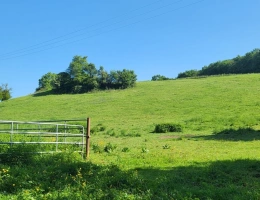
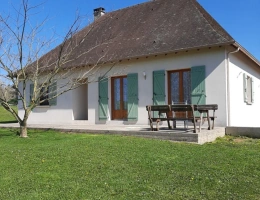
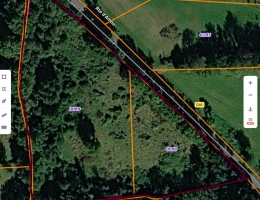
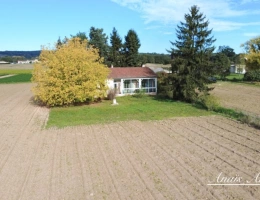
The market for a goat farm for sale in Nouvelle-Aquitaine has no equivalent elsewhere in France: Poitou and the Charentes make up the country's leading goat milk basin, with substantial herds, dairies that collect the milk and a dense network of farmhouse cheesemakers. The properties we publish reach us from farmers arranging their handover, from rural agencies and from notaries; they set out herd numbers, the type of building, the milking parlour, whether a processing workshop is included and the forage area. They join the rest of the goat farms for sale in France.
You will find more here than listings: the level of land prices in the region, the departments where a dairy goat holding most often comes up, the signs of wear to look for in a building and the controls the sector imposes. If the purchase is part of a setting-up project, our white paper « Créer une exploitation agricole » (in French) maps out the administrative and financial route.
Land weighs heavily on the budget for a goat farm. Transfers published by the French tax authorities (DVF, excluding vineyards) put the median for farmland in Nouvelle-Aquitaine at €4,538/ha in 2025, with an average of €5,135/ha over 2,103 sales. Eight transactions in ten settle between €2,500 and €8,190/ha, where the national median is €5,307/ha.
A second reference, the SAFER land value benchmark, sets vacant land and pasture at €5,770/ha for 2025, +5.5% in a year and +7.1% over a decade; the French average is €6,460/ha, and a sitting tenant costs a plot roughly 17% of its value.
Beyond pasture and rough grazing, value concentrates in the production tool: the housing and its straw-bedded areas, the milking parlour and how far it is automated, the bulk tank, the silos and forage stores, then the cheese dairy with its drying room, cellar and sales point where the farm processes. The herd, its genetics, its health status and either the collection contract or the customer base make up the rest of the price. To compare, open our land price observatory and test your plan with our financial calculators.
Holdings in the region range from the family herd run with a cheese dairy to the specialised milk unit delivering its whole output. In both cases, examine the frame and roof of the housing, the air volume, the layout of the bedded areas and feed barriers, the feeding and watering systems, then the parlour: number of units, automatic cluster removal, metering, washing and tank. Dairy goat holdings that have been re-equipped recently sell well above a set-up whose milking and ventilation are dated, because bringing them up to standard means heavy spending in the very first year after handover.
The herd is usually the most debated item. Alpine and Saanen animals dominate, with the Poitevine kept by a few breeders; yield per goat, regularity of lactations, replacement policy and screening results steer the discussion. Where the sale includes a house, sheds, pasture and rough grazing, ask for a price split before making an offer: the dwelling, the production tool, the animals and the stocks follow three different valuation logics and are not financed in the same way.
Deux-Sèvres, Vienne and Charente form the heart of the basin: sizeable herds, organised collection and the area of the Chabichou du Poitou PDO, where farmhouse processing is firmly rooted. Charente-Maritime extends that system with processing facilities and holdings that mix goats, cereals and sometimes vines. Vienne and Haute-Vienne offer land below the national average, which draws new entrants, while Creuse and Corrèze, grassy and enclosed, suit smaller herds run on home-grown forage with direct selling.
Dordogne, Corrèze and part of Lot-et-Garonne fall within the area of the Rocamadour PDO, a goat cheese appellation that shapes local outlets. Lot-et-Garonne and Gironde remain dominated by orchards and vines, where pressure on land often pushes livestock units aside. The Landes, heavily forested and geared to maize and poultry, count only a few goat herds. In the Pyrénées-Atlantiques, dairy sheep shape the mountain economy, yet a goat cheese farm is occasionally offered on the foothills, often with processing on site.
Because herds here are large, many units fall under the classified installations regime: declaration or registration according to numbers, change of operator to be notified to the prefecture, and siting and effluent storage requirements to read in the order before considering any enlargement. The health side weighs heavily on a big herd: CAEV and paratuberculosis status, Q fever management, worming plan, quality of the drinking water. Ask too for milk quality results from previous seasons, since they directly govern the price the dairy pays.
The collection contract is the other decisive point: contracted volume, remaining term, transfer conditions for the buyer and the processor's own policy should all be known before an offer is made. Where milk is sold direct, the approval held by the cheese dairy and the habits of the customer base are checked on site. Finally, much of the land is rented in this basin: the rural lease continues, the structures control applies and SAFER, the rural land agency, may pre-empt, so taking over a smallholding here is prepared well in advance.
The properties listed here come from farmers selling directly, from estate agencies specialising in rural property and from notaries across the region. Select the department, the area or the presence of a cheese dairy, then set up an alert: this basin has more would-be buyers than available farms. To widen the net, browse all farms for sale in Nouvelle-Aquitaine.