

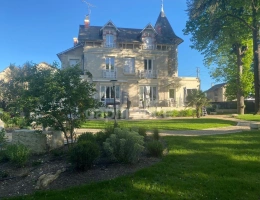
A historic monument for sale in Val-d'Oise readily brings to mind a Renaissance chateau in the Vexin français, an abbey or former priory in the Oise valley, or a half-timbered fortified farm typical of the arable plateau between Pontoise and Chaumontel. The department combines rural heritage still well preserved around Auvers-sur-Oise and L'Isle-Adam with valleys where, from the Renaissance onward, great families close to the court settled. This layered history explains why fortified farms and Renaissance chateaux so often stand within a short distance of one another. Browse the historic monuments for sale listed by the department's private owners, agencies and notaries.
This page describes the protected building types found in Val-d'Oise, the areas where they cluster, the obligations and grants attached to a classified or registered building, and the checks to make before buying, area by area. To place this project within a broader purchase strategy, read our guide to buying prestige property in France.
The classified chateau of Val-d'Oise often blends a Renaissance dressed-stone structure with classical additions from the seventeenth and eighteenth centuries, with corner turrets and tall slate roofs. The Vexin français plateau retains numerous fortified farms, surrounded by boundary walls and arranged around a square courtyard, while the Oise valley keeps traces of abbeys and priories converted into private residences after the Revolution. Locally cut limestone window surrounds appear on most of the classified facades of the plateau.
A residence to restore in this territory frequently comes with large outbuildings: tithe barns, square dovecotes typical of the Vexin, farm outbuildings and sometimes an attached seigneurial chapel. The main house most often retains its original panelling and fireplaces, while the barn roofs and the masonry of the boundary walls need particular attention when buying. Vaulted cellars, common beneath these houses, also deserve a careful check of their drainage and access.
The Vexin français, between Pontoise, Chaumontel and Marines, holds the greatest concentration of fortified farms and seigneurial residences amid an arable plain protected as a regional nature park. The Oise valley, from Auvers-sur-Oise to L'Isle-Adam and Beaumont-sur-Oise, offers properties on gentle slopes overlooking the river, while the Luzarches and Écouen area, closer to the Paris-region Vexin, retains heritage tied to the former royal court. To the southeast, towards Sarcelles and Garges-lès-Gonesse, urbanisation greatly limits the presence of this type of property. The L'Isle-Adam and Carnelle forests provide a wooded setting sought after for properties in the Oise valley.
The department has a TGV station at Roissy - Charles-de-Gaulle airport, linking directly to several regional and international hubs, complemented by Transilien lines H and J towards Paris; the A15 motorway and the RN1 cross the territory from north to south. The most sought-after areas lie in the Vexin and the Oise valley; the north-east of the department, more rural, offers comparable properties on more measured terms, particularly for fortified farms needing extensive restoration.
First find out the exact degree of protection: a classified building requires approval from the regional heritage office for any work, a registered building a less demanding prior notification. Around Écouen and the surroundings of major buildings in the Vexin, the Architecte des Bâtiments de France also reviews projects on unprotected structures situated within the surroundings perimeter. The Vexin français's status as a regional nature park also adds specific landscape rules, to be cross-checked against those of the monument itself.
The historic-monument tax regime applies under precise conditions; have its eligibility checked by a professional before committing. Selling a classified building requires the buyer to be informed of its status and the administration notified; entrust work on tithe barns and old masonry to a qualified contractor, and have the foundations of buildings near the Oise checked, as they are exposed to rising damp. Finally, check the availability of a Fondation du patrimoine grant for restoring dovecotes and tithe barns.
Historic monument listings in Val-d'Oise are placed by private owners, agencies specialising in character properties and notaries; refine your search by protection type, land and outbuildings, and set an e-mail alert to follow new listings. To compare with neighbouring departments, browse the historic monuments for sale in Île-de-France.