

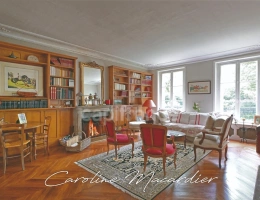
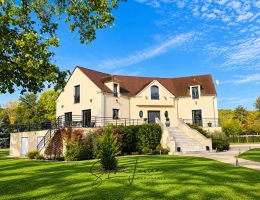
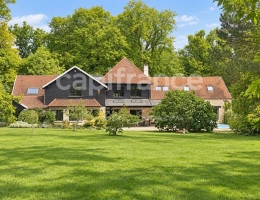
A historic monument for sale in Yvelines often takes the form of a classically styled chateau on the fringes of Versailles, a Grand Siècle townhouse in Saint-Germain-en-Laye, or a manor house in the Chevreuse valley dating from the seventeenth and eighteenth centuries. The closeness of the royal court left behind a dense heritage of noble residences, hunting lodges and farm outbuildings scattered across the Vexin français, the Rambouillet forest and the Seine river loops. Browse the historic monuments for sale listed by the department's private owners, agencies and notaries.
This page sets out the protected building types found in Yvelines, the areas where they cluster, the obligations and grants attached to a classified or registered building, and the checks to make before buying. To place this project within a broader purchase strategy, read our guide to buying prestige property in France.
The classified chateau of Yvelines is recognisable by its dressed-stone facades punctuated with pilasters, its Mansart-style slate roofs and its courtyards of honour flanked by matching outbuildings. In the outskirts of Versailles and Saint-Germain-en-Laye, the townhouse takes over, with restrained street facades and enclosed gardens set within the block, while the Rambouillet and Marly forests still hold hunting lodges and forester's houses linked to the former royal hunts. Wrought-iron gates, double-flight front steps and terraced flower beds often complete the composition of the department's grand classical residences.
The residences to restore of the Vexin and the Mantois area stand out for their rendered timber framing, round dovecotes and partly filled-in moats. The outbuildings, orangeries, ice-houses and stables are often the most deteriorated volumes, while the main house, better maintained through successive owners, retains its original panelling, flooring and fireplaces. Roofs and roof timbers remain the main item to renew across these large old volumes, along with the drainage systems of these extensive properties, often installed in successive stages over the twentieth century.
The Seine valley, around Poissy, Meulan and Mantes-la-Jolie, holds bourgeois residences and a few fortified ensembles overlooking the river. The Versailles - Saint-Germain-en-Laye - Marly-le-Roi triangle, where court aristocracy once settled, remains the most sought-after area for a classified or registered building. The Chevreuse valley, around Chevreuse, Dampierre and Le Perray-en-Yvelines, and the Houdan district, around Houdan and Montfort-l'Amaury, offer manor houses and seigneurial residences in a more rural setting. To the north, the Vexin français, between Meulan and the Val-d'Oise boundary, retains fortified farms and dovecotes protected under regional heritage rules. Between these two poles, the Plaine de Versailles, protected as a landscape, imposes its own planning constraints around the large estates.
The department has no station with regular TGV service; Versailles-Chantiers nonetheless handles a few high-speed departures, and Paris is otherwise reached by RER A, Transilien lines and the A13, A12 and A10/A11 motorways. The most sought-after areas remain those close to Versailles and Saint-Germain-en-Laye; the Vexin and Houdan districts offer comparable properties on more accessible terms, particularly for residences requiring a substantial works programme.
First establish the level of protection: a classified building requires prior approval from the regional heritage office for any works, while a registered building is subject to lighter but still mandatory oversight. Close to the Chateau de Versailles and the Saint-Germain-en-Laye estate, the Architecte des Bâtiments de France also reviews projects on plots within the surroundings perimeter, including for outbuildings that are not themselves protected. It is also worth asking about any rights of way inherited from the estate's former farming uses.
The historic-monument tax regime allows, under conditions, part of the restoration costs to be deducted; have the precise eligibility of the building and the works programme checked by a professional before committing. Selling a classified building requires the buyer to be informed of its status and the administration to be notified; entrust the works to a qualified contractor experienced with period materials, and have the roof timbers, slate coverings and services, often dated in these large ensembles, inspected. Finally, check any public-opening conditions that may be tied to a Fondation du patrimoine grant.
Historic monument listings in Yvelines come from private owners, agencies specialising in character properties and notaries; refine your search by protection type, floor area and outbuildings, and set an e-mail alert to follow new listings. To widen the search to neighbouring departments, browse the historic monuments for sale in Île-de-France.


