

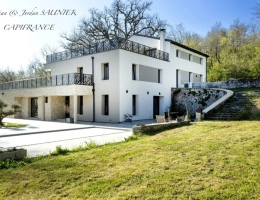
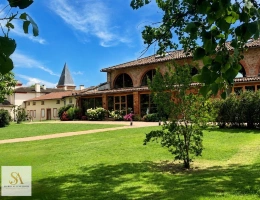
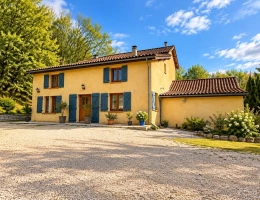
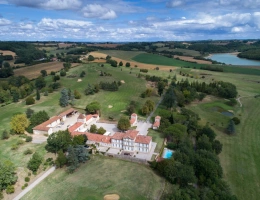
A historic monument for sale in Haute-Garonne most often appears in the pink brick of the Lauragais plain or the grey stone of the Pyrenean foothills around the Comminges. The department retains a heritage shaped by the woad trade of the fifteenth and sixteenth centuries, river commerce on the Garonne, and its proximity to the mountains towards the Luchon area. Classified chateaux, townhouses in old Toulouse, abbeys in the Volvestre and farming manors make up this protected heritage, often surrounded by parkland, dovecotes or old wine-making outbuildings. Browse the historic monuments for sale listed by the department's private owners, specialist agencies and notaries.
This page sets out the protected building types found in Haute-Garonne, the areas where they are most common, the obligations that come with classified or registered status and the grants available for restoration, without any budget or cost discussion. To place the purchase of a protected residence within a broader approach, read our guide to buying prestige property in France.
In the Lauragais and around Toulouse, a historic monument is recognised by its pinkish-orange fired brick, shallow-pitched canal-tile roofs and a main house arranged around a courtyard closed by an arched gateway. Towards the Comminges and the Pyrenean foothills, limestone or river cobble replace brick, with steeper slate roofs as the land climbs towards the mountains. Toulouse townhouses, many of them classified, retain carved façades, stone spiral staircases and inner courtyards lined with galleries.
The outbuildings matter as much as the main house: a raised or arcaded dovecote, a private chapel, a timber-framed wine store or barn, sometimes a mill on a stream feeding the Garonne. Many residences kept a farming role well into the twentieth century, which explains spacious outbuildings but sometimes plain interiors. Recent restoration campaigns favour ochre-tinted lime renders, oak framing sourced from the Comminges, and insulation compatible with thick solid-brick walls.
Around Toulouse, the areas of Lanta, Verfeil, Villefranche-de-Lauragais and Revel hold protected residences linked to the woad trade and large cereal estates. To the west, the Volvestre and the Save valley, around Carbonne and Rieumes, offer a more rural setting mixing fortified farms and small chateaux. To the south, the Comminges, from Saint-Gaudens to Saint-Bertrand-de-Comminges and Aspet, keeps a dense religious and seigneurial heritage at the foot of the Pyrenees, extending to the Luchon area where nineteenth-century spa-town residences complete the picture. Each area follows a different logic, from farmland plain to Lauragais hillside and the first mountain foothills.
Toulouse-Matabiau station, served by TGV, anchors access from Paris and Bordeaux, while the A64 motorway links the Comminges and the Pyrenees and the A61 serves the Lauragais towards Carcassonne. The most sought-after areas stay close to Toulouse and the main routes; residences in the rural Comminges and the Volvestre, further from urban centres, remain more accessible for a comparable protected floor area.
Before any offer, establish whether the property is classified or only registered: classified status brings tighter oversight of works by the Architecte des Bâtiments de France, while registered status allows more latitude subject to prior declaration. Any exterior work, including within the surroundings, needs approval from the regional historic monuments office or the DRAC Occitanie before the project starts. The seller of a classified building must inform the buyer of this status and notify the administration of the sale, a formality that should not be overlooked in the deed.
The historic-monument tax regime, which allows certain costs to be deducted under conditions, should be checked with a professional before signing, along with any possible public-opening obligation. On the technical side, have the roof timbers and canal-tile covering inspected, since these are often old, as well as the condition of the lime renders; entrust any restoration quote to a qualified contractor recognised for historic-monument work, the only kind authorised to work on this type of building.
Historic monument listings in Haute-Garonne come from private owners, agencies specialising in character properties and notaries; narrow the search by type, area and outbuildings, and set an e-mail alert to follow new listings. To widen the search to neighbouring departments, browse historic monuments for sale in Occitanie.


