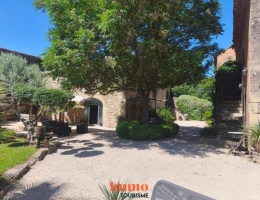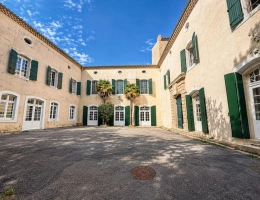
A historic monument for sale in Occitanie can be a Romanesque abbey on the Grands Causses, a Cathar chateau perched on its rocky spur, a pink-brick Toulouse townhouse or a fortified bastide town house in the Quercy. From the Pyrenees to the Mediterranean, by way of the Rouergue, the Quercy and the Languedoc, the region holds a considerable range of protected heritage, shaped by a long religious, military and rural history. You will find everything from a classified building already restored, outbuildings included, to a registered residence still awaiting full renovation. Browse the historic monuments for sale listed by the region's private owners, agencies and notaries.
This page sets out the protected typologies found across Occitanie, the areas where they cluster, the obligations and grants attached to a classified or registered building, and the checks to carry out before buying. To place this project within the wider approach to purchasing a character residence, read our guide to buying prestige property in France.
Materials trace the geography: pink brick in Toulouse and the Lauragais, pale limestone and lauze across the Grands Causses and the Aveyron, river pebbles and timber framing toward the Adour and the Gers, schist and granite in the Ariège Pyrenees, volcanic stone in places across the Lozère. The dominant typologies are the perched fortified chateau inherited from the crusade against the Cathars, the Romanesque abbey and priory, the fortified bastide town house of the Quercy and Tarn-et-Garonne, and the town mansion of Toulouse or Montpellier. Mills on the Tarn, the Aveyron or the Hérault complete this built heritage.
Outbuildings, a Gers dovecote, a seigneurial chapel, a dry-stone barn or a wine store, are often protected on the same footing as the main house. Many of these residences retain original features, vaults, fireplaces or wall paintings, while still standing as a residence to restore rigorously, particularly the very heavy lauze roofs. Recent projects favour local materials and contractors trained in limestone and timber-frame techniques.
The Hautes-Pyrénées and the Gers, around Tarbes and Auch, retain a dense rural and spa-town heritage. The Haute-Garonne, around Toulouse, and the Pyrenean Ariège complete this Occitan core. The Aude, between Carcassonne and Narbonne, and the Pyrénées-Orientales, around Perpignan, bring together Cathar chateaux and Catalan heritage, partly coastal. The Hérault and the Gard, from Montpellier to Nîmes, add Languedoc heritage that is also coastal around Sète and Aigues-Mortes. The Lozère, the most rural, and the Aveyron retain a well-preserved causse building tradition. The Tarn, the Tarn-et-Garonne and the Lot, finally, hold bastide towns, mills and Quercy residences around Albi, Montauban and Cahors.
Toulouse-Matabiau, Tarbes, Narbonne, Carcassonne, Perpignan, Montpellier, Nîmes and Montauban are served by TGV, while the Gers, the Ariège, the Lozère, the Aveyron, the Tarn and the Lot remain linked by Intercités and TER trains. Only the Aude, the Gard, the Hérault and the Pyrénées-Orientales front the Mediterranean; coastal areas and the outskirts of Toulouse rank among the most sought after, while the Lozère, the Aveyron and inland Gers remain markedly more affordable.
Check first whether the property is a classified building or a registered building: the former is subject to stricter oversight from the Architecte des Bâtiments de France and the regional heritage office for any works, including to its surroundings, while the latter allows more latitude for routine work. The historic-monument tax regime, which allows certain costs to be deducted, applies under conditions, to be checked with a notary, along with any grants available from the Fondation du patrimoine or the Occitanie regional heritage office.
Bear in mind that a protected property cannot change hands without the buyer being told of its status and, for a classified building, without the administration being notified; check that the seller has already taken care of this. On the technical side, have the lauze or canal-tile roofs checked, since they are heavy and costly to repair, the stability of dry-stone walls on sloping sites, and rural drainage systems; entrust quotations to a qualified contractor trained in Occitan heritage restoration techniques.
Historic monument listings in Occitanie come from private owners, agencies specialising in protected residences and notaries; filter them by protection status, outbuildings and works already carried out, and set an e-mail alert to follow new listings. To widen your search to the region's full range of high-end properties, browse prestige property for sale in Occitanie.