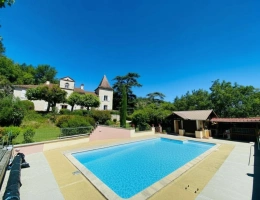
Finding a historic monument for sale in Lot most often leads towards the cliffs of the Lot valley, the limestone causses of the Quercy or the lanes of Cahors and Figeac, where medieval merchants' residences stand alongside chapels and fortified mills. The karst relief and rivers of the department have shaped a varied stock of protected buildings, from the castle perched on a rocky spur to the abbey church tucked into a wooded valley. Properties range from a residence already restored and sometimes open to the public to a dry-stone building still entirely to renovate. Discover the historic monuments for sale listed by the department's private owners, agencies and notaries here.
This page lists the protected building types found in Lot, the areas where they cluster, the obligations tied to a classified building or a registered one, and the checks worth making before buying, without ever touching on financial matters. To place this project within a wider approach, read our guide to buying prestige property in France. Financial support for restoration, whether DRAC subsidies or backing from the Fondation du patrimoine, is generally tied to opening the property to the public, a condition to weigh up case by case.
Protected buildings in Lot rest almost entirely on the golden limestone of the causses, cut into rubble stone for main houses and into thin slabs for the stone-slab roofs typical of the region, notably around Gramat and Martel. Castles perched on a rocky spur above the Lot or Célé valley often pair a medieval defensive tower with a main house reworked in the Renaissance, featuring mullioned windows and corbelled corner turrets. Merchants' residences in Cahors and Figeac, meanwhile, retain Gothic façades and arcaded inner courtyards.
Typical outbuildings include the Quercy dovecote on a pillar or built into the house, the dry-stone hut scattered across the causse's vines and pastures, and water or wind mills depending on the area. A residence to restore frequently retains beamed ceilings, Gothic fireplaces and rock-cut vaulted cellars, while stone-slab roofing demands specific know-how to maintain. Some Quercy cellars retain rock-cut recesses once used to store grain, a practical response to the causse's thin soils and limited timber.
Cahors, nestled in a bend of the Lot, and its immediate surroundings hold townhouses and fortified residences, while Saint-Cirq-Lapopie and the Lot valley towards Puy-l'Évêque bring together much sought-after clifftop castles. Figeac and the Célé valley, to the east, offer merchants' residences and mills set in more rugged terrain. To the north, the Dordogne valley, towards Souillac and Martel, and the Causses du Quercy regional park, around Gramat and Rocamadour, offer more isolated limestone buildings, generally more affordable than those along the Lot's banks.
Lot has no TGV station: rail access relies on Intercités and TER links to Paris and Toulouse, with a change possible at Brive-la-Gaillarde or Toulouse-Matabiau depending on the destination. The most sought-after areas remain the outskirts of Cahors and the Lot valley; the causses around Gramat and Martel offer comparable buildings in a more rural setting. Beyond rail links, the departmental roads threading the Lot and Célé valleys connect Cahors to Saint-Cirq-Lapopie and Figeac without difficulty.
Establish from the outset whether the property is classified as a historic monument or only registered, since the works authorisation regime differs, and any intervention within the surroundings of a protected building, outbuildings included, requires approval from the Architecte des Bâtiments de France after review by the regional heritage office. Selling a classified building requires informing the buyer of its status and notifying the administration, a formality the notary builds into the deed of sale. Requesting copies of any past authorisation decisions from the Bâtiments de France office is also worthwhile, since they show what work has already been cleared.
The historic-monument tax regime, which under conditions allows certain restoration works to be deducted, deserves thorough verification with a specialist adviser before any decision. On site, have the stability of the foundations checked for castles built on a limestone spur, the condition of the stone-slab roofing, and hand any restoration to a qualified contractor skilled in dry-stone and stone-slab techniques. A borescope inspection of the roof timbers is also worth arranging in the wooded valleys of the Lot and Célé, where wood-boring insects thrive in a humid climate.
Historic monument listings in Lot come from private owners, agencies specialising in Quercy protected heritage and notaries; filter them by building type, protection status and the presence of outbuildings, and set an e-mail alert to hear about new listings. To widen the search to the region, browse the historic monuments for sale in Occitanie.