
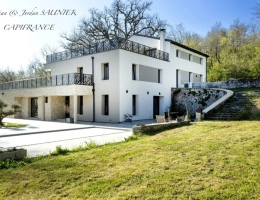
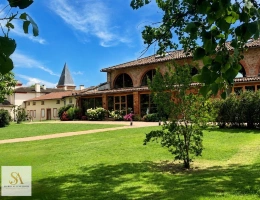

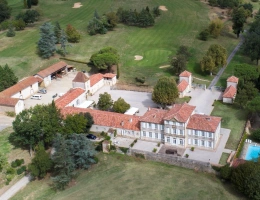
A luxury property for sale in Haute-Garonne is often recognisable by its pink or terracotta brick, inherited from the tile works of the Garonne valley, whether it is a Toulouse master house in one of the old suburbs, a Lauragais manor raised during the woad-dye boom, or a character residence set against the Volvestre hillsides. The department thus brings together the wine-growing and cereal-farming outskirts of Toulouse, the rolling hills of the pastel country and the first foothills of the Pyrenees in the Comminges district. Browse every luxury property for sale listed by private owners, agencies and notaries in Haute-Garonne.
This page gathers real price benchmarks observed across these different markets, a tour of the sought-after areas around Toulouse and towards the Pyrenees, the materials and volumes typical of local buildings, and the points to check before buying a large residence in the Lauragais or the Comminges. It also covers the current uses of these properties, from family homes to equestrian activity or bed-and-breakfast ventures aimed at visitors. To plan your purchase, read our guide to buying luxury property in France.
Our observatory tracks, in the DVF land registry data published by the French tax administration, sales of houses over 300 m² of living space on 0.05 to 10 ha of land, above €1,000/m²: chateaux, manor houses, master houses, villas and large rural residences. The benchmarks below are based on these actual sales, after removal of outliers; an estate of more than 10 ha or a listed monument sold with its farmland is excluded.
In Haute-Garonne, 119 sales of luxury properties were recorded between 2021 and 2025. The median price stands at €656,000, with an average of €740,800; the floor/ceiling range (P10–P90) runs from €415,900 to €1,150,200. The median price per square metre of living space reaches €1,753/m², for properties averaging 379 m² of living space on 14,242 m² of land. The department therefore sits 1% below the regional median (€662,500 in 2025) and below the 2025 national median (€822,000).
| Scope | Sales | Median price | Average price | Floor – ceiling (P10–P90) | €/m² living space |
|---|---|---|---|---|---|
| Haute-Garonne (2021-2025) | 119 | €656,000 | €740,800 | €415,900 – €1,150,200 | 1,753 |
| Occitanie (2025) | 126 | €662,500 | €856,900 | €430,000 – €1,477,000 | 1,804 |
| Occitanie (2021-2025) | 723 | €640,000 | €747,000 | €410,000 – €1,208,500 | 1,735 |
| France (2025) | 981 | €822,000 | €1,321,400 | €428,000 – €3,100,000 | 2,308 |
| Year | Sales | Median price | €/m² living space |
|---|---|---|---|
| 2021 | 202 | €633,600 | 1,706 |
| 2022 | 194 | €615,500 | 1,701 |
| 2023 | 105 | €625,000 | 1,833 |
| 2024 | 96 | €675,400* | 1,735 |
| 2025 | 126 | €662,500 | 1,804 |
These benchmarks place an asking price within its market; they do not replace a valuation of the property itself, whose worth depends on condition, architecture, outbuildings and setting. The breakdown by stratum (coastal, rural tourist, ordinary rural) and the full methodology are in our observatory of luxury property prices in France (in French). Then work out purchase costs and borrowing capacity with our financial tools and calculators, and prepare your project with our guide to buying luxury property in France.
Source: DVF (DGFiP), transactions from 1 January 2021 to 31 December 2025, processed by ma-propriete.fr; prices rounded to the nearest €100.
Around Toulouse, terracotta brick dominates the facades of bourgeois residences, with their stepped cornices and painted shutters, while the Lauragais manors, built during the fortune brought by the woad dye trade, often keep turrets and service wings arranged around a courtyard. Towards the Volvestre and the Comminges, limestone and river pebble gradually replace brick, under slate roofs that signal the nearby Pyrenees. These residences are frequently sold with barns, dovecotes or former silkworm houses converted into extra living space or guest cottages. Freestanding dovecotes, once a mark of seigneurial status, are sometimes found on their own within a park planted with plane trees or cedars, a short walk from the main house.
The condition of roofs and lime renders deserves particular attention on older buildings, as does the timber frame of barns when they are intended for conversion into living space. Lauragais properties often come with cereal land or vines still under cultivation, which means separating the value of the buildings from that of the adjoining farmland. Stables and riding arenas, a legacy of a strong equestrian tradition in the Volvestre, are also a feature sought by a number of buyers.
The Lauragais, between Villefranche-de-Lauragais and Revel, concentrates manors and master houses amid rolling fields; the Volvestre, around Rieumes and Carbonne, offers more rural buildings along the Garonne. To the south, the Comminges district and its main town, Saint-Gaudens, open onto the first Pyrenean valleys, where a handful of older residences overlook wooded slopes. To the east, the Fronton hillsides and the wine-growing part of the Lauragais also hold sought-after properties, while the immediate outskirts of Toulouse, around Lespinasse or Fonbeauzard, remain in strong demand for their closeness to the city. Further north, the Girou valley and the Fronton district, set among vines and orchards, round out the picture with master houses that draw less attention from Paris-based buyers.
Toulouse-Matabiau station, served by TGV in a little over four hours from Paris, together with Toulouse-Blagnac airport and the A61, A64 and A68 motorways, makes travel across the department straightforward. The immediate surroundings of Toulouse and the Fronton wine district show the highest levels, while the Comminges and the Volvestre remain markedly more accessible.
Manors and master houses listed or registered as historic monuments fall under the opinion of the Architecte des Bâtiments de France for any change to facades or roofs; check these easements before planning any extension. When the property is sold with farmland, the SAFER's pre-emption right may apply and any current farm leases need close review, as does the compliance of the drainage system, often non-collective in these rural communes. Ditches and irrigation systems inherited from former working farms are also worth checking where they still serve cultivated plots.
On the technical side, the timber frames of older barns and dovecotes call for a professional survey before any conversion into habitable rooms, and the heating systems of large houses are worth assessing early to anticipate the work involved. Also check the local plan if a new outbuilding or pool is being considered. In communes exposed to clay-shrinkage subsidence, common in this area, a check of the older buildings' foundations is also advisable before buying.
Luxury property listings in Haute-Garonne come from private owners, specialist agencies and notaries; narrow your search by property type, budget, living space and outbuildings, then set an e-mail alert to follow new properties as they come to market. To widen your comparison, browse the luxury properties for sale in Occitanie.



