




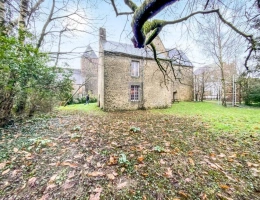
A maison de maître for sale in Sarthe can be spotted from afar by its russet sandstone or its tuffeau, its regular bays, its short flight of front steps and its slate hipped roof: this is the house that linen weavers, cattle dealers, notaries and manufacturers of Le Mans, La Flèche and the Loir valley had built in the nineteenth century. This section goes further: it brings together all the fine residences of Sarthe, gentilhommières of the Perche, prestige longères of the Alpes mancelles, architect-designed properties and contemporary villas on the edge of the towns, as soon as the living space exceeds 300 m² or the price nears a million euros, provided the property is not a chateau, a manor house or a historic monument. Here you will find the maisons de maître and fine residences for sale placed by private owners, agencies and notaries across the department.
This page offers real price benchmarks for the larger houses of Sarthe, the profile of the properties now on the market, the features of local construction, the areas where these houses cluster and the checks to make before committing. To organise your search from first contact to signing, rely on our guide to buying prestige property in France.
Maisons de maître form the core of the segment tracked by our observatory: houses with more than 300 m² of living space on 0.05 to 10 ha, sold above €1,000 per m², recorded in the DVF database of the French tax administration. These benchmarks frame the market for large residences without describing it entirely: a small village bourgeois house or a chateau sold with 30 ha of parkland fall outside this scope.
In Sarthe, 58 sales were recorded from 2021 to 2025, with a median price of €575,000*, a floor/ceiling range (P10–P90) of €407,000 to €909,300 and a median of €1,647/m² of living space, for an average of 368 m² of living space and 17,849 m² of land. Across the Pays de la Loire region, the 2025 median stands at €750,000* (57 sales), against €822,000 in France in 2025 (981 sales).
| Scope | Sales | Median price | Floor – ceiling (P10–P90) | €/m² living space (median) |
|---|---|---|---|---|
| Sarthe (2021-2025) | 58 | €575,000* | €407,000 – €909,300 | 1,647 |
| Pays de la Loire (2025) | 57 | €750,000* | €442,000 – €1,355,600 | 2,006 |
| France (2025) | 981 | €822,000 | €428,000 – €3,100,000 | 2,308 |
The breakdown by stratum (coastal, rural tourist, ordinary rural) and the five-year trend are in our observatory of prestige property prices in France (in French). Before making an offer, work out purchase costs and borrowing capacity with our financial tools and calculators.
Source: DVF (DGFiP), transactions from 1 January 2021 to 31 December 2025, processed by ma-propriete.fr; prices rounded to the nearest €100. * Fewer than 100 sales: read as an indication only.
As of 28 September 2026, the section lists 267 properties in France (the section does not yet have enough listings in Sarthe for a reliable calculation) at a median asking price of €978,000 (average €1,520,334); 80% of properties are offered between €485,000 and €2,750,000, for a median living space of 372 m² on 1.0 hectare of land, or €2,864 per m² of living space. These are asking prices, before negotiation; they compare with the actual sale prices in the previous section, which are generally lower.
| Asking price | Listings | Share |
|---|---|---|
| under €500,000 | 33 | 12 % |
| €500,000 to €800,000 | 58 | 22 % |
| €800,000 to €1.2M | 70 | 26 % |
| €1.2M to €2M | 67 | 25 % |
| €2M to €5M | 31 | 12 % |
| over €5M | 8 | 3 % |
Statistics calculated on the listings published in the section on 28 September 2026; they change daily with new listings and withdrawals.
Russet sandstone, a brown stone rich in iron, dominates the centre and west of the department, often paired with white tuffeau quoins around the windows; in the south, the Loir valley shifts towards pure tuffeau and flat tiles. The notables' houses of the market towns, on two floors under a Mansard-style attic, stand beside the broader residences of linen and hemp manufacturers, with a carriage gateway and an enclosed garden. In the suburbs of Le Mans, the interwar years left brick and millstone villas, while recent landscaped developments host architect-designed houses opening onto large plots.
Outbuildings make up much of the value: sandstone service buildings, a bread oven, a dovecote, a caretaker's cottage, an orangery when the house belonged to an industrialist, then a pool and pool house in properties brought up to date, the whole often enclosed by a stone wall and planted with limes, hornbeams and cedars. Inside, buyers look for herringbone parquet floors, marble fireplaces, staircases with turned wooden balusters and high ceilings.
The Sarthe Perche, around Bonnétable, La Ferté-Bernard and Saint-Calais, offers country residences surrounded by woods and hedged farmland, popular with Parisians seeking space. The Alpes mancelles, towards Fresnay-sur-Sarthe and Sillé-le-Guillaume, appeal for their prestige longères and valley views. The Loir valley, from La Flèche to Château-du-Loir by way of Le Lude, concentrates tuffeau maisons de maître, some backing onto cave dwellings cut into the hillside. Le Mans and its first ring, from Sargé-lès-le-Mans to Arnage, form the most sought-after area; Mamers and the north of the department remain more affordable.
The Le Mans TGV station puts Paris within an hour and a half, and the A11, A28 and A81 motorways link the department to Angers, Tours and Rennes without detours. Buyers coming from the Paris region find a fine residence with grounds for the price of a suburban flat, and remote workers like to stay within reach of a station served by many TGV trains, which explains the attention paid to properties a few minutes from the city.
On older houses, start with the roof: ageing slate and oak or chestnut roof frames call for a full inspection, since a completely renewed attic weighs heavily in the negotiation. Tuffeau is frost-prone and decays with damp; the harder russet sandstone mainly suffers from crumbling joints. Clay soils expose the ground to shrink-swell movement, and floods on the Sarthe, the Huisne and the Loir mean consulting the flood-prevention plans before any offer.
In the Loir valley, cavities dug into the slope can lie beneath a garden or a courtyard: have their stability checked. For a recent property, confirm that the pool, the veranda and the extensions obtained their planning consents, and ask for the ten-year building guarantee certificates. A visit with a mason who specialises in stonework will spare you many surprises.
Listings of fine residences in Sarthe come from private owners, specialist agencies and notary offices; sort them by living space, plot size, the presence of outbuildings or a pool, then create an e-mail alert to receive each new arrival. To widen the comparison to neighbouring departments, browse the maisons de maître and fine residences for sale in Pays de la Loire.