

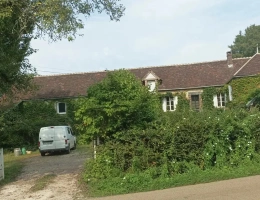
Between the wide arable plateaux of the north and the wooded hills of the south, Yonne offers a contrasted choice to anyone buying a poultry farm for sale in Yonne: houses run alongside a cereal rotation, laying units supplying eggs to shops and school kitchens, and farmhouse birds reared on range and sold at the farm or on markets. These properties are entrusted to us by farmers organising their handover, by rural agencies and by notaries, with the buildings, the equipment and the land set out in detail. They also appear on the national hub of poultry farms for sale.
This page carries what a listing leaves unsaid: what land is worth in the department, the areas where properties come free, the method for inspecting a livestock building, and the health and regulatory obligations of the sector. If a first setting-up is your horizon, our white paper « Créer une exploitation agricole » (in French) details every stage, from legal status to funding.
Land remains the largest item when buying a poultry farm. According to sales recorded by the French tax administration (DVF, vineyards excluded), the median price of agricultural land in Yonne (89) stood at €3,094/ha in 2025, with an average of €3,294/ha across 164 sales; 80% of transactions fall between €2,385 and €4,500/ha, against a national median of €5,307/ha.
The SAFER benchmark of land values (2025 figures) puts vacant land and pasture at €3,140/ha (-12.3% year on year, -14.7% over ten years), against a national average of €6,460/ha; land already let sells around 17% lower.
Beyond the land, a buyer is chiefly paying for a working tool: the design and condition of the house, insulation, ventilation, heating, silos and feed distribution, the egg room, collecting and grading equipment, fenced and planted ranges. The flock in place is appraised separately, as is membership of a producer group or, on farms selling direct, a customer book and market pitches held for years. To place an asking price, turn to our land price observatory and our financial calculators.
The local stock brings together enclosed, fan-ventilated broiler houses, farmhouse buildings opening onto grass range, floor-laying rooms fitted into old barns and, more rarely, aviaries. Faced with a broiler farm on the market, look at the frame and roof, the insulation, air renewal, heating, the floor and how easily it washes down, the biosecurity entry room, the washing bay, the silos and the feed auger. The open ground around the building deserves attention too: it decides whether an enlargement is possible and whether delivery and catching lorries can turn. Hard standing and a usable track matter as much in winter as the house itself.
Next comes the outlet. A unit working with a production organisation hands on a technical and commercial framework whose remaining term and takeover conditions should be read before any offer; a farm selling direct hands on customers, sometimes a cutting room and an approval to be transferred. Where the listing covers a complete property, with dwelling house, outbuildings and land, obtain a breakdown of the price between the production tool, the home and the ground itself.
The north of the department, from the Sénonais through the Gâtinais to the Joigny area, is arable country where land is dear and a poultry unit is usually found as diversification on a cereal holding. The plateaux of the Tonnerrois and the Auxerrois mix crops, woodland and vines, the latter tying up ground at values unrelated to a livestock project. The Puisaye, around Toucy, Saint-Fargeau and Saint-Sauveur-en-Puisaye, remains a country of small mixed farms, pasture and ponds: that is where an egg farm or a farmhouse unit most often comes up, complete with paddocks and outbuildings.
To the south-east, the Avallonnais and the Terre-Plaine, at the gates of the Morvan, keep a grassland character that suits free-range flocks, with more affordable buildings and less competition for a complete chicken farm than in the north. The motorway axis and the nearness of the Paris basin are a lasting commercial advantage for producers selling direct, while also sustaining demand for rural property, and therefore the prices asked on the best-placed farmsteads.
According to the number of birds kept, the holding falls under declaration, registration or authorisation as a classified installation under French law, and the incoming farmer notifies the prefecture. Read the applicable order before making an offer: old requirements can cap an extension project. Check the biosecurity plan, the rest period observed between batches, traceability and the housing measures that apply when avian influenza risk is raised. An egg packing station or a cutting room implies an approval whose transfer has to be prepared well ahead of completion, since a gap in cover means a gap in trading.
On the land side, rented parcels stay governed by the rural lease, which continues with the buyer subject to the landlord's agreement, and the operation remains subject to the structures control, the French authorisation regime for taking over farmland, and to SAFER's pre-emption right. Verify manure storage capacity, how well the spreading plan matches the area, any classification as a nitrate vulnerable zone, and the distance to dwellings. Separate valuations for buildings, equipment and land avoid a global figure nobody can justify.
Behind these listings stand owners selling without an intermediary as much as rural estate agencies and notaries' offices. Sharpen your criteria of area, budget, location or production, create an e-mail alert so that new entries in the department reach you promptly, and take the search on through all the poultry farms for sale in Bourgogne-Franche-Comté.