

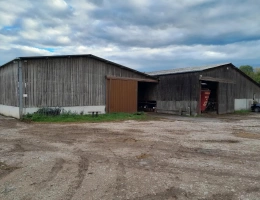
Hedged pasture, ponds and woodland, with some of the cheapest farmland in eastern France: that is the setting for a poultry farm for sale in Haute-Saône. Poultry here is a second string rather than a speciality, taking the form of table-bird units attached to a livestock or arable holding, laying rooms whose eggs supply Vesoul, Lure and the Montbéliard conurbation, and small farmhouse flocks sold at the gate or on local markets. Owners preparing a handover, rural agencies and notaries entrust the properties to us and set out the buildings, the equipment and the field pattern. The national view sits on our hub of poultry farms for sale.
This page adds the benchmarks the listings do not carry: what land is worth in the department, how supply divides between plain, plateau and uplands, how to judge a livestock building, and the timetable of regulatory formalities. If your plan is to set up, our white paper « Créer une exploitation agricole » (in French) gives the route to follow, from professional prerequisites to raising the money.
Land remains the largest item when buying a poultry farm. According to sales recorded by the French tax administration (DVF, vineyards excluded), the median price of agricultural land in Haute-Saône (70) stood at €2,615/ha in 2025, with an average of €2,727/ha across 156 sales; 80% of transactions fall between €1,999 and €3,577/ha, against a national median of €5,307/ha.
The SAFER benchmark of land values (2025 figures) puts vacant land and pasture at €2,660/ha (-1.5% year on year, +0.8% over ten years), against a national average of €6,460/ha; land already let sells around 17% lower.
Away from the hectares, most of the value sits in the building and its contents: roof and insulation sized for cold winters, ventilation, heating, silos, a tempered egg room, collecting and grading equipment. The flock is appraised on its own, with its stage of lay or finishing and its health record. A contract with an integrator, or conversely a book of short-chain customers, is a further asset to be priced in its own right. Our land price observatory and our financial calculators help frame the offer.
What comes up ranges from a recent poultry building, fan-ventilated and fitted with a compliant entry room, to an older farm volume converted into a floor-laying house, by way of mobile arks set out on grass, sometimes several of them on the same paddock. A careful buyer checks the roof and frame, sized for snow load, the quality of the insulation, air renewal, heating, how flat and washable the floor is, and how well the water system is protected against frost. On an egg farm, the nests, collecting belts, grader and egg store also come under scrutiny before any figure is discussed.
Few units here work under an integration contract: selling goes through shops, restaurants and nearby markets, so a takeover carries delivery arrangements that have to be confirmed one by one before signature. Farms that slaughter on site also pass on a workshop, a cold room and a health approval whose transfer decides whether trading continues uninterrupted. Where the sale bundles a dwelling house, pasture and woodland, ask for a clear split between the production tool, the home and the land.
Around Gray, Champlitte and Dampierre-sur-Salon, the Saône valley carries the most productive ground in the department, cropped with cereals and oilseeds; a poultry house there rounds out a rotation, and land changes hands at higher figures than elsewhere. The Vesoul plateau and the Jussey area mix pasture, crops and forest, and complete farmsteads come free there regularly as farmers retire. Eastwards, around Lure, Luxeuil-les-Bains and Mélisey, the land of a thousand ponds and the Vosges saônoises form grass country where poultry units stay small and often sell straight to visitors. A chicken farm found in these uplands usually comes with generous pasture and modest buildings.
The south-east, from Villersexel to Héricourt, benefits from the Belfort and Montbéliard urban area: customers are plentiful, but competition for built property is sharper. In the north and west, by contrast, a broiler farm can still be bought at a contained price, usually with older buildings that will need work on ventilation and insulation. Opening the search across several areas remains the surest route to a purchase, since supply renews itself slowly.
Depending on the number of birds kept, the unit falls under declaration, registration or authorisation within the French classified installations regime, and the incoming farmer must make himself known to the prefecture. Read the order in force, the biosecurity plan, the way the rest period between batches is handled and the housing measures that apply when avian influenza risk rises, which bite hardest on free-range flocks with outdoor access. An old prefectural order can also carry requirements that have quietly become restrictive. Check too the manure storage capacity, the validity of the spreading plan and whether the parcels sit in a nitrate vulnerable zone.
Land deserves the same rigour: rented parcels stay governed by the rural lease, which continues with the buyer subject to the landlord's agreement, and the deal passes through the structures control, the French authorisation regime for taking over farmland, and through SAFER. Check the distance to third parties, decisive for any extension, the state of the access tracks, and the easements attached to ponds and watercourses, which are common in this department. Valuing buildings, equipment and land separately protects the negotiation.
The properties shown on this page are put online by private owners as much as by rural estate agencies and notaries. Adjust the filters for area, price, budget or type of production, switch on an e-mail alert so that new listings reach you first, then widen the field to every one of the poultry farms for sale in Bourgogne-Franche-Comté.