
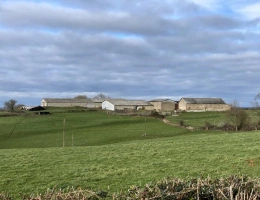

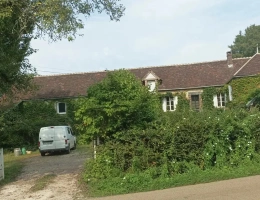
A land of hedged pasture, water and woodland ruled by the Charolais suckler herd, Nièvre offers anyone hunting for a poultry farm for sale in Nièvre a scattered but genuine supply: table-bird houses run alongside a grassland holding, laying flocks whose eggs reach nearby shops and markets, and farmhouse birds raised on planted ranges. Retiring farmers, rural agencies and notaries place these listings, and each states the built area, the production system, the equipment left in place and the land included in the sale. Nothing here is a converted barn: these are working holdings with a flock and an outlet. This local selection extends the national picture of poultry farms for sale.
Beyond the property descriptions, you will find farmland prices for the department, the areas where units come free, the points to inspect on a livestock building and the obligations specific to the sector. If you are shaping a setting-up project, our white paper « Créer une exploitation agricole » (in French) follows each stage, from choosing a legal form to arranging finance.
Land remains the largest item when buying a poultry farm. According to sales recorded by the French tax administration (DVF, vineyards excluded), the median price of agricultural land in Nièvre (58) stood at €3,040/ha in 2025, with an average of €3,182/ha across 150 sales; 80% of transactions fall between €2,013 and €4,156/ha, against a national median of €5,307/ha.
The SAFER benchmark of land values (2025 figures) puts vacant land and pasture at €2,990/ha (+1.7% year on year, -2.9% over ten years), against a national average of €6,460/ha; land already let sells around 17% lower.
Value here rarely rests on land alone. It is built from the design of the house, its insulation, ventilation and heating, the silos and feed distribution, the state of the fenced ranges, the collecting equipment. To these are added the flock in place, membership of a producer group where one exists and, for farms selling direct, a goodwill made of delivery rounds and loyal customers. To judge an asking price, use our land price observatory and our financial calculators.
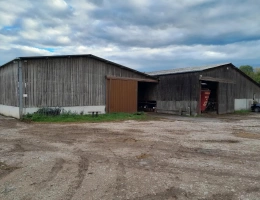
A chicken farm offered here may be a long enclosed table-bird house, a modest farmhouse unit opening onto grass range, or a floor-laying room for hens fitted into older farm volumes and served by a tempered egg store. The visitor studies the frame and roof, the insulation, the ventilation system, whether static or fan-driven, the heating, the floor, the biosecurity entry room, the washing bay and the silos. Just as telling are the condition of the range, its drainage, hedges and shelters, the water supply, often decisive in hedged country, and whether lorries can reach the building in wet weather.
The outlet weighs as much as the fabric. A unit attached to a production organisation passes on a technical and commercial framework whose remaining term and takeover conditions must be read; a farm that slaughters and sells its own birds passes on customers, a cutting room and an approval to be transferred into the buyer's name. Where the sale covers a whole farmstead, with dwelling and pasture, ask for the price to be broken down item by item, or the funding case becomes hard to argue.
The Loire valley, from Cosne-Cours-sur-Loire through La Charité-sur-Loire to Nevers, holds the most cultivated land and the best links to consumer markets, so competition for ground is keenest there and asking prices follow. Egg farms selling at the gate are more common on this axis, close to Nevers and its weekly markets. The Bazois and central Nivernais, around Corbigny, Saint-Saulge and Château-Chinon, form hedged cattle country where a poultry unit rounds out a suckler herd. To the north-west, the Puisaye nivernaise, towards Saint-Amand-en-Puisaye and Donzy, keeps a tradition of small mixed holdings: that is often where a broiler farm appears complete with its house and outbuildings.
The Morvan uplands, higher and more wooded, leave little room for large units: what comes on the market there tends to be small, sustained by visitor trade and by short supply chains that pay a premium for free-range birds. In the south of the department, around Decize and Luzy, land stays affordable and farm buildings are more readily available, which makes it a sensible search area for a first takeover.
Depending on flock size, a poultry building falls under declaration, registration or authorisation within the French classified installations regime; a change of operator is notified to the prefecture, and the order in force deserves close reading, since old requirements can hold back any enlargement. Go through the biosecurity plan, the rest period observed between batches, batch traceability and the measures applied when avian influenza risk is raised, which bear first on free-range units. If the farm packs eggs or processes meat, its approval or exemption must be capable of passing to you without a break in trading.
On the land side, part of the parcels is usually rented: the rural lease continues with the buyer, subject to the landlord's agreement, and the deal remains subject to the structures control, the French authorisation regime for taking over farmland, and to SAFER's pre-emption right. Measure the distance to neighbouring dwellings, which governs any extension, check manure storage capacity and the fit between the spreading plan and the available area, then have buildings, equipment and land valued separately.
Side by side here are properties placed by private owners, by rural estate agencies and by notaries. Narrow the list by area, budget or type of unit, ask for an alert so you hear of a property as it appears, and carry the search through to every one of the poultry farms for sale in Bourgogne-Franche-Comté.