

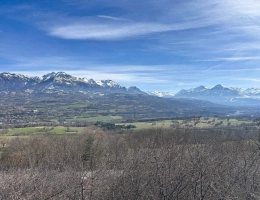
An arable farm for sale in Hautes-Alpes belongs to a mountain farming world in which cropland stays in the minority: most of the rotation sits in the lower valleys, along the Buëch and the Durance, with straw cereals, oilseed rape, forage and, further south, perfume plant crops. The properties flagged here are entrusted by farmers seeking a successor, by agencies specialising in rural land and by notaries in Gap, Laragne-Montéglin or Veynes; they state altitude, the watered share and the machinery included. They complete our picture of arable farms for sale.
This page adds what decides a mountain purchase: land values valley by valley, the communes where farms are changing hands, the condition of the watering canals and the buildings, and the approvals needed to set up. Our white paper « Créer une exploitation agricole » (in French) details the stages of starting or taking over a business.
Pricing the land comes first in any plan to buy an arable farm. On the basis of 2025 DVF sales (vineyards excluded), the median in Hautes-Alpes (05) works out at €5,005/ha and the average at €5,892/ha, across 3 transactions. The central range covering 80% of sales runs from €3,537 to €8,602/ha; nationally the median is €5,307/ha. * Fewer than 30 recorded sales: indicative value.
The SAFER benchmark, the market's second yardstick, gives €8,470/ha in 2025 for vacant land and pasture (-14.4% over twelve months, +23.8% over ten years), beside a national €6,460/ha; tenanted land is worth about 17% less.
In this relief, value turns less on extent than on the quality of the low ground: altitude and aspect, soil depth, access to a gravity canal or a borehole, whether machinery can work without slope constraints, and how closely the blocks sit around the yard. Frost-protected storage, a drier where one exists, equipment suited to small fields, basic payment entitlements and cooperative outlets all count too. Compare the asking price with our land price observatory, then cost the project with our financial calculators.
Everything is decided on the valley floor. The alluvium of the Buëch and the Durance carries free-draining soils that repay watering but suffer quickly once summer rainfall falls short; above them, slopes and plateaux give way rapidly to meadow and rough grazing. A grain farm offered here almost always pairs valley cropland with higher grass, sometimes a long way from the steading. Ask for the altitude of each block, the slope, the usual sowing and harvest dates, and the record of years with late frost or severe drought.
The watering canals, mostly old and run by syndicates, remain the main shared infrastructure. Check how extensive the water right is, the levy, the state of the intakes and channels, and the maintenance duty falling on the occupier. On the buildings side, look at storage volume and its frost protection, ventilation, winter access along the tracks, and the workshop. Machinery is priced separately, as is the dwelling: a well-restored mountain farmhouse carries a strong residential value that must be kept apart from the working tool.
The south of the department holds most of the cropped area: around Laragne-Montéglin, Ribiers, Serres and Veynes, the Buëch valley lines up cereals, forage and perfume plants on relatively wide, workable ground. The Durance valley, between Tallard, Chorges and Embrun, offers land that can be watered but is keenly sought by housing and tourism. Around Gap and in the Champsaur, grass and livestock dominate, with crops serving mainly to feed the herd. The Dévoluy, the Valgaudemar, the Queyras and the Briançonnais belong to high mountain farming where ploughed ground is exceptional.
Price gaps follow that logic, though not only that: residential and tourist demand lifts values in the served valleys and near the resorts well above what farm income alone would justify. A buyer often does better to look at districts furthest from the main roads, where competition is thinner, provided they accept longer runs between the blocks and the yard.
A takeover goes through the structures control, the prefectoral authorisation covering new entrants and expansion, and SAFER, the rural land agency, may exercise pre-emption. In the mountains, attention then turns to the legal nature of the ground: multi-year grazing agreements, land held through a pastoral group, and communal or sectional parcels made available, none of which pass on like ordinary freehold. Have an exact schedule drawn up of what is owned, what is rented and what is merely used, because the difference can transform the substance of the holding.
Then check the rural leases in force, the transfer of basic payment entitlements and the mountain area support that weighs heavily in the accounts. Confirm that water abstraction is properly authorised and review the restriction orders issued in recent seasons. Finally, look at designations and easements: catchment perimeters, the approaches to the nature parks, and natural hazard plans that can limit farm building.
Private owners, rural property firms and local notarial offices regularly entrust new properties to this page. Filter by area, by altitude or by budget, create an alert so nothing coming to market escapes you, then move on to the arable farms for sale in Provence-Alpes-Côte d'Azur.


