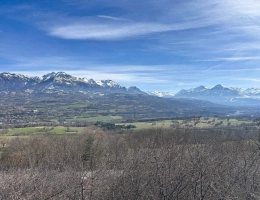
The figure that matters in farms for sale in Hautes-Alpes is not the total on the land register: it is the share that can actually be mown and worked with machinery, often cut down to a strip of valley floor, while the rest is rough grazing and summer pasture. That imbalance explains most of the value gap between two properties of comparable size. The files published here come from stock farmers stopping without a successor, from fruit growers of the Durance valley, from notaries in Gap, Embrun and Laragne, from agencies used to mountain property and from succession advisers. They join the wider picture of farms for sale in France.
This page adds what a buyer from the lowlands cannot guess: how grazing area is valued, which basins concentrate handovers, what a farmstead under snow for months implies, and which approvals condition setting up. For a project still open, our white paper « Créer une exploitation agricole » (in French) covers the preliminary steps, from legal framework to funding.
Land forms the base of a farm's value. DVF, the property sales database published by the French tax administration (vineyards excluded), records a 2025 median of €5,005 per hectare in Hautes-Alpes (05), an average of €5,892 and 3 sales; four transactions in five fall between €3,537 and €8,602, against a national median of €5,307. * Fewer than 30 recorded sales: indicative value.
The SAFER land value benchmark sets €8,470 per hectare for vacant land and pasture offered for sale in the same year, -14.4% over one year and +23.8% over ten, against €6,460 nationally. SAFER publishes no local figure for let land, too few sales being recorded; nationally, land sold with a farm tenancy in place trades at a discount of about 17%.
Against the Provence-Alpes-Côte d'Azur region, whose median is €13,518 per hectare, this department sits 63% lower. For commune-level detail and comparisons with neighbouring areas, see our land price observatory, then cost your purchase with our financial calculators.
The department lives on its flocks and herds. Sheep enterprises are in the majority, moving between mown meadows and high summer pastures, with a well-regarded mountain lamb. Cattle enterprises, dairy in the Champsaur and suckler elsewhere, occupy the widest valleys, while goat units hold a notable place in on-farm cheesemaking. As a counterpoint, the orchards of the Durance valley, around Ribiers, Tallard and the Avance valley, line up apples and pears on irrigated ground.
Those two economies are not financed alike. An orchard calls for planted capital, a packing facility or access to one, and organised seasonal labour. A mountain livestock holding calls for buildings able to house the animals all winter, a forage stock and access to summer ground. Before committing to an offer on an agricultural property, have the real forage balance drawn up: it tells you whether the stated herd holds together without bought-in feed.
The Champsaur and the Valgaudemar, north of Gap, form the grassland core of the department, with the most productive hay meadows and a still substantial number of dairy holdings. The Buëch, towards Laragne, Serres and Veynes, opens onto drier, flatter ground where cereals, perfume plants and seed crops become possible. The Embrunais, the Gapençais and the Avance valley combine livestock and fruit according to aspect. The Queyras, the Briançonnais and the Dévoluy belong to high-altitude farming where summer pasture supplies most of the forage.
Pressure on land comes not from scattered housing but from tourism and the ski resorts: around the ski areas and the busier valleys, flat and accessible ground is wanted for uses other than farming. Conversely, the high valleys offer extensive blocks whose agronomic value stays modest, and which trade accordingly.
Three points call for documentary proof. Access to summer ground first: communal pastures, pastoral groupings, pastoral land associations, multi-year grazing agreements. Those rights do not automatically follow the sale of the farmstead, and losing them changes the whole balance of the system. Irrigation next: many hay meadows and every orchard depend on old canals run by associations, whose upkeep and water rotas bind the new owner. Vacant farmland free of any occupation remains the exception.
The administrative frame completes the review: SAFER is informed of the transfer and keeps a right of substitution; permission to farm falls under structural control and the Provence-Alpes-Côte d'Azur regional plan; the sitting tenant holds a priority right to buy. Finally, mountain classification opens specific support but also imposes constraints on buildings, winter access and flock protection that should be costed before purchase.
This is a narrow market: a few dozen handovers a year, often known locally before they are advertised. Watching new listings works better than prospecting, and the e-mail alert does that without effort. The criteria that sort properties here are the altitude of the farmstead, the mowable area, the existence of a summer grazing right and winter access. Stock farmers, fruit growers, notaries and mountain agencies lodge their instructions online. Wider search: farms for sale in Provence-Alpes-Côte d'Azur.