
A buyer aiming at farms for sale in Vaucluse is entering one of the most intensive markets in France: a few hectares can keep a family, provided the water is there and the crop finds a buyer. Early vegetables in the Comtat, cherry orchards below Mont Ventoux, Rhône valley fruit, lavandin on the plateaux — the department sets very different systems side by side over short distances. Properties come from fruit and vegetable growers handing over, from notarial offices in Carpentras, Avignon and Apt, from rural land agencies and from succession advisers. They round out our selection of farms for sale in France.
Then comes everything a listing will never tell you: how high the price per hectare climbs on the plain against the plateaux, which sectors are actively looking for successors, which cantons genuinely see properties change hands, and what has to be verified before signing a preliminary contract. Setting up outside a family business calls for a mapped-out route, from choosing a legal form through to closing the funding; it is laid out in our white paper « Créer une exploitation agricole » (in French).
Land forms the base of a farm's value. DVF, the property sales database published by the French tax administration (vineyards excluded), records a 2025 median of €14,435 per hectare in Vaucluse (84), an average of €14,943 and 19 sales; four transactions in five fall between €9,654 and €22,081, against a national median of €5,307. * Fewer than 30 recorded sales: indicative value.
The SAFER land value benchmark sets €14,740 per hectare for vacant land and pasture offered for sale in the same year, -1.1% over one year and +19.3% over ten, against €6,460 nationally. SAFER publishes no local figure for let land, too few sales being recorded; nationally, land sold with a farm tenancy in place trades at a discount of about 17%.
Against the Provence-Alpes-Côte d'Azur region, whose median is €13,518 per hectare, this department sits 7% higher. For commune-level detail and comparisons with neighbouring areas, see our land price observatory, then cost your purchase with our financial calculators.
The Comtat Venaissin remains the heart of French early-vegetable market gardening: strawberry, melon, asparagus, salad crops and protected tomato follow one another around Carpentras, Cavaillon, Monteux and Pernes, with a logistics chain shipping to northern European markets. Fruit growing carries that intensity onto the slopes and the left bank of the Rhône: dessert and processing cherries below Mont Ventoux, table grapes under designation, apples, pears and plums. Vines cover large areas in the north and the Luberon, but they trade on a market of their own, handled in our wine estates category.
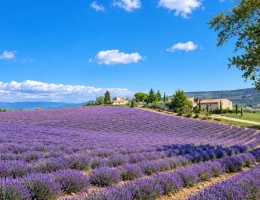
Higher up, the picture changes. The Sault country, the Albion plateau and the Vaucluse hills live on lavandin, fine lavender and aromatic plants, which fall under specialist crops, often combined with einkorn wheat, truffle growing and an upland flock. On those terroirs a working farm is worth what its still, its planted area and the age of its plants are worth, the buildings coming second; a few mixed farming systems complete the offer along the Drôme and Alpes-de-Haute-Provence borders.
The Comtat plain, from Carpentras to Cavaillon and down to the Durance, carries the most productive and the dearest land: small parcels, glasshouses, windbreak hedges and irrigation nearly everywhere. The Haut-Vaucluse, around Orange, Bollène, Valréas and the papal enclave, mixes orchards, field crops and vines on larger units. The country circling Mont Ventoux, from Malaucène to Mormoiron and Bédoin, lives mainly on cherries and grapes.
To the south, the Apt country and the Luberon combine hillside orchards, olives and lifestyle estates whose value owes a great deal to the setting; a buyer looking for a working tool has to sift carefully there. The Sault and Albion plateaux, finally, offer the widest areas and the most affordable entry prices in the department, with yields hanging on the weather and a compressed working season.
In this department a water right can be worth more than the soil. Much of the plain is served by long-established irrigation canals, the Carpentras canal among them, run by growers' associations: the right attaches to the parcel rather than to the farmer, and it lapses if the charges have gone unpaid. Have the association's perimeter confirmed, along with the delivery method — gravity or pressurised — the watering rota, the annual subscription and the condition of the headworks. For a borehole, insist on the authorisation order and the meter.
The second source of risk is the weather: spring frost on stone fruit, hail, mistral on tunnels and young plantings, drought on the plateaux. Then comes the legal frame, the same as elsewhere but applied here to small areas: SAFER Provence-Alpes-Côte d'Azur is notified of every intended sale by the notary, authorisation to farm follows from the regional structure plan, and a running farm tenancy protects the tenant, who will buy ahead of you if the owner sells. Bare farmland forms a separate segment.
Decide first between the irrigated plain and the plateaux: that single choice governs the budget, the production available and the area to aim for. Glasshouses, a cropping orchard, storage buildings — those filters come afterwards. Setting an e-mail alert pays off in a department where sound units are taken quickly. Fruit and vegetable growers handing over, notaries and rural agencies publish here, as do private owners. See also farms for sale throughout Provence-Alpes-Côte d'Azur.



