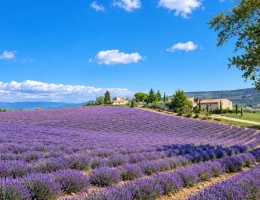
A farm for sale in Provence-Alpes-Côte d'Azur is rarely measured in tens of hectares: a market-garden mas in the Comtat, a cherry orchard below Mont Ventoux, a lavender holding on the Valensole plateau, an olive grove in the Var hills or high grazing run with a transhumant flock. Price depends less on area than on irrigation, appellation and distance to the markets — and very often on how badly a non-farming buyer wants the same place. What a listing has to settle here is the water: which canal or borehole serves the parcels, under what entitlement, and for how many hours at the height of summer. Soils, tenure and the equipment left behind follow on from that. Sellers are growers closing their business, rural agencies, notarial offices and transmission advisers. This regional set sits inside the broader inventory of farms for sale in France.
What follows fills in the rest: what a hectare fetches in each of the six departments, which production carries which district, where properties tend to come up, and what has to be verified before an offer is signed. The administrative, tax and banking route into a first holding is described in our white paper « Créer une exploitation agricole » (in French).
Land forms the base of a farm's value. DVF, the property sales database published by the French tax administration (vineyards excluded), records a 2025 median of €13,518 per hectare in Provence-Alpes-Côte d'Azur, an average of €14,884 and 59 sales; four transactions in five fall between €5,947 and €23,101, against a national median of €5,307.
The SAFER land value benchmark sets €12,260 per hectare for vacant land and pasture offered for sale in the same year, +2.8% over one year and +12.5% over ten, against €6,460 nationally. SAFER publishes no local figure for let land, too few sales being recorded; nationally, land sold with a farm tenancy in place trades at a discount of about 17%.
These figures place regional land values; they do not price a farm, which depends first on its buildings, its herd and its outlets. For department-level detail, see our land price observatory, then cost your purchase with our financial calculators.
| Department | DVF sales 2025 | Median price/ha | SAFER vacant land |
|---|---|---|---|
| Alpes-de-Haute-Provence (04) | 9 | €6,436 * | €7,670 |
| Hautes-Alpes (05) | 3 | €5,005 * | €8,470 |
| Alpes-Maritimes (06) | 1 | €7,245 * | n/a |
| Bouches-du-Rhône (13) | 24 | €20,637 * | €16,720 |
| Var (83) | 3 | €12,000 * | €11,330 |
| Vaucluse (84) | 19 | €14,435 * | €14,740 |
The region stands out for the intensity of its productions rather than the size of its holdings. Market gardening, under cover or in the open, occupies the irrigated Comtat Venaissin plain, the lower Durance and the land around the lagoons; fruit growing spans cherries, apricots, upland apples in the Hautes-Alpes, olives and table grapes. Specialist crops carry real weight: perfume, aromatic and medicinal plants on the high Provence plateaux, seed crops, rice and Crau and Camargue hay, cut flowers and ornamental horticulture along the Riviera. Vines, finally, shape whole districts of the Var, the Vaucluse and the Rhône margins.
Livestock holds the mountain side and the dry rangelands. Transhumant sheep flocks link the Crau and the Préalpes to the alpine summer pastures, while mountain mixed farming systems combine forage, rough grazing and small processing units. For a buyer, a working farm here is judged less by its area than by its access to water, its aspect and the quality of its equipment: glasshouses, trellising, packing sheds, a distillation unit or high pasture buildings.
Vaucluse (84) holds the densest concentration of specialist holdings: market gardens and orchards on the Comtat, Côtes du Rhône and Ventoux vineyards, lavandin on the Vaucluse hills and around Sault. Bouches-du-Rhône (13) brings together the Crau plain and its hay, the rice fields and grazing marshes of the Camargue, the vegetable crops of the Baux valley and the lower Durance, and hillside olive groves. Var (83) is first of all a vineyard department, extended by olives, extensive grazing in the upper country and valley market gardens.
Alpes-de-Haute-Provence (04) combines perfume-plant plateaux, orchards in the Durance valley and sheep farming spread across the uplands. Hautes-Alpes (05) belongs to mountain systems: cattle and sheep, summer pastures, forage crops, and a well-regarded fruit district in the Durance valley and around Gap. Alpes-Maritimes (06) has little farmland, shared between horticulture around Grasse, terraced olive groves, pastoral farming in the upper country and peri-urban market gardening.
The widest supply comes from the alpine departments and the upper Var, where areas are larger and entry prices more affordable. The coastal strip, the outskirts of Aix, Avignon and the Riviera, and the most sought-after appellation areas concentrate high values, fragmented parcels and constant competition with residential and tourism uses.
In a Mediterranean region nothing matters more than the water supply. A holding served by a gravity canal, connected to the regional pressurised network or with an authorised borehole is not worth the same as a dry-farmed parcel. Check the water right, membership of a growers' irrigation association, the allocated volume, the annual charge and the record of restriction orders, now a decision factor in their own right on the lower Durance as on the coastal rivers.
Climate risk deserves the same scrutiny: spring frost on stone fruit, hail, prolonged drought, exposure to the prevailing wind for glasshouses and orchards, and the legal obligation to clear scrub in wooded areas at risk of fire, which is particularly demanding on holdings enclosed by forest.
In a region where housing covets the same parcels, SAFER Provence-Alpes-Côte d'Azur watches closely what a property is destined for. Told by the notary of any intended sale, it may take the buyer's place, and may even propose a revised price where it judges the figure disconnected from agricultural use. A file showing real, costed activity, submitted before signature, stands up far better to that scrutiny.
The right to farm then falls under the regional structure plan: above certain areas a prefectural authorisation becomes necessary, and the thresholds take specialist productions into account. Occupation remains: a sitting tenant keeps his lease and buys in priority if the owner sells. An agricultural property largely let is not taken over on the same timetable as a vacant one, and bare farmland sold without buildings follows a market of its own again.
Two criteria decide here before any other: access to water and distance to the markets. Start with those, add the department and the production, then let the budget choose between what is left. An e-mail alert saves watching the page, since supply is both scarce and quickly taken. Retiring farmers, rural agencies and notaries across the six departments lodge their instructions here. Other regions can be consulted from farms for sale in France.