

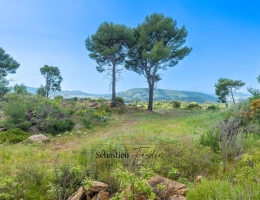
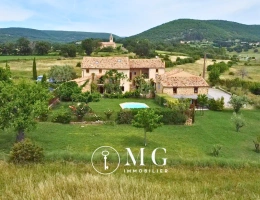
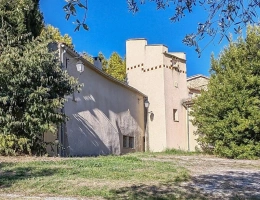
Hunting for an arable farm for sale in Alpes-Maritimes calls for patience: the department holds very little ploughable ground, and field crops come well behind ornamental horticulture, vegetable growing, olives and perfume plants. The properties appearing here are passed on by farmers looking for a successor, by rural land agencies and by notaries in the back country; they state the soil type, the water supply, the condition of the buildings and the area genuinely workable. They form part of our national selection of arable farms for sale, far better stocked elsewhere.
This page sets out what a listing hides: how high local land values run, the valleys where workable ground survives, how to price old buildings and a watering network, and the planning rules that frame any farming plan. To prepare an entry into farming, our white paper « Créer une exploitation agricole » (in French) explains how it works.
Pricing the land comes first in any plan to buy an arable farm. On the basis of 2025 DVF sales (vineyards excluded), the median in Alpes-Maritimes (06) works out at €7,245/ha and the average at €7,245/ha, across 1 transactions. The central range covering 80% of sales runs from €7,245 to €7,245/ha; nationally the median is €5,307/ha. * Fewer than 30 recorded sales: indicative value.
With no local SAFER average published, the French reference applies: €6,460/ha for vacant land and pasture, €5,350/ha for tenanted land.
In this corner of France the value of a farm is built differently: on the scarcity of flat, workable parcels, on the security of the water supply, on the quality and floor area of the buildings, on the scope for direct selling to a large and close customer base, and on whether a processing room or a usable shed comes with it. Short supply chains often weigh more than yield per hectare. Place the asking price with our land price observatory, then test the balance of your plan with our financial calculators.
The first question is how much ground can actually be cropped. Between terraces, slopes, woodland and unusable margins, a crop farm here often advertises a total area bearing no relation to what a tractor can work. Ask for a block-by-block schedule, the gradient, machinery access and soil type. Water comes next: watering canals run by syndicates, springs, declared boreholes, pressurised mains. In a department with dry summers and heavy urban demand, secure watering governs a parcel's value far more than its fertility ever will.
The buildings mix mas farmhouses, old sheepfolds and more recent farm structures, often in stone and sometimes sitting in strictly zoned agricultural land. Assess the roofs, the covered area available, whether storage or a workshop can be fitted, and access along narrow roads. The residential share matters unusually here: in a tight property market, a house with character can account for a decisive part of the price. Separate it from the working tool, or the funding plan will rest on a false figure.
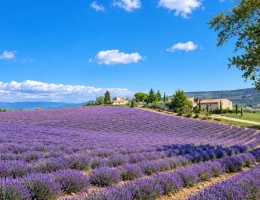
Workable ground lies mainly inland: the Estéron valley, towards Roquestéron and Puget-Théniers, the upper Var valley, the edges of the Valbonne plateau and the terraces of the Grasse country, where perfume plants have long held a strong place. The Tinée and Vésubie valleys keep narrow cultivated floors, tested more than once by the floods of recent years. On the coast and in the lower Var valley, around Carros and La Gaude, horticulture and vegetable growing occupy a residual and tightly controlled agricultural reserve.
The consequence is plain: competition bears less on cropping projects than on land use itself, fought over between farming, housing and tourism. Values per hectare rank among the highest in the country as soon as you approach the coast, while the distant valleys offer more affordable openings in exchange for genuine isolation and demanding logistics, both for collection and for delivery.
As elsewhere, a takeover depends on the structures control, the French authorisation regime for farming land, and SAFER, the rural land agency, may pre-empt. But the decisive ground here is planning: check how the parcels are zoned in the local plan, whether a protected agricultural zone applies, what can be built on agricultural land and what rights of way exist, numerous in such broken relief. Any plan resting on putting up a building or a farmworker's dwelling must be tested before purchase, never after.
Check too the watering rights and how they attach to individual parcels, the rural leases or occupation agreements running, the transfer of basic payment entitlements and the support tied to less-favoured areas. Lastly, examine the natural hazards, flooding, land movement and fire, together with the legal scrub-clearance duties imposed around buildings: they represent a real annual cost that many buyers discover far too late.
The listings visible here reach us from owners, from firms specialising in rural transactions and from notarial offices across the department. Select by workable area, by budget or by valley, set up an alert so every new arrival reaches you, then extend the search to the arable farms for sale in Provence-Alpes-Côte d'Azur.


