
The market for a goat farm for sale in Vaucluse splits in two: the irrigated plains of the Comtat, where land is dear and goes to market gardening or vines, and the heights of the Ventoux, the monts de Vaucluse and the Luberon, where caprine farming still holds its place thanks to rough grazing. These properties reach us from breeders arranging their departure, from agencies specialising in rural estates and from notaries; they state the herd, the livestock building, the milking equipment, whether a cheese room exists and what the land consists of. Every one of them appears among our goat farms for sale.
Alongside the listings, this page brings together what weighs on a decision: local land and pasture values, the districts that regularly release a holding, how to read a building exposed to drought and to the mistral, and the checks tied to processing. The white paper « Créer une exploitation agricole » (in French) rounds out the preparation of a start-up or a takeover.
Land weighs heavily on the budget for a goat farm. Transfers published by the French tax authorities (DVF, excluding vineyards) put the median for farmland in Vaucluse (84) at €14,435/ha in 2025, with an average of €14,943/ha over 19 sales. Eight transactions in ten settle between €9,654 and €22,081/ha, where the national median is €5,307/ha. * Fewer than 30 recorded sales: indicative value.
A second reference, the SAFER land value benchmark, sets vacant land and pasture at €14,740/ha for 2025, -1.1% in a year and +19.3% over a decade; the French average is €6,460/ha, and a sitting tenant costs a plot roughly 17% of its value.
Price rarely rests on hectares alone: housing and ventilation, parlour and bulk tank, make room, drying room and ripening cellar, sales point, then the milking goats themselves, their genetics and their health record. Water, access to scrub and heath grazing, the chosen route to market and the goodwill already built complete the picture. Cross-check all of it with our land price observatory and test your funding with our financial calculators.
Local goat houses run from purpose-built sheds for a sizeable herd to stone sheepfolds reworked at the foot of the mountain. Review frame and roof, height under the ridge, cross ventilation and resistance to the mistral, the layout of batches, the kidding pen, the bedded area and the volume of hay storage. Then the milking plant: number of units, cluster removal, washing, cooling, tank capacity against the herd actually milked, and the cleanliness and drains of the milk room. A unit whose effluent handling and wiring already comply spares you a considerable line in the takeover budget.
Running a goat cheese farm changes what the property is worth. Make room, drying room, cellar, cold store and shop form an asset read through the health approval, the volumes produced and the clientele won on markets, in producers' shops or with local restaurants. The herd is judged separately: Alpine and Saanen dominate, alongside the age of the goats, the bucks, replacement kids and health status. Where a farm is sold with dwelling, outbuildings and land, have the price broken down, since residential value runs high in this department.
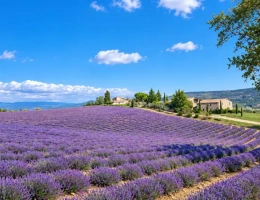
The Sault country and the Albion plateau, with lavender and einkorn wheat, remain where goat farming keeps the most ground; this is also the part of the department inside the Banon designation area, whose specification governs a cheese ripened wrapped in chestnut leaves. The monts de Vaucluse, around Murs, Lioux and Saint-Saturnin-lès-Apt, together with the northern slope of the Ventoux towards Malaucène and Bédoin, offer extensive grazing. The Luberon, from Saignon to Apt and southwards, combines livestock, orchards and heavy residential pressure, so a dairy goat holding coming up there is usually priced with its house and its setting in mind rather than its milk output alone.
The Comtat Venaissin around Carpentras, the Rhône corridor and the Cavaillon plain leave little room for a caprine holding: market gardening, vines and orchards carry land to levels a dairy unit can hardly sustain. The Enclave des Papes, around Valréas, sits closer to the Drôme model. Everywhere, tourism and the Provençal markets support direct selling, make a smallholding's volumes worth producing and shorten the time a new keeper needs to build a customer base of their own.
On a caprine farm in this department, water governs everything: its origin, the abstraction permit, a declared borehole, any service from a canal, the yield through dry spells and drinking arrangements on grazing that can lie far from the buildings. Depending on numbers, the unit falls under the departmental health regulation or under the French classified installations regime, by declaration or registration, with the change of operator notified to the prefecture, and with distances to dwellings, effluent storage and the spreading plan to examine, in a landscape where scattered housing often sits beside farm buildings.
If the holding is licensed under the designation, be aware that the licence does not follow the sale automatically: it transfers after inspection, and the specification governs both what the herd is fed and how the cheese is made. Ask for the CAEV history, that is caprine arthritis-encephalitis virus, paratuberculosis monitoring, the cheese room's food safety plan and its self-checks. Statutory clearance obligations, running rural leases, the structures control and SAFER's involvement complete the list.
What you see here is put on the market by private owners, rural estate agencies and notarial offices in the department. Select by area, by budget or by the presence of a cheese room, and schedule an e-mail alert: caprine supply renews slowly and moves fast. Thinking of handing your own farm on? Post the listing. Continue towards goat farms for sale in Provence-Alpes-Côte d'Azur.