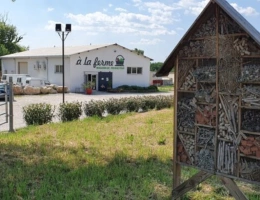
A goat farm for sale in Bouches-du-Rhône has little in common with a unit in a northern dairy basin: herds live off scrubland, limestone slopes and rough grazing, while customers sit a short drive away, on the markets of Arles, Aix and the shores of the Étang de Berre. Breeders stepping back, firms specialising in Provençal rural estates and notarial offices send us these files, which set out how many goats are milked, how the livestock building is laid out, whether a cheese room is attached, how much of the area is rough grazing and what grazing agreements come with it. They all sit within our national view of goat farms for sale.
This page adds what a listing leaves unsaid: what pasture and arable ground are worth locally, which districts release a holding most often, how to read a building designed against heat, and the checks that come with on-farm cheesemaking. Our white paper « Créer une exploitation agricole » (in French) then covers the setting-up route, the professional qualification and the funding plan.
Land weighs heavily on the budget for a goat farm. Transfers published by the French tax authorities (DVF, excluding vineyards) put the median for farmland in Bouches-du-Rhône (13) at €20,637/ha in 2025, with an average of €19,365/ha over 24 sales. Eight transactions in ten settle between €10,674 and €24,734/ha, where the national median is €5,307/ha. * Fewer than 30 recorded sales: indicative value.
A second reference, the SAFER land value benchmark, sets vacant land and pasture at €16,720/ha for 2025, -4.2% in a year and -2.1% over a decade; the French average is €6,460/ha, and a sitting tenant costs a plot roughly 17% of its value.
Beyond the hectares, value rests on the working tool and on access to grass: a shaded, well-ventilated shed, parlour and bulk tank, make room, drying room and sales point, then the animals themselves, their breeds, their health record and the replacement kids coming through. Water, grazing agreements over the hills and the chosen outlet weigh just as much, whether direct selling on Provençal markets or collection by a dairy. Place the land side with our land price observatory, then test your takeover plan with our financial calculators.
Buildings here range from open timber-clad goat houses to converted stone sheepfolds and reworked farm sheds. The climate drives the inspection: height under the ridge, through openings and air movers, shade over the collecting yard, insulation of the milk room, sheltered hay storage. Then come the milk line, the number of units, the washing system, the cooling capacity and the tank size measured against the herd actually milked, followed by effluent handling and drinking arrangements for each batch. A unit whose services and compliance work have just been dealt with trades far above one where everything still has to be tackled.
A goat cheese farm is the norm rather than the exception here: make room, drying room, cold store and sales point form an asset whose worth follows the approval held, the volumes produced and the customers won. The herd counts separately, mostly Alpine and Saanen, with some keepers attached to the Rove goat, a hardy Provençal breed suited to rough grazing. Where the sale takes in a mas, its outbuildings and its land, insist on a line-by-line breakdown: close to Aix or the Alpilles, residential value often outweighs the farming asset.
The Alpilles, from Saint-Rémy-de-Provence to Les Baux and Eyguières, form the most caprine district, with herds working scrub, heath and slopes. Around the chaîne des Côtes, the Trévaresse and the pays d'Aix, a handful of units survive between vines and olive groves on keenly contested ground. The Crau plain, home of the hay that feeds much of the region's livestock, supplies forage more than dairy units; the Camargue, given over to rice, bulls and horses, holds very few milking herds. Towards Saint-Chamas, the Sainte-Victoire and the slopes of the Sainte-Baume, grazing stays easier to secure.
Population density changes the commercial picture: numerous weekly markets, delicatessens, restaurants and producers' shops absorb the output of a smallholding quickly. Working the other way, urban and tourist pressure lifts prices well past any farming logic, and holdings combining dwelling, buildings and attached grazing move fast. No protected goat cheese designation covers the department, so marketing leans on the reputation of the farm itself.
A caprine holding is judged as much on its paperwork as on its walls. Depending on numbers it falls under the departmental health regulation or under the French classified installations regime, by declaration or registration, with any change of operator notified to the prefecture; distances to dwellings, effluent storage and the spreading plan deserve close reading where neighbours are near. Water calls for separate attention: where the resource comes from, the abstraction right, service by the gravity-fed canals, summer restrictions and drinking arrangements on distant grazing.
Look next at grazing agreements and access to natural areas, which carry wildfire risk, summer closures and clearance obligations around buildings. On the animal side, ask for the CAEV record, that is caprine arthritis-encephalitis virus, paratuberculosis monitoring and the replacement policy; on the processing side, the food safety plan and the latest self-checks. The deal itself passes through the structures control, the French authorisation regime for taking over farmland, then through SAFER, heavily called upon in this department.
Private owners, Provençal rural agencies and notaries feed this page as holdings come up. Sort by grazing area, by budget or by how the milk is marketed, then arm an e-mail alert: a dairy goat holding is scarce here and finds its buyer within days. Preparing your own handover? Post the listing. From here, open the search out to goat farms for sale in Provence-Alpes-Côte d'Azur.