
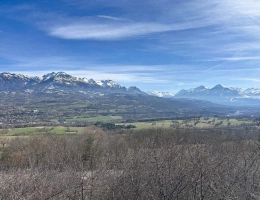
Taking over a goat farm for sale in Hautes-Alpes means committing to mountain livestock farming, paced by the move to summer pasture and by a long winter that dictates how buildings are designed and how much forage must be stored. Breeders on their way out, firms specialising in rural estates and notaries of the Gap and Briançon country pass these files to us; they set out herd size, the nature of the goat house, milking equipment, any cheese room and the pastoral ground used. Each one joins our national selection of goat farms for sale.
This page adds what really weighs on a decision: the value of local pasture and land, the valleys where a holding comes onto the market, how to appraise a mountain building, and the checks that pastoral farming calls for. Our white paper « Créer une exploitation agricole » (in French) also details the route to setting up.
Land weighs heavily on the budget for a goat farm. Transfers published by the French tax authorities (DVF, excluding vineyards) put the median for farmland in Hautes-Alpes (05) at €5,005/ha in 2025, with an average of €5,892/ha over 3 sales. Eight transactions in ten settle between €3,537 and €8,602/ha, where the national median is €5,307/ha. * Fewer than 30 recorded sales: indicative value.
A second reference, the SAFER land value benchmark, sets vacant land and pasture at €8,470/ha for 2025, -14.4% in a year and +23.8% over a decade; the French average is €6,460/ha, and a sitting tenant costs a plot roughly 17% of its value.
At altitude, worth is not read in hectares alone: how solidly the goat house stands under snow, hay storage volume, parlour and tank, any hut or building on the summer pasture, the water resource, and an approach passable in winter. The cheese room, with drying room, cellar and sales point, then counts heavily, as does the herd, its fitness for walking and the custom attached to its products. Set all of it against the land side with our land price observatory, then stress-test your figures with our financial calculators.
Buildings divide between new goat houses designed for wintering, old stone sheepfolds taken over for goats, and valley barns reworked for the purpose. Snow load guides the inspection: frame, roof, span, clearing around the doors, and equally insulation of the milk room, frost protection of the services, heating of the cheese room and self-sufficiency in water. Check hay storage capacity, decisive since part of the forage comes up from the valley or is bought in, along with the state of the parlour, its washing system and the cooling unit against what the herd actually yields.
Farmhouse processing dominates, for want of dense collection: make room, drying room, ripening cellar, cold store and shop form the core of the value, together with the health approval and the reputation earned on markets and with tourist accommodation. The herd is judged separately, on hardiness, fitness for walking, the age of the milking goats, the bucks and replacement stock. Where a house, outbuildings and meadows are included, have the price itemised: in a tourist area the dwelling can account for a large share of the total.
The Gap country and the Champsaur, through to the Valgaudemar, hold most of the herds, with grassy valley floors, accessible buildings and firm land values close to Gap. The Buëch, around Serres, Veynes and Laragne-Montéglin, opens onto drier hills and, in its southern part, joins the area of the Banon protected designation. The Dévoluy, the Embrunais, the Guillestrois, the Queyras and the Briançonnais work on a markedly pastoral pattern, with long winters, extensive summer pasture and small holdings. Around the ski resorts, property values bear no relation to agricultural use.
Visitor numbers, in winter as in summer, make direct selling a solid outlet: markets, producers' shops, mountain refuges, restaurants and guest accommodation. A unit with its own sales point and an approach clear all year is valued well above a perched site cut off for weeks by snow, which demands a particular way of working and trades on other terms.
A mountain unit often depends on ground the seller does not own: communal summer pasture, multi-year grazing agreements, pastoral groupings and land associations. Examine how long those rights run, whether they transfer and what charges attach to them, because they are the summer forage base. Predation, a live issue across these ranges, calls for guard dogs, night pens and shepherding, with the labour and investment that implies. Core areas of national parks and protected sites set precise rules of use on top of that.
Administratively, the building falls under the departmental health regulation or the French classified installations regime depending on numbers, with the change of operator notified to the prefecture. Ask for the herd's health status, including CAEV, the caprine arthritis-encephalitis virus, and paratuberculosis, and, for the cheese room, the food safety plan and the approval or exemption for direct supply. Rented parcels stay under the rural lease, transferable with the landlord's agreement, and the deal passes through the structures control, France's authorisation regime for taking over farmland, then SAFER.
Private owners, rural estate agencies and notaries from the high valleys supply this section. Sort by pastoral area, by budget or by whether a processing workshop comes with the property, and arm an e-mail alert, since sales come up rarely and attract several candidates at once. Selling your holding? Post your listing. Carry on towards goat farms for sale in Provence-Alpes-Côte d'Azur.