
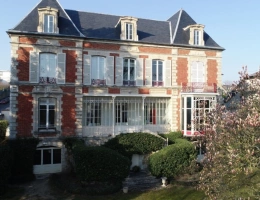
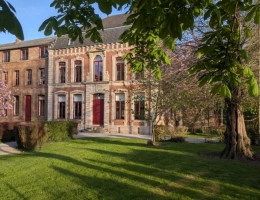
Farmhouse cheeses have won a place on Picardy market stalls, which explains the attention paid to any goat farm for sale in Somme. The department is first of all wheat and sugar beet country, yet its wet valleys, the slopes of the Ponthieu and a busy coastline provide good settings for a family-sized goat unit that processes on site. No local goat cheese carries a protected designation: value rests on the farm's own name, on the markets of Amiens and Abbeville and on the custom of the bay. Offers come from farmers winding down, specialist agencies and notaries, with herd, machinery and acreage set out. You will find them among the goat farms for sale published across the country.
This page extends the listings on a few decisive points: where Picardy land values sit, which areas see holdings change hands, how to judge a livestock building lodged in a brick farmstead, and what rules govern cheesemaking before you commit to a dairy goat holding. The route to setting up is laid out in our white paper « Créer une exploitation agricole » (in French).
Land weighs heavily on the budget for a goat farm. Transfers published by the French tax authorities (DVF, excluding vineyards) put the median for farmland in Somme (80) at €8,655/ha in 2025, with an average of €9,402/ha over 267 sales. Eight transactions in ten settle between €6,364 and €13,926/ha, where the national median is €5,307/ha.
A second reference, the SAFER land value benchmark, sets vacant land and pasture at €10,100/ha for 2025, -2.1% in a year and +4.8% over a decade; the French average is €6,460/ha, and a sitting tenant costs a plot roughly 17% of its value.
The price of such a holding rarely rests on the parcels alone. The livestock building, the milking parlour, the milk room, the cheese room and its ripening cellar form the heart of the tool, joined by haymaking machinery, fencing and water supply on the grazing. The herd adds its share through productivity and health status, and goodwill adds its own: box subscriptions, weekly markets, collective sales outlets, coastal restaurants. The gap between two farms of similar size almost always comes from there. Cost each element with our land price observatory and our financial calculators.
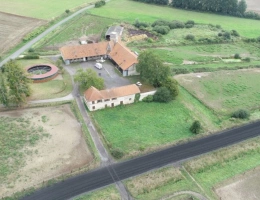
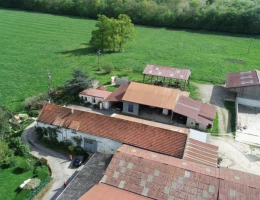
The local goat unit often shelters in a building taken over from another use: a byre freed up when a dairy herd stopped, a partitioned storage shed, the barn of a courtyard farm. Look at the frame and roof, ventilation, floor drainage, machine access for bedding and mucking out, then the parlour, its plant and the washing area. Where a goat cheese farm includes a dairy, examine the make room, the drying room, the cellar and the cold store separately: this second tool governs food safety compliance and, very often, most of the turnover.
The herd is assessed on the number of milking does, the share of kids reared as replacements, the spread of kiddings and milk results. Alpine and Saanen animals form the backbone of local flocks, hardy bucks serving mainly for kid production. If the house and land are included, have separate values drawn up: a restored Picardy farmstead can carry a large slice of the asking price on its own.
The Santerre and the Vermandois, east of Amiens, belong to industrial crops: grass is scarce and land reaches levels that discourage a livestock project. The Ponthieu, around Crécy and Auxi-le-Château, the Vimeu and the Bresle valley keep hedged farmland, pasture and modest holdings. The lower Somme valley, from Long to Abbeville, and the Marquenterre offer wet meadows that work well as grazing. Around Montdidier and on the Picardy plateau, supply stays limited by pressure from arable farming.
The choice of area commits you to a selling model: close to the Somme bay, Saint-Valery and Le Crotoy, the holiday season clears farm production quickly; inland you have to build rounds towards Amiens, Abbeville or Péronne, in return for a more affordable entry price.
A goat unit enters the classified installations nomenclature, the French environmental permitting system, above a set herd size: declaration at first, then registration for larger flocks, with notice to the prefecture when the operator changes. Processing calls either for health approval or for the exemption covering direct sale to consumers, both requiring an up-to-date food safety plan, batch traceability and regular own-checks. With the whole department classed as a nitrate vulnerable zone, effluent storage capacity and the spreading plan are looked at closely.
Then comes the legal side: the status of each parcel, continuation of rural leases with the owner's agreement, farming authorisation under the structures control, and an eye on SAFER, the rural land agency, which acts regularly where neighbouring farms are seeking to expand. On valley-bottom meadows, check wetland status, drainage easements and any rules attached to water catchments. Finally ask for the herd's health paperwork before making an offer.
The properties visible here are brought to market by working farmers, by Picardy rural estate agencies and by notarial offices. Refine by area, by budget or by the existence of a processing workshop, then create an alert: demand clearly outstrips the number of smallholding opportunities available. You can equally look towards goat farms for sale in Hauts-de-France.