

Looking for a goat farm for sale in Pas-de-Calais means targeting a department where goat keeping survives as small farmhouse units, on the margins of the arable country of the Artois. Goats have held their place here thanks to on-farm cheesemaking and a dense local market, between the Lens conurbation, Arras, Saint-Omer and the Opal Coast. No protected designation covers goat cheese locally, so it sells under the name of the farm itself, within an old dairy tradition. Properties come from retiring breeders, firms specialising in rural property and notarial offices, each describing the herd, the buildings and the land attached. They join the goat farms for sale tracked throughout France.
Beyond the listings, this page gathers what weighs on a decision: where land values stand in the department, which areas see handovers taking shape, the condition to expect of a livestock building, and the checks specific to a processing workshop. To prepare a start-up, our white paper « Créer une exploitation agricole » (in French) sets out the administrative and financial steps.
Land weighs heavily on the budget for a goat farm. Transfers published by the French tax authorities (DVF, excluding vineyards) put the median for farmland in Pas-de-Calais (62) at €7,500/ha in 2025, with an average of €8,667/ha over 326 sales. Eight transactions in ten settle between €6,066 and €14,000/ha, where the national median is €5,307/ha.
A second reference, the SAFER land value benchmark, sets vacant land and pasture at €13,070/ha for 2025, +0.8% in a year and -0.8% over a decade; the French average is €6,460/ha, and a sitting tenant costs a plot roughly 17% of its value.
Acreage tells only part of the story. What counts first is the goat shed and its bedded area, the milking parlour and milk room, the cheese room and its cellar, forage storage and grazing fences. The herd comes next, judged on genetics, steadiness of yield and health status. Goodwill does the rest: markets in Arras or Béthune, producer shops, catering custom, coastal trade in season. A unit that already carries an established outlet does not compare with an empty set of buildings. Use our land price observatory and financial calculators to cost each item.
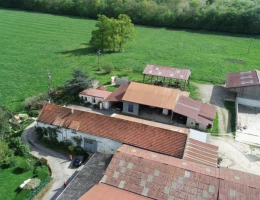
In an arable department, a goat shed rarely occupies purpose-built housing: more often a former cow byre, a closed-in storage barn or the brick barn of an Artois farmstead. Inspection covers roof and frame, ventilation in a volume that is usually too tightly shut, the nature of the floor, muck removal, then the milking block and the washing area. Where the farm processes, the cheese room, the drying room and the ripening cellar amount to a second working tool, and bringing it up to standard often costs more than upgrading the animal housing. Hay storage capacity decides how self-sufficient the farm can be.
The herd shows in the number of milking does and replacement kids, in the kidding pattern and in recorded milk results; Alpine and Saanen animals dominate, with some farms keeping hardy bucks for kid sales. Where the dwelling house is part of the package, ask for a clean split between house, farm buildings, land and stock: in the Ternois as in the Boulonnais, demand for rural housing props up prices and can disguise a worn-out production tool.
Farming geography sorts the opportunities. The Artois plains and the former coalfield, given over to sugar beet, wheat and potatoes, leave little room for grass and show fiercely contested land values. The high country of the Artois and the Ternois, around Saint-Pol-sur-Ternoise, keep pasture and mid-sized farms. The Boulonnais, with its hedged farmland and valleys, and the neighbouring Montreuillois combine livestock farming with visitor trade. The Sept-Vallées, from Hesdin to Fruges, and the Audomarois around Saint-Omer round off the areas where a dairy goat holding may come on the market.
Outlets follow that map: setting up near the coast or the towns lets you sell direct with barely any travelling, whereas the Ternois and the Sept-Vallées offer more forage ground for a comparable budget, at the cost of longer rounds towards Arras, Béthune or the seaside.
A goat cheese farm falls under the classified installations regime, the French environmental permitting system, as soon as the herd passes the threshold in the official nomenclature: declaration first, registration above it, with notice to the prefect when the operator changes. If milk is processed, the workshop needs health approval or must rely on the exemption for direct retail sale, backed by a food safety plan, batch traceability and documented own-checks. As the whole department lies in a nitrate vulnerable zone, effluent storage capacity and the spreading plan deserve close attention.
On land, separate what is owned from what is rented, have the landlord confirm that rural leases continue, and build into the timetable both the farming authorisation under the structures control and a possible move by SAFER, the rural land agency, whenever an arable neighbour bids for the same parcels. Ask for herd health results, including screening for caprine arthritis encephalitis, and milk analyses from recent seasons. Lastly negotiate a period with the seller on site, without which direct-sale customers drift away.
Retiring owners, rural estate agencies and Artois notaries feed this selection. Sort by forage area, by budget or by the presence of a cheese room, then save an alert so you hear as soon as a smallholding of this kind appears: sales are scarce and buyers many. The search can also open out to goat farms for sale in Hauts-de-France.