
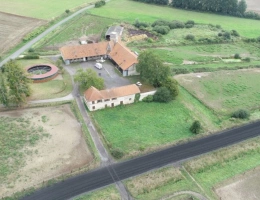
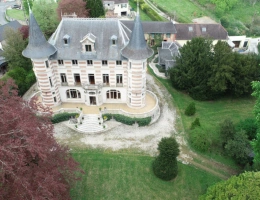
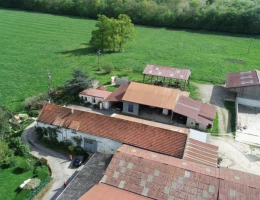
Finding a goat farm for sale in Hauts-de-France takes patience: this northern region has never been a major goat-keeping area, and the units that change hands are nearly always modest, run with an on-farm dairy and direct selling on the edge of the conurbations. What comes on the market is released by farmers preparing their retirement, by notaries and by rural agencies used to small livestock holdings; the particulars state herd size, milking equipment, whether a processing workshop is included and the grassland attached to the farmstead. You can also browse every goat farm for sale across France.
Besides the listings, this page gathers the bearings buyers usually lack: the level of land prices in the region, the areas where a dairy goat holding occasionally comes up, the condition of the buildings to inspect closely and the controls specific to goat milk production. Our white paper « Créer une exploitation agricole » (in French) guides new entrants from choosing a legal structure to building the funding plan.
Land weighs heavily on the budget for a goat farm. Transfers published by the French tax authorities (DVF, excluding vineyards) put the median for farmland in Hauts-de-France at €7,976/ha in 2025, with an average of €8,940/ha over 1,365 sales. Eight transactions in ten settle between €6,000 and €14,000/ha, where the national median is €5,307/ha.
A second reference, the SAFER land value benchmark, sets vacant land and pasture at €10,890/ha for 2025, -0.5% in a year and +9.4% over a decade; the French average is €6,460/ha, and a sitting tenant costs a plot roughly 17% of its value.
What a goat farm is worth here depends far less on hectares than on the production tool itself: the air volume and natural ventilation of the housing, the milking parlour, the bulk tank and, where one exists, an approved cheese dairy with its drying room and ripening cellar. Add the herd, its health management and its genetic level, then the goodwill built up patiently at markets, through box schemes and in producer shops. To place each asking price in context, use our land price observatory and our financial calculators.
The building governs everything else. Sound goat housing shows generous air volume, natural ventilation that works without draughts, a well-kept straw bed and no lingering damp, since dairy goats cope badly with confined air. Next comes the milking block: the number of units against the herd size, the milking machine and its periodic testing, the bulk tank, the wash area and the utility room. Many dairy goat holdings on the market in the region include a cheese dairy; the make room, drying room, cellar and laboratory must then meet the requirements of health approval, failing which bringing them up to standard is added to the advertised price.
The herd is valued separately. Its balance of Alpine, Saanen or crossbred animals, the age profile, the number of replacement kids and the health status account for wide gaps between one offer and the next. Where the sale includes a dwelling house, a shed and grassland, ask for an item-by-item breakdown: the house follows the local residential market, the housing and equipment their useful value, and the animals and forage stocks an inventory agreed by both parties on the day of handover.
The Aisne, and above all the hedgerow country of the Thiérache, still has grassland and farmsteads within reach, which makes it the area new entrants watch most closely. The Nord keeps a comparable grazing landscape in the Avesnois, while the rest of the department, heavily urbanised, mainly shelters small units living off a nearby customer base. The Oise combines arable plateaux, where land is contested and rarely available for a livestock project, and the edge of the pays de Bray, greener and with a long habit of farmhouse processing.
The Pas-de-Calais has two faces: the Artois hills, the Ternois and the Boulonnais, all grazing country, where a goat cheese farm is occasionally offered, and the cereal plains of the south, where competition for land pushes small units out. The Somme mixes wet valleys with cultivated plateaux; goat herds remain scarce there and almost always geared to farm-gate sales and short supply chains around Amiens and Abbeville.
Above a certain herd size, a goat unit falls under the French classified installations regime: depending on numbers it is covered by the departmental health regulation, by a declaration or by registration, and any change of operator must be notified to the prefecture. Ask for the order in force and read its requirements, particularly the distances to neighbouring dwellings, as they cap any future extension. The herd health file deserves equal attention: veterinary monitoring, screening, management of CAEV and paratuberculosis, replacement policy. If a cheese dairy is running, make sure its approval, or the exemption it relies on, can be transferred to your name.
Then check where the milk goes. Collection by a dairy implies a contract and an allocated volume that do not automatically follow the buyer; direct selling rests on a customer base that transfers poorly and has to be rebuilt. On the land side, rented parcels stay under a rural lease, the deal goes through the structures control, the French authorisation regime for taking over farmland, and SAFER, the rural land agency, may pre-empt. Taking over a smallholding of this kind is therefore prepared with the seller, the accountancy centre and the chamber of agriculture.
The properties shown here are entrusted to us by private farmers, by rural estate agencies and by notaries based in the region. Narrow your search by grassland area, budget or the presence of a processing workshop, and switch on an e-mail alert: supply is thin here and moves quickly. You can also widen the search to every farm for sale in Hauts-de-France.