
Buying a goat farm for sale in Nord means setting up in immediate contact with a dense consumer market, which changes the whole business model: almost every goat unit in the department processes its own milk and sells at the gate, through producer shops or on urban markets. The holdings are compact, well equipped, sometimes with a visitor and school-farm activity attached. Sales pass through the farmers themselves, through rural property agencies and through notaries in Lille, Cambrai, Avesnes or Dunkirk. They complete the national supply of goat farms for sale.
This page lights up what the listing leaves in shadow: land values in one of the tightest markets in France, the districts where handovers appear, the criteria for judging a livestock building close to housing, and the formalities of milk processing. All of these weigh heavily in the closing negotiation. Our white paper « Créer une exploitation agricole » (in French) sets out the route to establishment.
Land weighs heavily on the budget for a goat farm. Transfers published by the French tax authorities (DVF, excluding vineyards) put the median for farmland in Nord (59) at €7,910/ha in 2025, with an average of €9,021/ha over 347 sales. Eight transactions in ten settle between €5,570 and €15,000/ha, where the national median is €5,307/ha.
A second reference, the SAFER land value benchmark, sets vacant land and pasture at €13,560/ha for 2025, +1.1% in a year and +6.8% over a decade; the French average is €6,460/ha, and a sitting tenant costs a plot roughly 17% of its value.
Here more than anywhere, goodwill weighs as much as the fabric. What counts is the goat shed and its milking parlour, the cheese room, drying room and cold store, the shop and its fittings, forage machinery, the herd and its yield, then the loyal customer base, the market pitches and the agreements with local retailers. A dairy goat holding already known to its buyers is worth more than the sum of its equipment. To ground the analysis, open our land price observatory and our financial calculators.
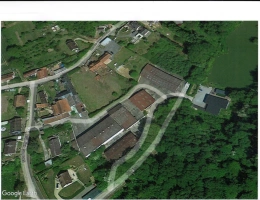
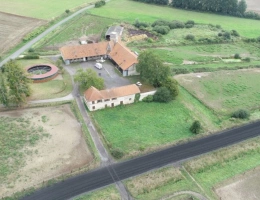
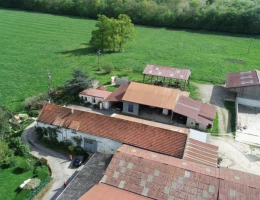
Units in the department occupy brick farmsteads, Flemish courtyard farms or recent steel-clad buildings. Nearby housing demands particular care over nuisance: where manure sits, how effluent is handled, how collection lorries or customers move through the yard. Examine the roof, the frame, ventilation and the quality of the bedded area, then the milking block, its number of units and the tank. A fitted farm shop, reachable from the road and separate from the animal areas, is an asset in its own right that few incoming buyers manage to recreate at reasonable cost.
On livestock, ask for the number of milking does and replacement kids, the kidding calendar, milk results, CAEV monitoring and the bucks on site. Alpine and Saanen animals remain the majority. If the package includes the dwelling and the land, insist on three separate valuations: peri-urban housing sells dearly in this department and can mask an ageing production plant that the buyer will have to bring back up to standard within the first seasons.
The Avesnois, around Avesnes-sur-Helpe, Maubeuge and Solre-le-Château, forms the main reservoir of pasture: hedged country, grassland farms, a long cheese tradition based on cow's milk, and land values more accessible than elsewhere. Inland Flanders, towards Hazebrouck, Bailleul and the Cassel hill, keeps a few mixed farms on hotly contested ground. The Cambrésis and the Pévèle are largely arable. Around the Lille conurbation, Valenciennes and the Dunkirk coast, competition from development pushes prices to levels rarely compatible with a goat project.
The trade-off lies between entry cost and closeness to the market: a goat cheese farm in the Avesnois is cheaper to buy but requires delivery rounds into the towns, while setting up at the edge of the conurbation commands a full price and sells its output without leaving the yard. Between the two, farms in inland Flanders sometimes strike an acceptable balance, provided you accept modest acreages and scattered parcels.
The classified installations regime, the French environmental permitting system, applies according to herd size, by declaration and then registration, with any change of operator notified to the prefecture. Processing requires health approval or the exemption provided for direct retail sale, together with a food safety plan, batch traceability and own-checks. As the department is a nitrate vulnerable zone, effluent storage and spreading rules closely govern how the herd is run. Finally, check the statutory distances to dwellings and the history of relations with neighbours, a sensitive matter in such a densely settled countryside.
Legally, verify the nature of the rural leases and the landlord's agreement, allow for the structures control, the French authorisation regime for taking over farmland, and for the farming qualification required to claim aid. SAFER intervenes frequently in a market where farmland is contested and sometimes threatened by development schemes: read the municipal planning documents before committing, particularly for parcels closest to the built-up areas.
Retiring farmers, agencies specialising in rural estates and notaries post their properties here. Select by area, by price or by the presence of a processing workshop, then set up an e-mail alert: supply falls far short of the number of candidates, and a smallholding of this kind stays visible for only a few days. You can widen the search to goat farms for sale in Hauts-de-France.