
A goat farm for sale in Oise is rarely found by chance: arable plateaus take up most of the department and goat keeping shelters in the valleys and in the hedged country of the west. In return, closeness to the Paris region gives farmhouse cheeses a solid outlet, through markets, weekly boxes and the capital's cheese shops. Properties are presented by farmers handing over, by rural property firms and by notaries in Beauvais, Compiègne or Senlis, with details of herd, acreage and equipment. They appear among the goat farms for sale circulated nationwide.
On this page: benchmarks for land values in the department, the districts that release grassland farms, the criteria for inspecting a livestock building and a cheese room, and the administrative steps of a takeover. These markers serve as much to rule a property out as to build a reasoned offer. Our white paper « Créer une exploitation agricole » (in French) accompanies the project step by step.
Land weighs heavily on the budget for a goat farm. Transfers published by the French tax authorities (DVF, excluding vineyards) put the median for farmland in Oise (60) at €7,927/ha in 2025, with an average of €8,723/ha over 174 sales. Eight transactions in ten settle between €6,000 and €13,118/ha, where the national median is €5,307/ha.
A second reference, the SAFER land value benchmark, sets vacant land and pasture at €10,740/ha for 2025, +14.1% in a year and +27.3% over a decade; the French average is €6,460/ha, and a sitting tenant costs a plot roughly 17% of its value.
Acreage explains only part of the asking figure. The rest lies in the goat shed and its milking parlour, in the cheese room, cellar and cold store, in haymaking and feeding machinery, in the worth of the herd and its genetics, and finally in goodwill: market pitches, box subscribers, resellers around Paris. A goat cheese farm already delivering to its customers carries intangible value that the buildings alone do not express. To frame the financing, consult our land price observatory and our financial calculators.
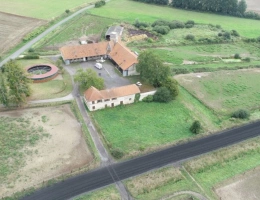
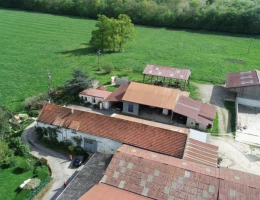
Building stock here mixes stone and brick courtyard farms, timber-framed barns in the west of the department and agricultural sheds converted into goat housing. Inspection covers the frame and roof, ventilation of a volume that is often too enclosed, the floor of the bedded area and effluent drainage. Then comes the milking plant: units relative to herd size, condition of the milk line, cooling capacity, compliance of the milk room. Where the unit processes, the cheese room, drying room and cellar must form a circuit independent of the animals, with a delivery access that does not cross the livestock area.
The herd is assessed on the number of milking does, the share of replacement kids, kidding, cell counts and CAEV status. Alpine and Saanen animals form the backbone of local flocks. If the dwelling is part of the sale, have it appraised separately from the land and the working plant: in a department where buyers from the Paris region seek out rural properties, the residential share of the price can be decisive.
The Pays de Bray, west towards Songeons, Formerie and Le Coudray-Saint-Germer, is the main grassland area: hedgerows, damp clays, dairy farms and medium-sized holdings, with more moderate land values. The Thérain, Brèche and Automne valleys keep meadows on their floors. By contrast the Picardy plateau, the French Vexin, the Valois and the Noyon country are dominated by arable cropping and carry high values. Around Chantilly, Senlis and the forest massifs, residential and equestrian demand pushes rural property prices sharply higher.
The usual compromise is to buy in the Bray or in a valley, where the price stays bearable, while organising sales towards the Beauvais and Creil conurbations and the northern edge of the Paris region, reachable on a short delivery round. That pattern assumes a dependable refrigerated van and a work routine that leaves time away from the goat shed.
The activity falls under the classified installations regime, the French environmental permitting system, from the herd threshold set in the nomenclature, by declaration and then registration, with the prefecture informed when the operator changes. Processing milk requires health approval or the direct retail exemption, supported by a food safety plan, batch traceability and documented own-checks. No protected goat cheese designation covers the department: commercial value rests entirely on the farm's own name and its sales networks, which should therefore be secured contractually at handover.
Land calls for close reading of rural leases, the landlord's agreement, the structures control, the French authorisation regime for taking over farmland, and possible SAFER intervention, sought by arable farmers looking to expand. In the Bray, check drainage, the load-bearing of pastures and regulated wetlands; elsewhere, nitrate vulnerable zone rules govern effluent storage and spreading. Finally, examine easements linked to the forest massifs and to bridleways, common in the south of the department.
The offers visible here are entrusted to us by farmers, rural estate agencies and notarial practices across the department. Use the filters for area, price or type of unit, then schedule an alert so you hear as soon as something goes online: a dairy goat holding comes onto the market only a handful of times a year. You can also browse goat farms for sale in Hauts-de-France.