
Spotting a goat farm for sale in Aisne calls for well-aimed searching: the department lives mainly on arable crops and sugar beet, and goat keeping survives in the hedged country of the north-east and in a few grassland valleys. The holdings involved are modest in size, often organic, processing on site and selling to market towns, producer shops and buyers from the Paris region. Offers come from farmers handing over, from rural property advisers and from notaries in Laon, Saint-Quentin or Soissons, stating herd, acreage and machinery. They join the goat farms for sale listed throughout France.
On this page you will find what a listing never specifies: how land values rank across the department, which districts release grassland farms, how to read the condition of a livestock building, and the constraints specific to a processing workshop. Each of those points shapes the price you can reasonably defend. Our white paper « Créer une exploitation agricole » (in French) usefully rounds out preparation for a takeover.
Land weighs heavily on the budget for a goat farm. Transfers published by the French tax authorities (DVF, excluding vineyards) put the median for farmland in Aisne (02) at €7,769/ha in 2025, with an average of €8,841/ha over 251 sales. Eight transactions in ten settle between €5,737 and €14,000/ha, where the national median is €5,307/ha.
A second reference, the SAFER land value benchmark, sets vacant land and pasture at €11,340/ha for 2025, +0.6% in a year and +27.0% over a decade; the French average is €6,460/ha, and a sitting tenant costs a plot roughly 17% of its value.
On a property of this type most of the value escapes any per-hectare arithmetic. It rests on the goat shed and its milking equipment, on the cheese room, drying room and cold store, on forage harvesting machinery, on the conformation and productivity of the herd, and finally on outlets already in place, from the weekly market to the delivered box. A goat cheese farm with its customers and its market pitches is negotiated differently from a building on its own. Before framing an offer, consult our land price observatory and our financial calculators.
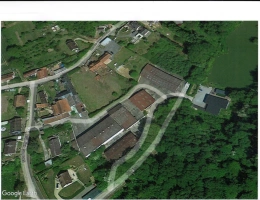
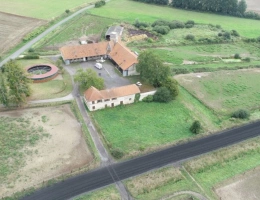
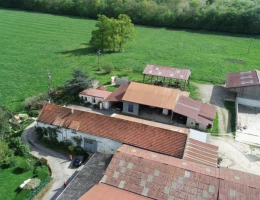
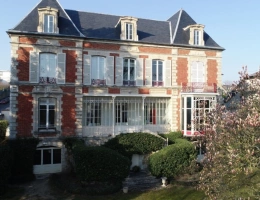
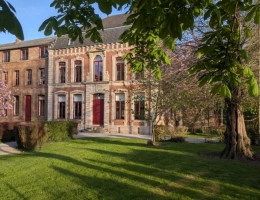
Local rural building stock supplies most of what is taken over: long brick farmhouses, barns around a closed yard, converted agricultural sheds. Their frame, roof, insulation of technical rooms and ventilation all need checking, the last often limited in low, elongated volumes. The milking parlour is assessed on the number of units against herd size, on the condition of the pump block and on milk cooling capacity. Where the farm processes, the cheese room, its cellar and the sales area govern continuity of trade: compliance work postponed by the seller feeds straight back into the purchase price.
The herd is judged on the number of milking does and replacement kids, the kidding pattern, cell counts and health monitoring. Alpine and Saanen animals form the basis of local flocks. When house and land are sold with the dairy, ask for a line-by-line valuation: in a department sought after for accessible countryside, the dwelling can absorb a large share of the headline figure.
The Thiérache, around Vervins, Hirson and La Capelle, holds most of the department's permanent pasture: dense hedgerows, medium-sized farms, more affordable land than elsewhere, and a long cheese-making tradition, even though the local protected cheese is made from cow's milk rather than goat's. The Oise, Serre and Ourcq valleys keep pockets of grass. The Soissonnais, Vermandois, Laonnois and the Tardenois plateau, geared to arable and beet, carry high values and release few livestock buildings.
The south of the department, towards Château-Thierry, combines vineyard slopes with passing trade, which supports direct selling. A goat unit there finds outlets quickly, whereas in the Thiérache the lower entry price is paid for with commercial effort towards Saint-Quentin, Laon and the northern towns. Expect regular delivery rounds and a distribution plan worked out from the day you take over.
The unit falls under the classified installations regime, the French environmental permitting system, according to herd size, by declaration and then registration above the regulatory threshold, with any change of operator reported to the prefecture. Processing milk requires health approval or the exemption applying to direct retail sale, with a food safety plan, traceability and own-checks. In a department largely classed as a nitrate vulnerable zone, effluent storage capacity, spreading windows and soil cover are tightly prescribed, and should be examined before planning any growth of the herd.
Land is verified document by document: which parcels are owned and which rented, the landlord's agreement for leases to continue, the structures control, the French authorisation regime for taking over farmland, and watchfulness over SAFER pre-emption, heavily used where arable farmers are seeking to expand. On the animals, request health reviews, CAEV monitoring and milk analyses. Finally, plan for the seller to stay on hand so markets and supply contracts transfer with the business.
This page gathers properties posted by working farmers, by rural estate agencies and by notarial offices in the area. Filter by grassland area, by budget or by the presence of a cheese room, then create an alert so you hear before wider circulation: a dairy goat holding rarely comes up here. The search can be opened out to goat farms for sale in Hauts-de-France.