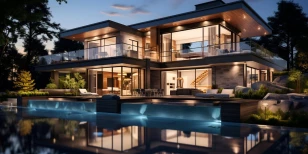

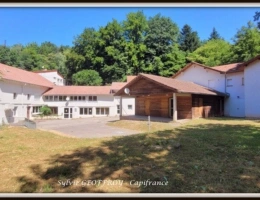
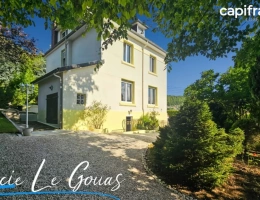
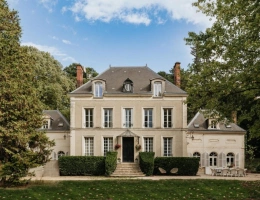
The maison de maître for sale in Bas-Rhin is identified by its pink sandstone, its half-timbering or its neo-Renaissance façade: it is the home of the wine merchants of Obernai and Barr, the brewers of Schiltigheim, the notables of Haguenau and Wissembourg and the bourgeois of Strasbourg's Neustadt. This section extends beyond it: it gathers all the fine residences of the department, Wilhelmine villas, enlarged winegrowers' houses, architect-designed properties, contemporary villas in parkland, wherever the living space exceeds 300 m² or the price approaches a million euros and the property is neither a chateau, nor a manor house, nor a historic monument. Find the maisons de maître and fine residences for sale posted by private owners, agencies and notaries in Bas-Rhin.
This page presents the profile of the residences currently on sale, Alsatian buildings from the vineyard to the northern Vosges, the areas from Strasbourg to the Kochersberg and the checks to make, including local law. Your search then draws on the guide to buying prestige property in France. Nothing here is a national template.
Maisons de maître form the core of the segment tracked by our observatory: houses with more than 300 m² of living space on 0.05 to 10 ha, sold above €1,000 per m², recorded in the DVF database of the French tax administration. These benchmarks frame the market for large residences without describing it entirely: a small village bourgeois house or a chateau sold with 30 ha of parkland fall outside this scope.
DVF statistics do not cover this department, which is governed by the Livre foncier land register: only figures for the Grand Est region are given. Across the Grand Est region, the 2021-2025 median stands at €550,000 (149 sales), against €822,000 in France in 2025 (981 sales).
| Scope | Sales | Median price | Floor – ceiling (P10–P90) | €/m² living space (median) |
|---|---|---|---|---|
| Grand Est (2021-2025) | 149 | €550,000 | €371,900 – €892,000 | 1,475 |
| France (2025) | 981 | €822,000 | €428,000 – €3,100,000 | 2,308 |
The breakdown by stratum (coastal, rural tourist, ordinary rural) and the five-year trend are in our observatory of prestige property prices in France (in French). Before making an offer, work out purchase costs and borrowing capacity with our financial tools and calculators.
Source: DVF (DGFiP), transactions from 1 January 2021 to 31 December 2025, processed by ma-propriete.fr; prices rounded to the nearest €100.
As of 28 September 2026, the section lists 267 properties in France (the section does not yet have enough listings in Bas-Rhin for a reliable calculation) at a median asking price of €978,000 (average €1,520,334); 80% of properties are offered between €485,000 and €2,750,000, for a median living space of 372 m² on 1.0 hectare of land, or €2,864 per m² of living space. These are asking prices, before negotiation; they compare with the actual sale prices in the previous section, which are generally lower.
| Asking price | Listings | Share |
|---|---|---|
| under €500,000 | 33 | 12 % |
| €500,000 to €800,000 | 58 | 22 % |
| €800,000 to €1.2M | 70 | 26 % |
| €1.2M to €2M | 67 | 25 % |
| €2M to €5M | 31 | 12 % |
| over €5M | 8 | 3 % |
Statistics calculated on the listings published in the section on 28 September 2026; they change daily with new listings and withdrawals.
The pink sandstone of the northern Vosges, quarried near Wasselonne and Saverne, builds the façades of many residences, while half-timbering and jettied storeys characterise the timber-framed houses of the vineyard and the Kochersberg. Strasbourg has, with the German Neustadt, buildings and neo-Renaissance and neo-Baroque villas with slate roofs and turrets, whose ceiling heights and stucco are sought after. Large winegrowers' houses, with porch, inner courtyard and vaulted cellar, are turned into charming residences. On the heights of Strasbourg, architect-designed houses from the 1960s to today stand on wooded plots. Door lintels often carry a carved date and the initials of the first owner.
Outbuildings range from the barn to the private winstub, by way of the caretaker's cottage, the coach house, the greenhouse and the garden pavilion. The park, sometimes walled in sandstone, holds lime, horse-chestnut and cedar trees. Inside, faience stoves, panelling, panelled parquet, monumental staircases and high ceilings give the notables' houses their value. Winegrowers' outbuildings offer rare volumes, which many buyers turn into reception rooms or studios.
Around Strasbourg, the Orangerie district, Robertsau, Schiltigheim and the Kochersberg villages, from Wolfisheim to Truchtersheim, group maisons de maître and recent villas in parkland. The wine-growing foothills, from Obernai to Barr and Dambach-la-Ville, offer large winegrowers' houses. In the north, Haguenau, Wissembourg and the Outre-Forêt alternate bourgeois houses with forest estates; in the west, Saverne and the Alsace bossue offer residences in a hilly setting. Each area has its own way of living: discreet villas in the regional capital, closed courtyards in the vineyard villages, isolated houses near the forests in the north.
Strasbourg station and those of Saverne and Sélestat are served by the TGV, Strasbourg-Entzheim airport connects several European cities, and the A35 and A4 cover the department. Proximity to Germany, across the Kehl bridges, interests cross-border buyers. For a weekend residence, a short journey counts as much as the space available.
Like Haut-Rhin and Moselle, Bas-Rhin applies local law: ownership is recorded in the Land Register, the authentic deed follows specific formalities, and an up-to-date extract must be obtained and the easements, rights of way and old entries checked by the notary. The territory is classified as moderate seismicity, which affects building and renovation rules. The roof frames and half-timbering of old houses call for inspection against wood-boring insects and damp. Sellers of older houses normally hold the insect-treatment certificates. Water in the cellars is worth asking about at every visit.
The historic centres of Strasbourg, Obernai and Wissembourg lie within protection perimeters, where façades, windows and renders need the agreement of the architect of the Bâtiments de France. In the Ried, the high water table and the floods of the Ill require consulting the flood prevention plan. On a contemporary villa, check the compliance of the extension, the pool and the heating installations. The Alsatian notary knows these features and can explain them before the preliminary contract is signed. Ask also who paid for past works on the shared walls.
Private owners, agencies and notaries in Bas-Rhin distribute their residences on ma-propriete.fr; sort by living space, land and outbuildings, then activate an alert to follow each new listing. To set the Alsatian offer against Lorraine and Champagne, look at the maisons de maître and fine residences for sale in Grand Est.